AI Generated Image
India is rapidly reducing its dependence on foreign suppliers for defence procurement, with the Atmanirbhar Bharat initiative bringing a major shift in the country’s defence manufacturing landscape.
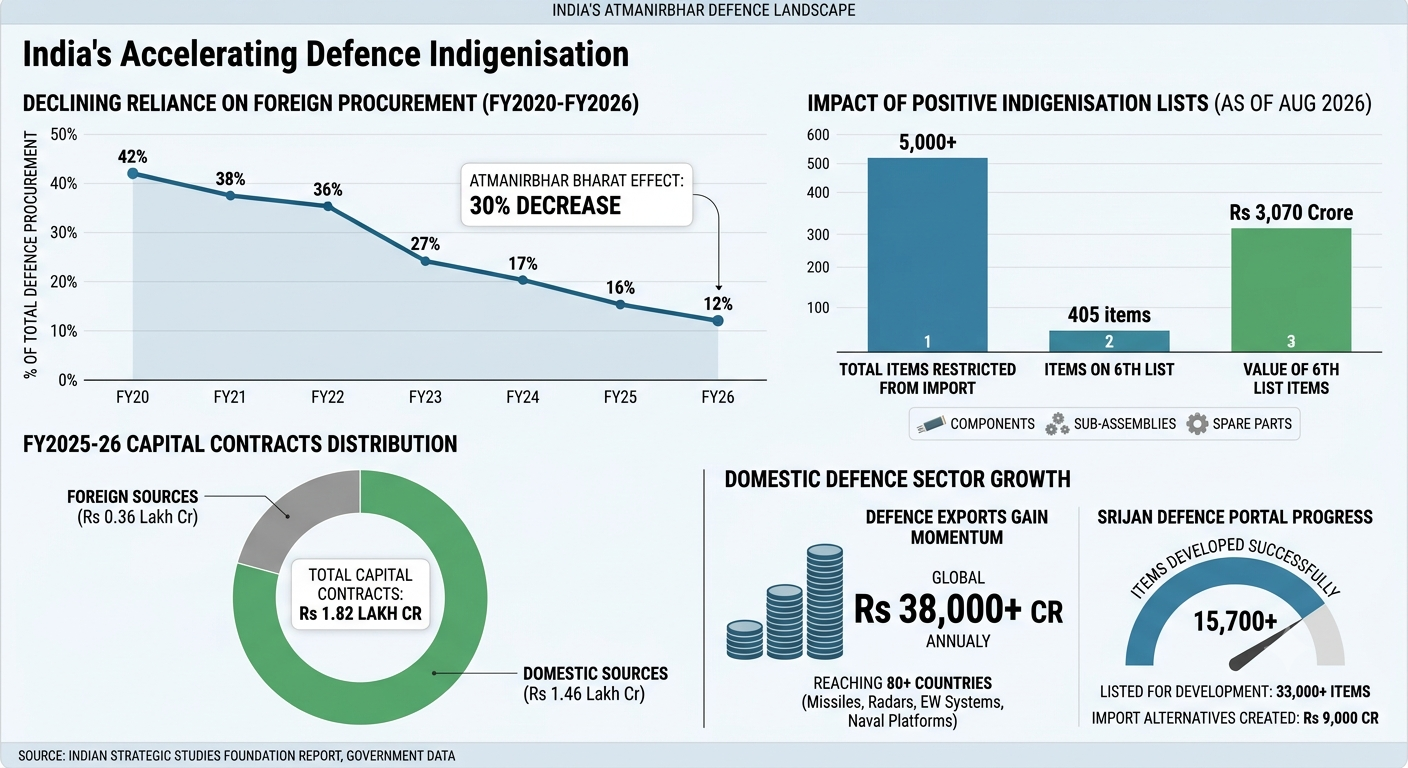
The foreign share of total defence procurement declined from around 42% in FY2020 to nearly 12% in FY2026.
Government policies have driven the shift by promoting domestic manufacturing and reducing reliance on overseas suppliers.
According to an Indian Strategic Studies Foundation report, the Positive Indigenisation Lists have played a key role.
The government has progressively restricted imports of hundreds of military equipment, sub-systems and platforms, creating opportunities for domestic defence companies, MSMEs and startups.
The sixth Positive Indigenisation List, released in August 2026, covers 405 strategically important items for the Army, Navy, Air Force and electronics sector, with an estimated business value of around Rs 3,070 crore.
The list includes components, sub-assemblies, spare parts and raw materials used in platforms such as the Su-30MKI, Tejas, T-72 and T-90 tanks, BMP-2 and warships.
Government spending has supported the shift.
In FY2025-26, capital contracts worth Rs 1.82 lakh crore came to Rs 1.82 lakh crore, while around 80% of the capital acquisition budget went towards domestic sources.
Defence exports have simultaneously grown to more than Rs 38,000 crore annually, with Indian defence products reaching over 80 countries. These include missiles, radars, electronic warfare systems and naval platforms.
The Srijan Defence Portal is another key initiative. More than 33,000 items have been listed for indigenous development, with over 15,700 reportedly developed successfully, creating alternatives for imports worth around Rs 9,000 crore.
Also Read: Pranav Adani Contributes Rs 15 Crore For 100 New Mumbai Police Cars
To read more such news, download Bharat Express news apps