



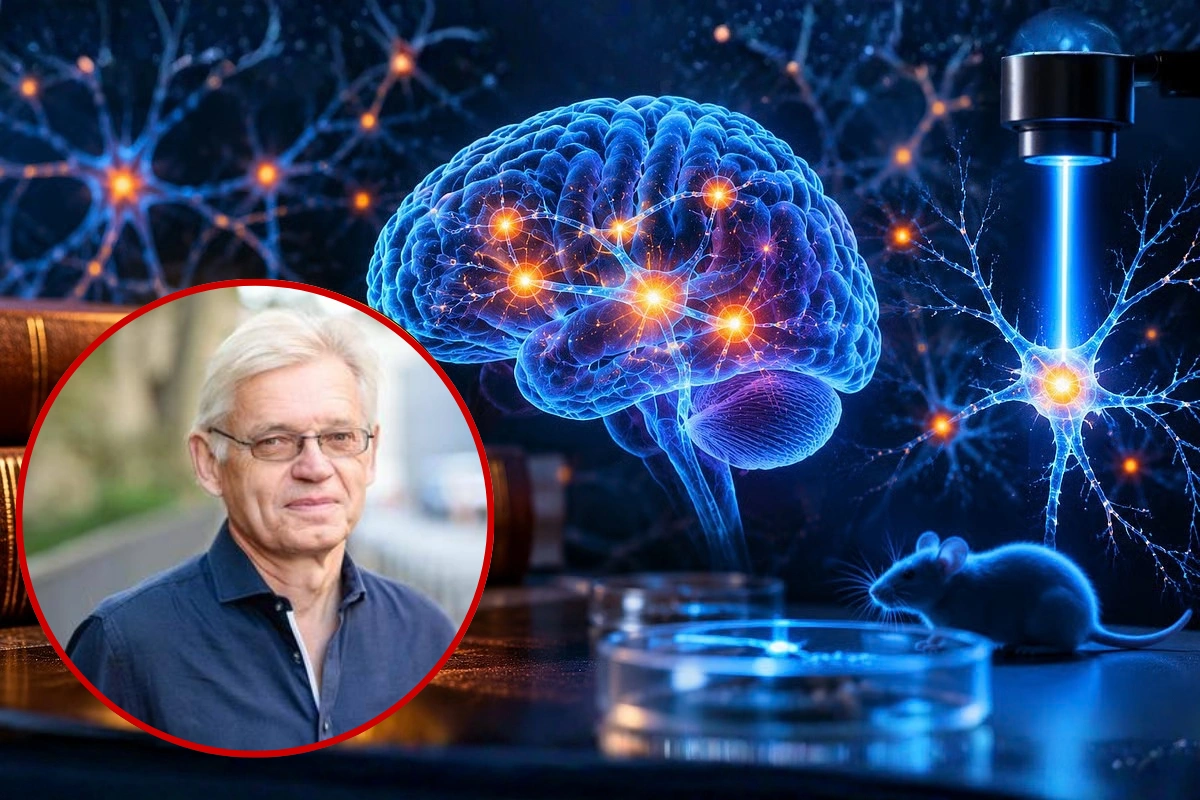
Peter Hegemann, Georg Nagel and Karl Deisseroth won the 2026 Nobel Prize in Physiology or Medicine for developing optogenetics, which uses light to control nerve cells.
The breakthrough has transformed neuroscience by enabling researchers to study how living brains shape memories, emotions and behaviour.
The human brain controls a vast range of functions, from emotional responses and behaviour to movement and memory.
For decades, scientists tried to determine how different parts of the brain influence these functions. However, earlier techniques could often show associations without establishing clear cause-and-effect relationships.
The breakthrough began with Peter Hegemann’s interest in how the single-celled alga Chlamydomonas moves towards light. In the early 2000s, Hegemann and Georg Nagel discovered channelrhodopsin, a light-sensitive protein found on the surface of algal cells.
When exposed to blue light, the protein opens a channel that allows charged ions to enter the cell, triggering an electrical signal.
Researchers later found that introducing the protein into other cells could make them responsive to light.
Karl Deisseroth advanced the discovery by introducing the channelrhodopsin gene into mice’s nerve cells. Blue light then triggered nerve signals in these cells. He published the landmark findings in 2005 and successfully demonstrated the technique in living mouse brains two years later.
The approach became known as optogenetics and opened a new era in brain research. Scientists can now activate or inhibit specific groups of nerve cells with remarkable precision, helping them identify neural circuits linked to particular memories, emotions and behaviours.
The technique is also contributing to research into neurological and psychiatric disorders. Scientists are exploring its potential in clinical medicine, including efforts to restore vision in people with visual impairment.
The Nobel-winning discoveries have therefore changed how researchers study the brain, offering new ways to understand one of biology’s greatest mysteries — how networks of nerve cells produce memories, emotions and behaviour.
Also Read: Isabgol For Constipation: Know The Right Way To Take It
To read more such news, download Bharat Express news apps