



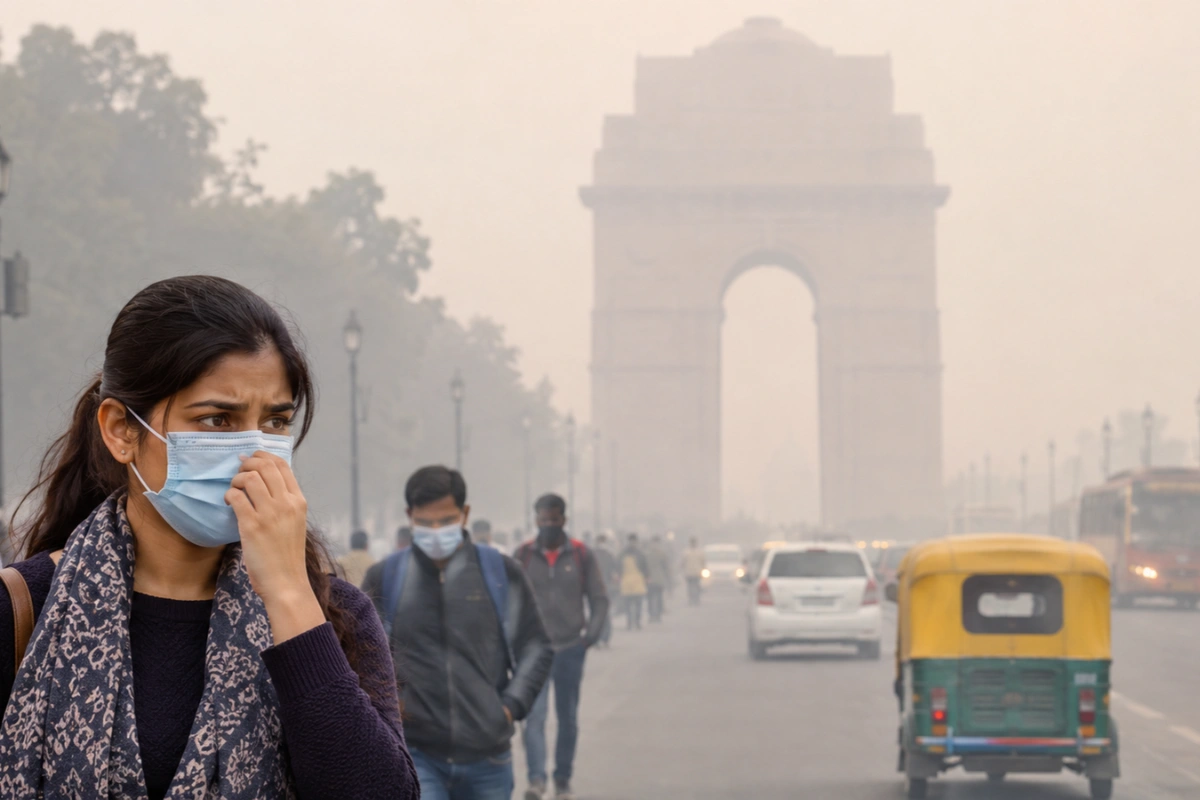
AI Generated Image
Delhi’s air quality deteriorated on Thursday morning, with the Air Quality Index (AQI) rising from 212 to 289 at 8:30 AM. According to the Central Pollution Control Board (CPCB), the reading placed the national capital in the ‘poor’ category.
Thick smog covered several parts of Delhi during the early morning hours, reducing visibility. Residents also experienced chilly weather alongside foggy conditions.
Several monitoring stations recorded ‘poor’ and ‘very poor’ air quality. Sirifort reported an AQI of 363, while JNU recorded 367. Other affected areas included ITO (356), NSUT Jaffarpur (358), CRRI Mathura Road (347), Talkatora Garden (344), DTU (344), Chhawla (320) and Jahangirpuri (319).
Neighbouring cities also reported poor air quality. Gurugram recorded an AQI of 271, while Noida registered 237 and Faridabad 207, according to CPCB data.
On Wednesday, Delhi recorded an average AQI of 232. The capital had registered its cleanest air of the month on Tuesday, with an AQI of 204, the lowest since October 31, when the reading stood at 117.
Of 58 monitoring stations reporting on Wednesday, 33 recorded ‘poor’, 20 ‘moderate’ and five ‘very poor’ air quality. Uttam Nagar recorded the highest AQI at 385.
The CPCB classifies AQI levels of 201–300 as ‘poor’, 301–400 as ‘very poor’ and 401–500 as ‘severe’.
The Air Quality Early Warning System warned that unfavourable weather over the next two days could trap pollutants and worsen air quality.
The CAQM lifted GRAP Stage III restrictions on Tuesday after pollution levels improved. However, winter conditions and stubble burning, particularly in Punjab, continue to affect Delhi’s air quality.
Authorities introduced GRAP Stage I on October 21, Stage II on November 2 and Stage III on November 6 after the AQI entered the ‘severe’ category.
Also Read: Could Muslims Become The World’s Largest Religious Group By 2035? Pew Study Explains
To read more such news, download Bharat Express news apps