



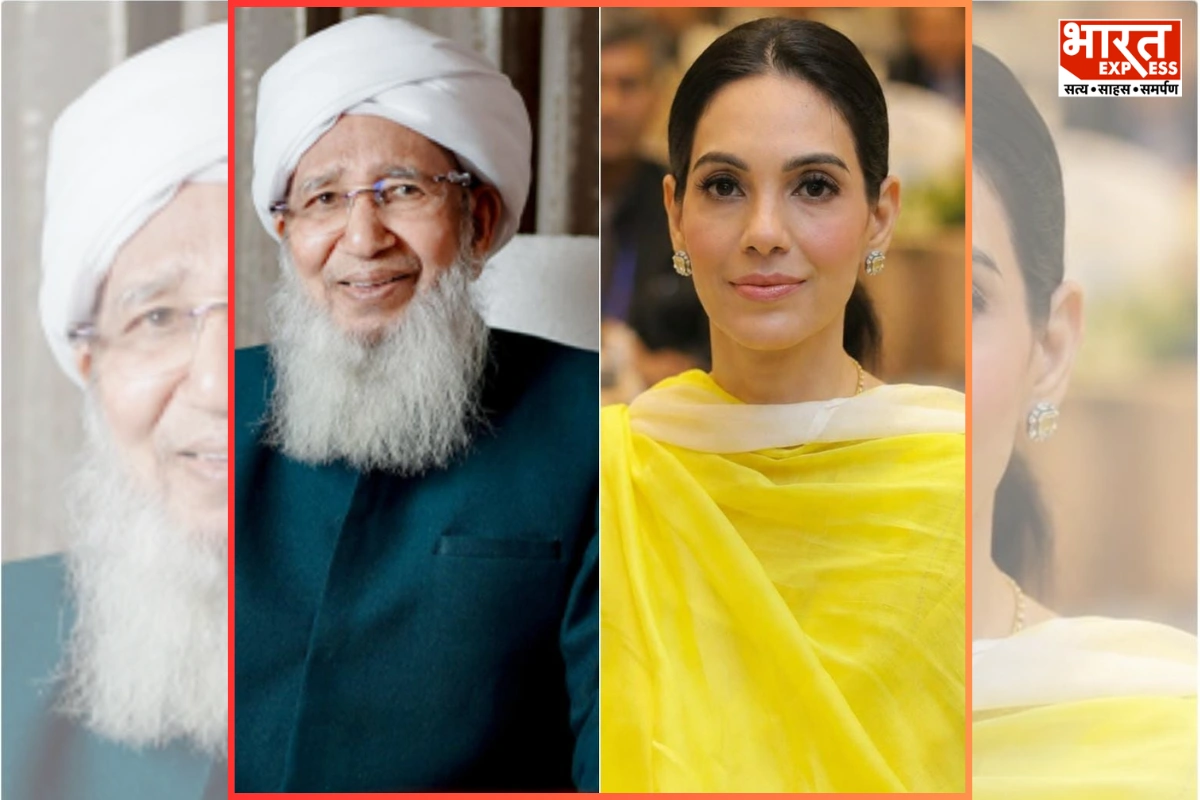
The remarks by Kerala Grand Mufti Sheikh Abubakr Ahmad, advocating that women should remain confined within the four walls of their homes, have sparked a sharp debate across the country.
Speaking at a religious conference in Kochi, Sheikh Abubakr Ahmad said that women should stay at home and should not enter public life. He compared women with gold jewellery. He argued that families keep gold necklaces in boxes to protect their beauty and value, and said women should likewise remain at home.
Mufti Sheikh described women entering public life as a cause of ‘great destruction’ and linked the issue to the practice of purdah.
Dr Shalini Ali opposed the remarks, saying home confinement denies dignity, restricting women’s freedom and potential. She said Indian women now serve in all three branches of the armed forces and excel as scientists, doctors, engineers, economists, educators, journalists, pilots and athletes.
Dr Shalini Ali said that asking them to stay at home ignores the reality of modern India. She described the statement as highly objectionable and an example of an authoritarian mindset. She said a woman is neither a gold necklace nor a decorative object that can be locked away in a box.
Dr Shalini Ali is a free human being who lives with her dreams, talent, hard work and the right to make her own decisions.
According to her, the mindset of keeping women confined within the four walls of the home instead of educating and empowering them is one that takes society backwards.
Dr Shalini Ali said even an ignorant or uneducated person should not make such a statement. Yet, she argued, some so-called religious leaders seek to keep women dependent and uninformed instead of treating them as equal citizens.
The Grand Mufti said women should stay home and avoid public life. He linked this view to the Quran and purdah. He further sought to clarify that his intention was not to demean women but to ensure their respect and protection.
Critics are asking: Can taking away someone’s freedom in the name of security really be called respect? Should a woman’s dignity depend on how far she remains removed from society and how confined her life is?
The Grand Mufti explained his argument using a gold necklace. He said shops keep it covered before showing it to customers.
Grand Mufti compared the situation with a roadside stone-grinding machine. He said a necklace on the road could tempt passersby to touch it, diminishing its beauty and value.
Based on this analogy, Grand Mufti said that bringing women into public life could lead to ‘great destruction’ and that this was the reason for the system of purdah. This comparison has, however, become one of the most controversial aspects of the entire debate.
Why compare a woman to jewellery? A gold necklace may belong to a shop, but a woman owns her life. She is not anyone’s possession; she is a citizen with rights. Her education, career, public participation and choices about her future cannot be restricted in the name of ‘security’ or ‘respect’.
This is the fundamental question at the heart of Dr Shalini Ali’s objection.
Modern India has moved well beyond the old belief that a woman’s identity belongs solely to the home and family.
The country’s daughters are fighter pilots, scientists, doctors and engineers. They lead in universities, courts, journalism, industry and sports. They are defending the country’s borders, working on challenging scientific projects, saving lives in hospitals and representing India on the global stage.
Keeping women locked inside their homes severely restricts aspirations and limits half the country’s potential.
Dr Shalini Ali said in this context that Indian women are serving in all three branches of the armed forces to protect the nation. They are making their mark in science, medicine, engineering, sociology, economics, education, journalism, aviation and sports, among numerous other fields.
According to her, women should not face prejudice because of their gender. Society must trust their capabilities. A woman who can defend the country is certainly capable of making decisions about her own life.
Grand Mufti Sheikh Abubakr Ahmad said religious scholars have long promoted this view. He said it helps preserve women’s ‘dignity’.
Sheikh Abubakr Ahmad said religious scholars must speak on religious matters. He vowed to continue, saying no one could stop him.
Grand Mufti discussed women’s status in Islamic history. He further said Islam ended practices like killing daughters and gave women property and inheritance rights.
Grand Mufti argued that keeping women away from public life protects them. He further said it helps ensure their respect and safety.
In other words, his broader argument was that restrictions should be understood as protection and distance from public life should be regarded as respect.
But this is precisely the point on which the Muslim Rashtriya Manch’s objection is strongest.
The organisation has stated that a woman’s dignity lies not in confinement but in her rights, independence and respect.
Managing her home is her right. So is joining the armed forces, becoming a doctor, pursuing journalism, business or public life.
The choice must belong to the woman—no other person can decide the course of her life on her behalf. It is important to note that the Grand Mufti’s remarks do not represent the entire Muslim community or all Muslim scholars. They represent the interpretation and viewpoint of one religious leader.
Defining millions of people on the basis of one individual’s statement would be neither appropriate nor fair.
Criticism of these remarks should not become an attack on any religion. Instead, people should view the debate through the lens of women’s freedom, equality and rights.
Ultimately, the issue is very straightforward: Does a woman deserve respect or control? Security or confinement? Opportunity or four walls?
The women of modern India have already answered these questions through their work and achievements. They do not need to prove that they are capable. They have established their place everywhere—from the armed forces to space, from hospitals to sports fields, and from schools to Parliament.
The strongest message from this controversy is clear. India’s daughters are not gold necklaces to lock away and preserve their ‘value’. She is the architect of her own future.
Families will become stronger, society will become stronger, and the nation will become stronger not by confining women, but by enabling them to move forward.
The Grand Mufti’s ‘stay at home’ view should be questioned. Any mindset that restricts women’s freedom deserves scrutiny, regardless of the community.
Because a woman’s freedom is not a favour granted by any religion, caste or community; it is her dignity and right as a citizen.
To read more such news, download Bharat Express news apps