



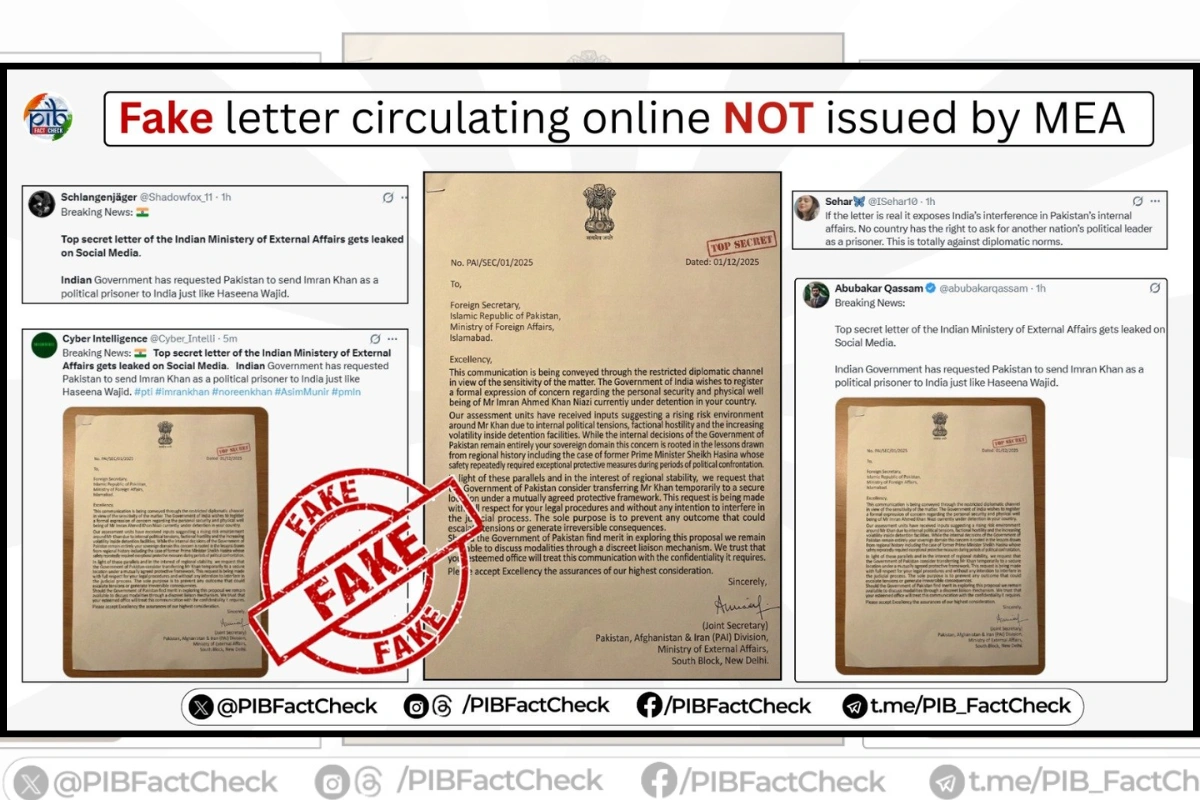
PIB Fact Check has debunked a fake letter that falsely claimed India’s Ministry of External Affairs requested Pakistan to transfer jailed former Prime Minister Imran Khan as a political prisoner.
The document circulated widely online, triggering concern before officials labelled it part of a Pakistani disinformation campaign.
The forged letter, dated December 1, 2025, appeared convincing at first glance. It displayed official-looking seals and formatting typically seen in diplomatic communications.
However, investigators quickly identified several inconsistencies. The text strangely referenced Bangladesh’s Prime Minister Sheikh Hasina in an unrelated context, exposing clear logical flaws.
Both Indian and Pakistani fact-checking organisations independently confirmed that the document was AI-generated and entirely fabricated.
🚨 #PAKISTAN Propaganda Alert!
Several Pakistani propaganda accounts are circulating a letter on social media, claiming it to be a top-secret Ministry of External Affairs document that allegedly leaked online. The fabricated letter claims that the Indian Government has requested… pic.twitter.com/DWxalnwjjM
— PIB Fact Check (@PIBFactCheck) December 1, 2025
The hoax spread first through Pakistani social media networks. Accounts presented it as a sensational ‘leaked communication’, designed to provoke outrage and fuel political narratives.
The posts framed India as meddling in Pakistan’s internal matters, especially concerning Imran Khan, whose imprisonment remains a deeply polarising issue within Pakistan.
The speed and coordination of the posts indicated a deliberate attempt to amplify misinformation.
AI-Forged Letter Sparks Outrage
PIB Fact Check responded immediately. It issued an official clarification stating that India never made such a request and that the letter was not issued by the Ministry of External Affairs.
Officials stressed that the content, structure and diplomatic references within the document violated basic standards of official correspondence. They warned citizens against circulating forged artefacts that attempt to distort bilateral relations.
Analysts noted that this incident reflects a recurring pattern in cross-border propaganda.
Forged diplomatic papers, fake memos and fabricated communiqués have increasingly become tools in information warfare.
These items are crafted to appear credible, using AI-driven design to mimic government formats. Their goal is simple: erode trust, inflame public sentiment and disrupt diplomatic norms.
Fact-checking groups highlighted that the inclusion of Sheikh Hasina’s name, without relevance to the India-Pakistan context, underscored the sloppiness of the forgery.
Experts said such mismatched references often occur when AI systems piece together unrelated political themes from prior training data. These elements reveal the synthetic nature of the document despite its outward realism.
The incident reinforces the urgent need for vigilance as AI-generated misinformation becomes more sophisticated.
Officials urged the public to rely on verified government channels and credible fact-checkers. They also emphasised that false narratives weaken public understanding and undermine regional stability.
The exposed hoax serves as a reminder that disinformation attempts will continue to target sensitive geopolitical issues.
India’s swift rebuttal and coordinated fact-checking response helped contain the spread and reaffirmed the importance of truth in public discourse.
Also Read: PIB Fact Check Uncovers Fake BSNL 5G Tower NOC Scam
To read more such news, download Bharat Express news apps