



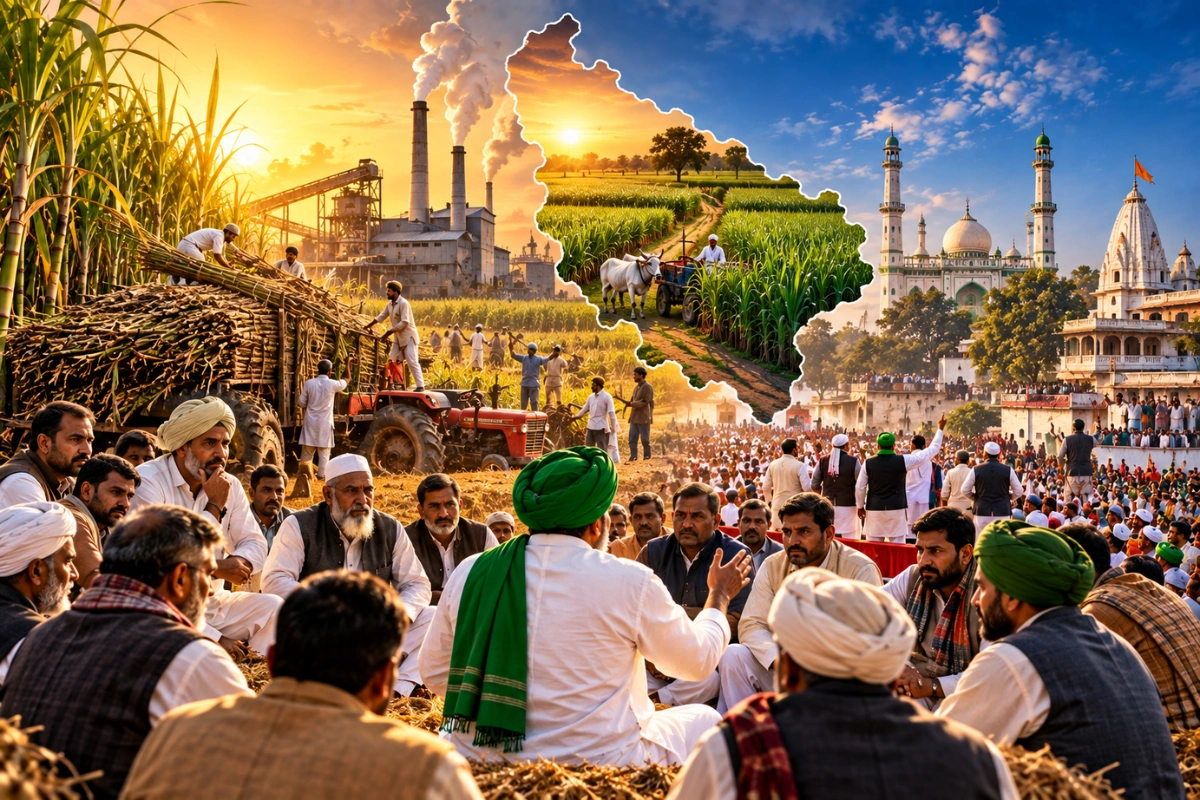
AI Generated Image
Western UP politics is shaped by a mix rarely found in one place: sugarcane farming, caste coalitions, communal memory, farmer unions, and fast-changing party alliances. To understand UP politics beyond Lucknow and Delhi headlines, this region must be read through its fields, mandis, mills, khaps, and local power brokers—not only through party manifestos.
Why Is Western UP Politics So Different?
Western UP politics is different because economic identity and social identity overlap tightly. The sugarcane belt links farmers to mills, payment cycles, electricity costs, irrigation, procurement prices, and local leadership, making agrarian stress a direct political issue rather than a background concern. Reports on the region repeatedly note that Jat politics, Muslim voters, Dalit mobilisation, and alliance arithmetic can all reshape contests seat by seat.
The Sugarcane Economy Is a Political Engine
Sugarcane is not just a crop here; it is a political timetable. When payments face delays, input costs rise, or procurement becomes uncertain, anger quickly moves from villages to rallies and polling booths. This is why local politics in Muzaffarnagar, Shamli, Baghpat, Meerut, Bijnor, and nearby districts often begins with farm economics before it becomes a party debate.
For voters, the practical question is simple: which party or leader can secure price, payment, and dignity? That makes Western UP politics more transactional and more emotional at the same time. A farmer may speak about dues in the morning, caste representation by afternoon, and national leadership by evening.
Caste, Community, and Memory Shape Every Contest
The region’s political landscape reflects the influence of Jats, Muslims, Dalits, Gujjars, Rajputs, and other local communities. Jat-Muslim relations matter especially because both communities remain deeply rooted in the rural economy, while riots, farmer protests, and party strategies have shifted their political alignments over time. Coverage of the region has linked post-2013 polarisation, farmer mobilisation, and attempts at renewed Jat-Muslim solidarity to changing electoral possibilities.
Dalit voters add another layer. The Bahujan Samaj Party’s independent positioning, the Samajwadi Party-Congress understanding, and the BJP-RLD alliance have all affected how votes consolidate or fragment in recent contests. In this region, a small shift in Dalit, Muslim, or Jat voting can alter the result in closely fought seats.
Alliances Matter More Than Slogans
Western politics in this part of India is alliance-heavy because no single identity explains the full vote. The Rashtriya Lok Dal’s influence among sections of Jat voters gives it strategic importance beyond its size, while the BJP, SP, Congress, BSP, and smaller formations compete to convert social blocs into winnable seat combinations. In 2024, the RLD joined the BJP-led NDA, while the SP and Congress contested as INDIA bloc partners, changing the regional equation.
Key factors to watch in any political analysis of Western UP include:
- Sugarcane Payments: Delays or confidence in payment systems can influence farmer sentiment.
- Jat Consolidation: Even partial shifts can matter in rural constituencies.
- Muslim Vote Strategy: Consolidation, turnout, and candidate choice remain decisive.
- Dalit Voting Patterns: Fragmentation or tactical voting can swing close races.
- Local Candidates: Personal networks often matter as much as party branding.
- Farmer Unions and Khap Councils: They may not always endorse parties, but they shape political mood.
Political Trends Move Between Protest and Pragmatism
The farmer protests showed that economic grievance could cut across community lines, but electoral politics often pulls voters back towards caste, security, welfare, and leadership preferences. That tension explains why Western UP politics can look anti-incumbent in one conversation and alliance-driven in the next.
What Should Observers Watch Next?
Observers should watch whether farm issues remain central or whether welfare delivery, religious mobilisation, candidate selection, and state-level leadership narratives take centre stage. The most useful approach is not to ask who ‘controls’ Western UP, but which coalition can hold together long enough across sugarcane villages, semi-urban seats, and caste-sensitive constituencies.
For anyone studying UP politics, Western UP offers the clearest lesson: local actors negotiate power before national politics counts the votes.
Also Read: The Green Flag: How Chaudhary Charan Singh Made The UP Farmer A Political Kingmaker
To read more such news, download Bharat Express news apps