



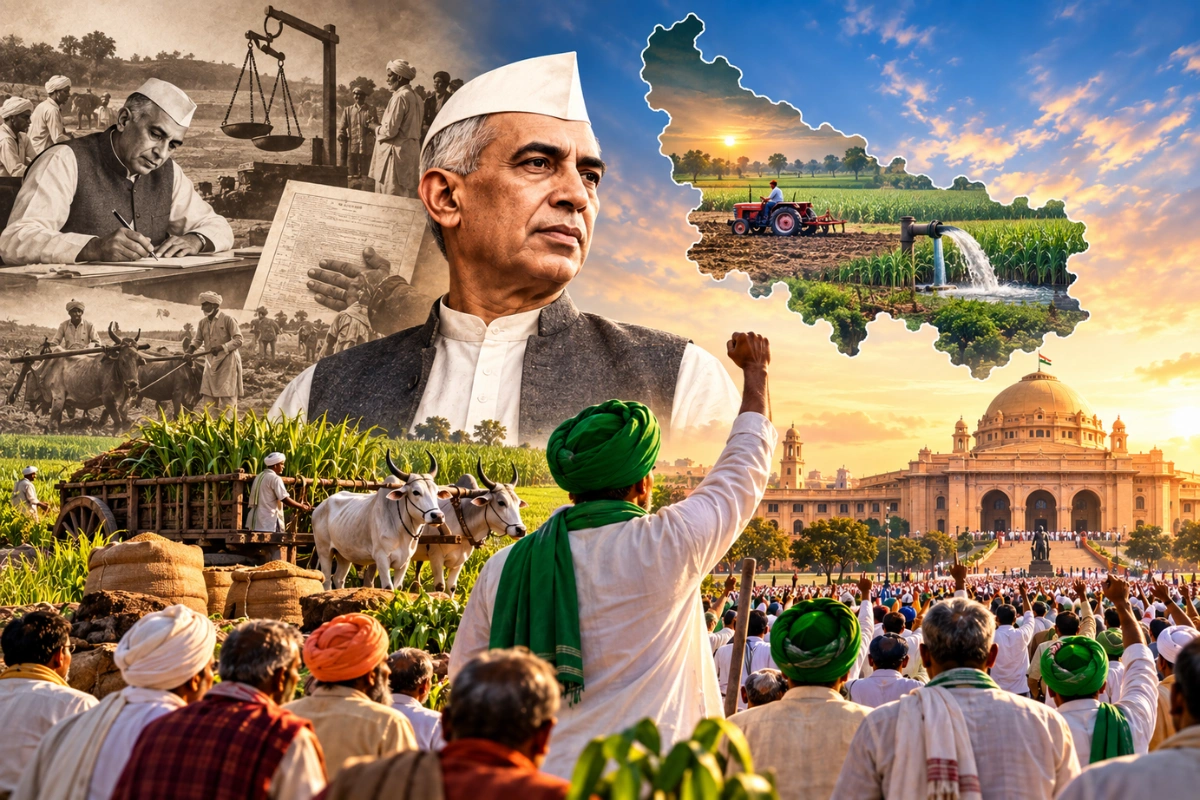
AI Generated Image
Chaudhary Charan Singh changed the way Uttar Pradesh understood political power: he placed the cultivator, not the city elite or landlord, at the centre of public life. His legacy is not just that he spoke for farmers, but that he helped turn the UP farmer into a decisive electoral force whose concerns could shape parties, governments, and agriculture policy. To understand farmer politics in North India, one must understand how Singh transformed rural identity into organised political influence.
How Did Chaudhary Charan Singh Make the UP Farmer Politically Powerful?
Chaudhary Charan Singh made the UP farmer politically powerful by combining law, language, organisation, and identity. He pushed land reform, opposed landlord dominance, wrote extensively on rural India, and framed the farmer as a producer whose interests deserved priority in democracy. The Prime Minister’s Office biography notes his reputation for grassroots command, while accounts of his work in Uttar Pradesh emphasise his role in the abolition of zamindari and land reform debates.
His politics worked because it gave farmers more than sympathy. It gave them a political vocabulary. The cultivator was not merely a poor villager waiting for relief; he was the backbone of the economy, a taxpayer in kind, a food producer, and a voter whose anger could change governments. That shift made UP farmers’ political influence a durable feature of state and national politics.
The Rural World That Shaped His Politics
Charan Singh was born in 1902 in what is now western Uttar Pradesh, a region where land, caste, tenancy, credit, and crop prices shaped everyday power. His political thinking grew from this agrarian landscape. The Charan Singh Archives describe him as emerging from a tenant-farmer background and becoming one of independent India’s most prominent voices for the village.
This background mattered because he did not treat the village as a romantic symbol. He saw rural society as a place of production, hierarchy, debt, and struggle. A farmer could own land yet remain vulnerable to moneylenders, markets, officials, and larger political interests. A tenant could work the soil but lack secure rights. Agricultural communities could feed the country while still feeling ignored by policy made in cities.
That experience sharpened Singh’s critique of development. He argued that Indian democracy could not be meaningful if rural producers remained politically dependent on urban-led parties or landed intermediaries. His version of agrarian politics was therefore both economic and social: it asked who owned land, who controlled credit, who benefited from state spending, and whose voice counted inside government.
Land Reform Turned a Grievance Into a Political Programme
The foundation of Singh’s influence was his association with land reform in Uttar Pradesh. As parliamentary secretary and later Revenue Minister, he was closely linked with the drive to abolish zamindari, a system that had placed intermediaries between cultivators and the state. The Charan Singh Archives describe his leadership in the movement to abolish zamindari in UP, while other biographical and academic sources identify land reform as central to his political career.
Land reform did more than change legal arrangements. It changed political imagination. When cultivators saw that law could alter the balance between landlord and tenant, the state became a battlefield worth entering. Voting, party work, petitions, rallies, and legislative pressure were no longer distant rituals; they became tools for rural advancement.
This is where agriculture policy became farmer politics. Questions of land ceilings, tenancy protection, procurement, prices, irrigation, rural credit, and cooperative institutions became vote-shaping issues. Singh’s message was direct: if policy could make or break the cultivator, then the cultivator had to become politically organised.
Key Ways Land Reform Strengthened Farmer Confidence
- It Weakened Older Landlord-Centred Authority: The farmer could imagine a direct relationship with the state rather than dependence on intermediaries.
- It Connected Law With Dignity: Land rights were not just economic assets; they signalled recognition.
- It Created a Rural Political Agenda: Farmers learned to demand changes in revenue rules, credit access, crop pricing, and administrative behaviour.
- It Produced Leadership From Below: Local rural leaders could rise by speaking the language of cultivation rather than elite patronage.
The Farmer Became an Identity, Not Just an Occupation
One of Singh’s most important contributions was turning ‘kisan’ into a political identity. In everyday life, farmers were divided by caste, region, land size, and crop pattern. Singh’s politics tried to gather these groups under a broader rural producer identity, especially in western Uttar Pradesh. Scholarship on rural politics notes that Singh played a pivotal role in reorganising the political economy of agriculture in UP and in shaping the emergence of the kisan identity.
This identity had emotional power. It told cultivators that they were not isolated households negotiating individually with officials or traders. They were a political community. Once that idea took root, parties could not ignore them without risk.
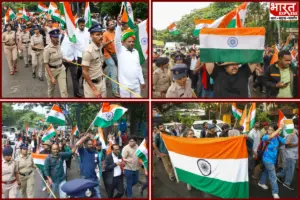
The ‘green flag’ associated with farmer mobilisation became more than a colour of protest. It suggested land, crops, rural pride, and a claim to representation. In rallies and electoral campaigns, the farmer could stand not as a passive beneficiary but as a maker of governments.
Why Did Uttar Pradesh Become Central to Farmer Politics?
Uttar Pradesh became central to farmer politics because of its size, rural population, regional diversity, and high electoral value. A political shift among UP farmers could influence assembly results, parliamentary representation, coalition calculations, and national narratives. Western UP, with its relatively commercialised agriculture and strong cultivating communities, became especially important in shaping UP farmer political influence.
Singh understood that the road to power in India did not run only through capitals. It ran through mandis, sugarcane belts, village councils, caste networks, cooperative bodies, and district-level mobilisation. He built politics around the practical concerns of cultivators: land security, fair treatment by officials, rural credit, crop prices, and respect for village society.
Uttar Pradesh also mattered because it exposed the tension between national parties and regional social realities. A party might speak broadly about development, but farmers asked specific questions: Who gets irrigation? Who receives procurement support? Who pays the cost when input prices rise? Who listens when cane payments are delayed? These questions gave agrarian politics its staying power.
Charan Singh’s Challenge to Urban-Centred Development
Singh’s politics carried a strong critique of urban bias. He believed postcolonial development often favoured cities, industry, bureaucracy, and large capital while underestimating the productive power of small cultivators. A Cambridge University Press chapter on the history of the Green Revolution describes Uttar Pradesh’s reform-oriented path as associated with Singh’s regional peasant leadership.
This did not mean he rejected modernisation. Rather, he questioned development that treated agriculture as backward and industry as naturally superior. For him, a healthy economy had to begin with the purchasing power and security of the rural majority. If farmers had stable incomes, they could support markets, education, small industry, and democratic participation.
His view also affected how he evaluated leadership. The effective leader, in his imagination, was not simply a polished speaker in a city assembly. It was someone who understood harvest risk, debt cycles, land disputes, irrigation dependence, and the social weight of a failed crop.
The Making of the Farmer as Kingmaker
By the late 1960s and after, Indian politics began moving away from single-party dominance in many states. In Uttar Pradesh, this created space for rural blocs, caste-based mobilisation, regional parties, and farmer-centred platforms. Charan Singh became Uttar Pradesh’s first non-Congress Chief Minister, and his political experiments helped show that rural consolidation could challenge established power.
The ‘kingmaker’ role emerged from numbers and negotiation. Farmers were not always united, but when enough rural groups moved together, they could decide close contests. Their support could lift a candidate, break a ruling party’s confidence, or force alliances to rewrite their promises.
This is the heart of UP farmer political influence: the farmer became a voter no party could safely treat as background. Even when parties disagreed with Singh’s ideology, many learned to speak in the idiom he popularised—respect for the kisan, attention to agriculture policy, and recognition of rural dignity.
What Made His Model Politically Effective
- Clear Social Base: He spoke directly to cultivators, especially middle and small farmers seeking recognition.
- Policy Depth: His politics was tied to concrete issues such as land reform, revenue, credit, and rural administration.
- Moral Language: He framed farmers as honest producers whose labour sustained society.
- Organisational Reach: His appeal travelled through villages, local leaders, caste networks, and electoral platforms.
- Coalition Potential: Farmer politics could connect with backward-class politics, anti-landlord sentiment, and regional aspirations.
What Were the Limits of His Farmer-Centred Politics?
The limits of Charan Singh’s farmer-centred politics lay in the uneven meaning of the word ‘farmer’. Landed cultivators, smallholders, tenants, landless labourers, Dalits, and agricultural workers did not always share the same interests. Later commentary on western UP farmer mobilisation has noted that kisan politics could underrepresent landless Dalits even while claiming to speak for rural society as a whole.
This tension matters because agrarian politics is never one simple story. A demand for better crop prices may help cultivators but not automatically help landless labourers. A movement for farmer dignity may challenge urban bias while still carrying rural hierarchies. Singh’s achievement was enormous, but the social category he mobilised contained internal inequalities.
Recognising this does not diminish his role. It makes the legacy clearer. He expanded democratic participation for rural producers, but later politics had to confront questions his broad kisan identity could not fully resolve: caste exclusion, landlessness, women’s labour, ecological stress, and the difference between prosperous and marginal farmers.
The Legacy in Today’s Agrarian Politics
Charan Singh’s influence remains visible whenever parties compete to prove their pro-farmer credentials. Promises around minimum support prices, cane dues, electricity rates, loan relief, procurement, irrigation, and rural roads all reflect a political world in which the farmer’s vote must be courted. The vocabulary of farmer respect, rural dignity, and producer rights did not appear by accident; leaders like Singh made it central to democratic competition.
His legacy is also intellectual. He wrote and argued about the place of agriculture in India’s economy, insisting that rural India was not a leftover from the past but a foundation for the future. The Charan Singh Archives note his extensive writings on villages and agriculture in India’s political economy.
For Uttar Pradesh, the deeper lesson is that farmers became powerful when economic pain turned into political organisation. Complaints alone rarely change policy. But when grievances become a shared identity, when identity becomes votes, and when votes become bargaining power, the farmer becomes a kingmaker.
A Lasting Lesson From the Green Flag
Chaudhary Charan Singh’s rise shows how democracy changes when the countryside finds its voice. He did not merely ask rulers to help farmers; he asked farmers to see themselves as rulers in waiting, capable of shaping governments through ballots, organisation, and policy demands.
That is why his place in farmer politics endures. He converted agrarian distress into political confidence, and he made the UP farmer visible as a force no serious party could ignore. In the story of Indian democracy, the green flag stands for that transformation: the moment the cultivator stepped from the field into the centre of power.
Also Read: The Battle For Relevance: Can The Congress Ever Rebuild Its Base In India’s Heartland?
To read more such news, download Bharat Express news apps