



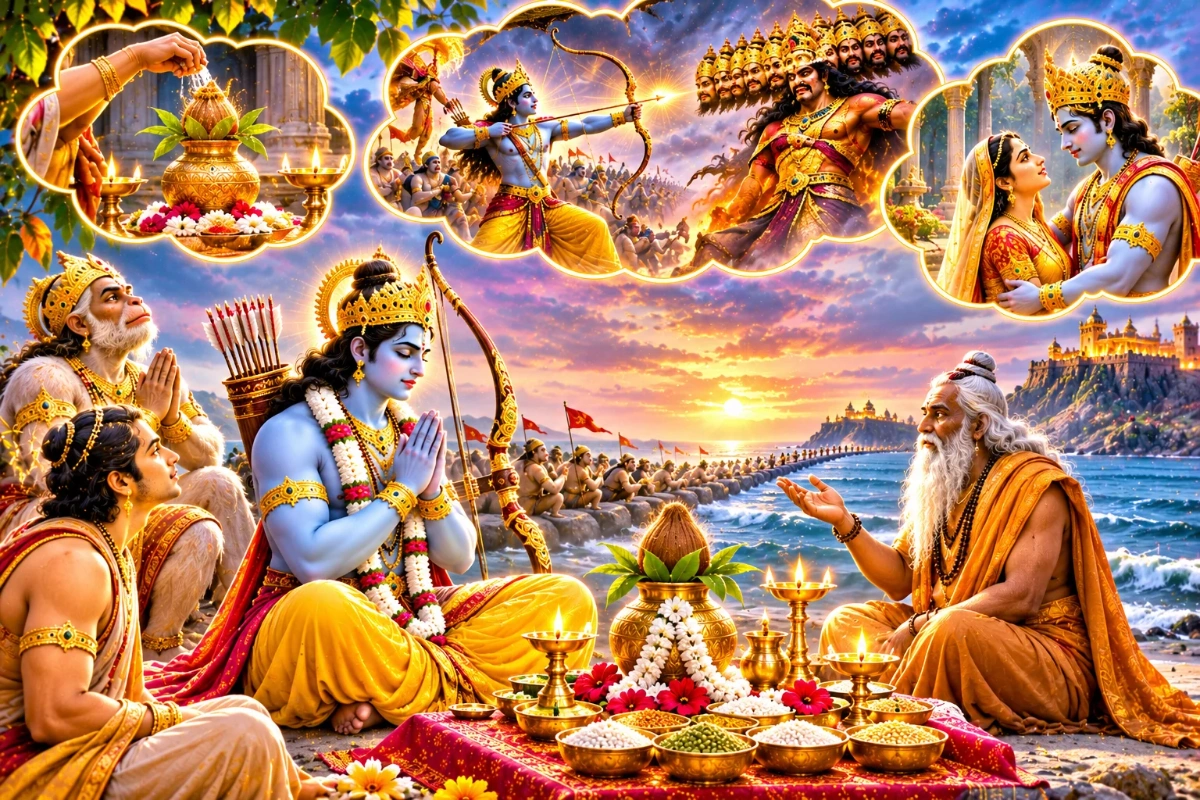
AI Generated Image
Vijaya Ekadashi Before the Battle for Lanka: The Sacred Tradition Associated with Lord Rama’s Victory
Vijaya Ekadashi is a sacred observance dedicated to Lord Vishnu, remembered through a devotional tradition connecting Lord Rama’s fast with his victory over Ravana. Its story places Rama at the ocean’s edge before the journey to Lanka, seeking guidance before taking decisive action. Understanding this tradition means looking beyond the fasting date to its themes of humility, disciplined effort, worship and righteous victory.
Why Is Vijaya Ekadashi Associated with Lord Rama’s Victory?
According to the Vijaya Ekadashi narrative in the Padma Purana, Lord Rama observed this vow on the advice of sage Bakadalbhya before crossing the ocean to Lanka. The sage prescribed worship and religious observances, assuring Rama that the vow would support his victory. The account concludes that Rama followed the instructions, defeated Ravana and recovered Sita. This is a scriptural devotional narrative rather than an independently established historical chronology.
The setting gives the story its emotional force. Hanuman has found Sita, Rama’s allies are assembled, and the purpose of the expedition is clear. Yet the ocean remains an immense obstacle. At Lakshmana’s suggestion, Rama approaches a sage instead of treating strength alone as sufficient.
One way to read this episode is as a lesson in preparation: courage need not exclude counsel, and resolve need not become arrogance. Before confronting an external challenge, the seeker pauses to examine their intentions and seek guidance.
The Sacred Story and the Meaning of Victory
The Padma Purana presents this teaching through a layered conversation: Yudhishthira asks Krishna about the Ekadashi of the dark fortnight of Phalguna, and Krishna recounts a teaching given by Brahma to Narada. Rama’s observance appears within this account. Identifying the source helps readers distinguish this particular Ekadashi tradition from a general retelling of Rama’s life.
‘Vijaya’ means victory, and the devotional account associates the observance with success and spiritual merit. These are religious assurances expressed within the tradition, not measurable promises that fasting will produce a particular worldly outcome.
For personal reflection, victory can also mean refusing anger, persevering without dishonesty, or choosing responsibility over convenience. This interpretation need not replace the sacred story. Instead, it offers a way to carry its questions into daily life: What am I trying to achieve, and are my methods worthy of that goal?
A useful intention for the day might be: ‘May I act with clarity, patience and integrity’. Pair that intention with one concrete action, such as completing a neglected responsibility or repairing a strained relationship.
When Is Vijaya Ekadashi, and How Does Its Tithi Work?
Vijaya Ekadashi falls on the eleventh lunar day of the waning fortnight, called Krishna Paksha. It is described as Phalguna Krishna Ekadashi in the Purnimanta calendar and corresponds to Magha Krishna Ekadashi in the Amanta system. These different month names refer to the same observance, not separate festivals.
The Vijaya Ekadashi tithi is not identical to a midnight-to-midnight calendar date. It can begin during one civil day and end during another. The fasting date therefore follows calendar rules involving the local day and the observance tradition; it should not be inferred simply from the tithi’s starting time.
Vijaya Ekadashi 2026 and Earlier Dates
For New Delhi, Vijaya Ekadashi 2026 was observed on Friday, February 13, 2026. Drik Panchang lists the tithi from February 12 at 12:22 pm until February 13 at 2:25 pm, in Indian Standard Time. Its listed parana window was February 14, from 7:00 am to 9:14 am; these timings should not be applied to other cities.
Earlier calendar listings also show why an isolated date can be misleading:
| Observance | New Delhi Calendar Reference |
|---|---|
| Vijaya Ekadashi 2022 | February 26, with Gauna observance on February 27. |
| Vijaya Ekadashi 2023 | February 16, with Vaishnava observance on February 17. |
| Vijaya Ekadashi 2024 | March 6 in the cited New Delhi listing. |
These are historical references, not a reusable annual schedule. The 2022 and 2023 listings explicitly distinguish alternate observances, while the cited 2024 calendar identifies March 6.
For any future observance, select your city in a reliable panchang and follow your household or temple’s tradition. Readers in the United States should use a local calendar rather than copy Indian dates and times, since published timings are location-specific.
The Traditional Kalasha Worship
A distinctive feature of the Vijaya Ekadashi story is worship centred on a kalasha, a sacred water vessel. The traditional instructions describe preparation on Dashami, worship on Ekadashi and a concluding offering on Dwadashi. Seven kinds of grain appear beneath the vessel as ritual materials; their presence does not make them fasting foods.
The narrative’s main elements include:
- Preparing the vessel: A pot of gold, silver, copper or clay is filled with water and arranged with leaves or sprouts.
- Honouring Lord Vishnu: An image of Narayana is installed, with offerings including incense, flowers, sandalwood and a lamp.
- Giving time to devotion: Sacred narration and a night vigil accompany the worship.
- Concluding with generosity: The vessel and associated offerings are given to a qualified Brahmin on Dwadashi.
These details describe the traditional rite, not a shopping list that every beginner must reproduce without guidance. If you wish to undertake the full observance, ask your priest or spiritual teacher how your community performs it. Prepare the materials beforehand so that uncertainty about arrangements does not consume the time intended for worship.
What Are the Vijaya Ekadashi Fasting Rules?
Vijaya Ekadashi fasting rules generally follow Ekadashi practice: devotees abstain from grains and pulses while choosing a degree of fasting suited to their circumstances and religious guidance. Some consume fruit, milk or permitted non-grain foods, while others follow a stricter fast. Complete abstinence from food and water should not be presented as the only recognised way to participate.
Food Choices and Careful Preparation
ISKCON guidance lists rice, wheat, beans, peas and lentils among the foods to avoid, along with products containing them. This makes checking ingredients important: a dish may appear suitable but contain wheat flour or a pulse-based ingredient. The same guidance emphasises keeping cooking ingredients free from grain contamination.
A practical preparation checklist is:
- Confirm your food rules: Follow one established household or temple practice rather than combining contradictory online lists.
- Plan simple meals if eating: Choose permitted foods in advance instead of improvising while hungry.
- Check packaged ingredients: Look beyond the main ingredient to flour, coatings and added mixtures.
- Keep worship central: Reserve time for prayer, reading or chanting rather than making the day entirely about recipes.
The devotional purpose is greater remembrance of the Lord, not competition over who can endure the most demanding fast. ISKCON Reading’s guidance explicitly places that remembrance at the centre of Ekadashi practice.
Parana Completes the Observance
Parana means breaking the fast. It is generally performed after sunrise on the following day, within the appropriate window; Hari Vasara, an initial portion of Dwadashi, is excluded. This is why ‘eat at sunrise tomorrow’ is not always a sufficient instruction.
Record the parana window when checking the fasting date, rather than waiting until the last minute. If your temple follows a Vaishnava calendar, use its corresponding instructions for breaking the fast. A calendar for another tradition may list a different observance day and therefore a different conclusion to the vow.
Carrying the Tradition into Everyday Life
Consider building your observance around three commitments: time for devotion, restraint in conduct and a useful act of generosity. Put your phone aside while reading the katha. When irritation arises, pause before speaking. Choose a modest charitable action you can complete rather than making an ambitious promise you may forget.
Read this way, Rama’s pause before Lanka invites reflection on how to meet difficulty without surrendering humility. The practical takeaway is simple: verify the local calendar, observe with informed guidance and let the day shape your actions as well as your meals. Victory becomes a worthy aspiration when the path towards it is worthy too.
Also Read: Jaya Ekadashi Legend: Celestial Love & Redemption
To read more such news, download Bharat Express news apps