AI Generated Image
A Love Story, a Celestial Curse and the Search for Freedom: The Legend of Jaya Ekadashi
The Jaya Ekadashi legend tells of two celestial lovers whose distraction brings a devastating curse, and whose unexpected observance of a sacred fast opens a path to freedom. Associated with devotion to Lord Vishnu, the story connects love, responsibility, suffering and divine grace. It offers both a religious explanation for the observance and an opportunity to reflect on whether our mistakes must define us forever.
What Is the Meaning of Jaya Ekadashi?
The meaning of Jaya Ekadashi is commonly expressed as ‘victorious eleventh’: Jaya conveys victory, while Ekadashi identifies the eleventh lunar day. This observance falls during Shukla Paksha, the waxing fortnight of the Hindu month of Magha. It is particularly associated with release from a cursed existence through Vishnu’s grace.
Here, victory need not be understood as defeating another person. Read alongside the legend, it becomes a way of thinking about overcoming spiritual bondage, recovering clarity and finding a life beyond suffering. This interpretation gives the name an intimate dimension: freedom begins to matter most when it seems impossible.
The calendar provides the setting, but the story gives the day its emotional force. Before liberation comes a moment of attraction—and a disastrous loss of attention.
The Jaya Ekadashi Story: Love Interrupted by a Curse
The account appears in the Uttara Khanda of the Padma Purana as part of Krishna’s explanation to Yudhishthira. Names vary across translations and devotional retellings: the lovers are widely known as Malyavan and Pushpavati, while one English translation uses Malyavat and Pushpadanti. The essential sequence remains the same: celestial life, a curse, hardship and restoration.
A Distracted Performance in Indra’s Court
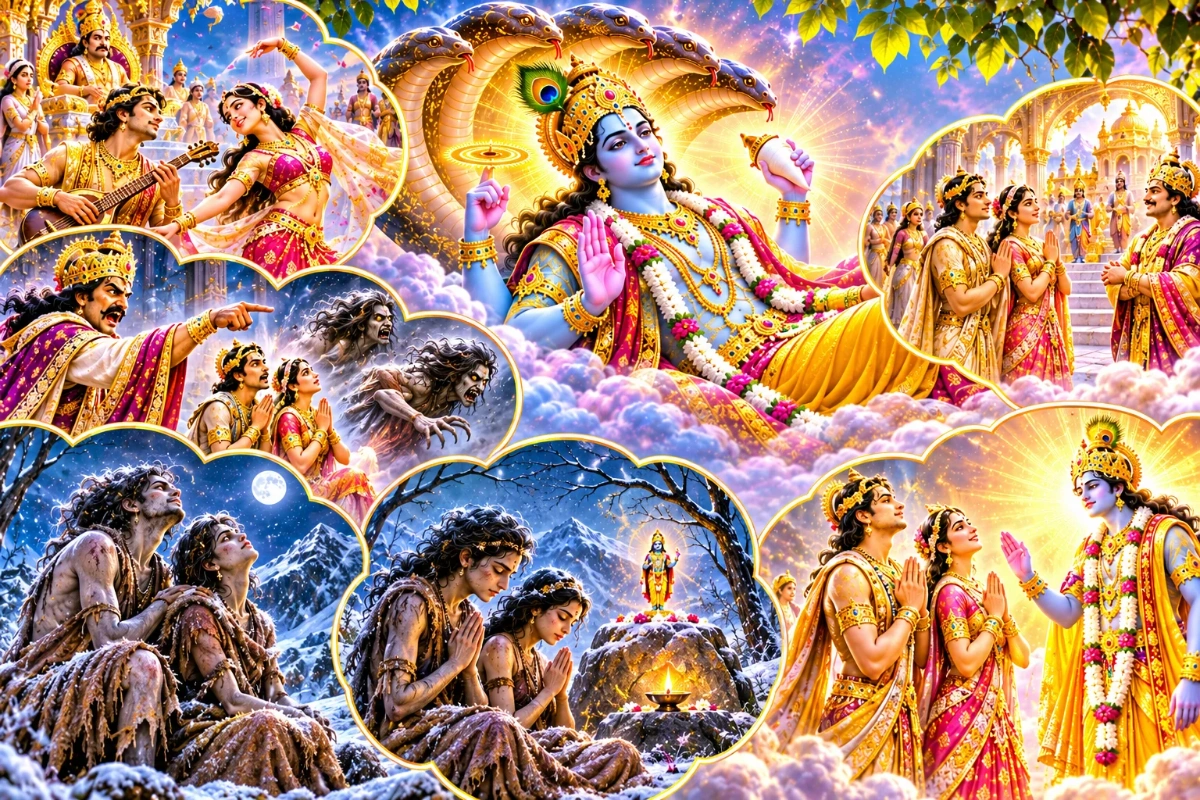
In a familiar devotional retelling, Indra enjoys music and dance in the heavenly pleasure grove of Nandana. Among the performers are Malyavan, a celestial musician, and Pushpavati, a celestial dancer. Attracted to each other, they become absorbed in exchanging glances rather than concentrating on their performance.
Their rhythm and singing falter. Indra interprets this failure as disrespect and curses them to leave heaven and assume the forms of pishachas, terrifying spirit-like beings. The transformation takes them from beauty and privilege into a state of distress.
The contrast is stark. The same attraction that draws them together accompanies the loss of everything familiar. Readers can recognise their distraction without necessarily regarding the punishment as proportionate or gentle.
A Night Without Food or Rest
Cast into the Himalayan wilderness, the pair endure bitter cold and the misery of their altered forms. When Jaya Ekadashi arrives, they pass the day without food or water. Their suffering also keeps them awake throughout the night.
This is not presented as a carefully planned religious observance. They are overwhelmed by their circumstances, yet their involuntary fasting and wakefulness coincide with the sacred day. The narrative makes this coincidence the turning point in their release.
There is an important distinction here: the legend describes extraordinary hardship; it need not become an instruction to reproduce that hardship. Its emotional centre is the possibility of mercy when the sufferers have little power left.
The Morning of Release
On Dwadashi, the following lunar day, the curse ends through Vishnu’s power. Their celestial forms return, and they ascend to heaven, where Indra asks how they escaped his sentence. They attribute their restoration to the observance of Jaya Ekadashi and divine grace.
The ending changes the balance of the story. Indra’s judgement begins their exile, but it does not have the final word. Their return makes the narrative more than a warning about inattention: within its devotional world, it becomes a promise that condemnation need not be permanent.
Why Does This Legend Matter for Ekadashi Significance?
The legend explains the significance of Ekadashi through a specific act of deliverance: fasting and wakefulness on Jaya Ekadashi become the occasion for Vishnu to release the lovers from their cursed state. In devotional readings, this supports the day’s association with purification and freedom from spiritually distressing conditions. These are religious teachings rather than outcomes that can be independently guaranteed.
Beyond that religious explanation, several themes invite reflection. They do not replace the traditional account; they offer ways to engage with it thoughtfully:
- Attention has consequences. The failed performance can prompt us to notice where distraction is weakening a responsibility we have accepted.
- A mistake does not define an entire identity. The lovers’ restoration offers an image of renewal rather than endless identification with failure.
- Mercy differs from punishment. The contrast between exile and release invites reflection on whether correction should leave room for recovery.
- Companionship matters during hardship. Their shared ordeal can be read as a reminder to meet another person’s vulnerability with care.
These themes make the story meaningful without turning every detail into a rigid moral rule. You might identify with the lovers’ distraction, question Indra’s anger or find reassurance in the ending. A thoughtful reading can make room for all three responses.
Love, Responsibility and the Limits of a Simple Moral
It would be easy to reduce the narrative to ‘love causes trouble’. That reading misses its tension. The lovers’ attention fails during a duty, but affection itself is not erased by their restoration: the translated account describes their attachment continuing after the curse ends.
A more useful interpretation distinguishes affection from absorption. Caring deeply for someone does not remove other commitments, and fulfilling responsibilities need not require rejecting love. The challenge is to give each its proper attention.
The curse also raises an uncomfortable question about power. Readers can acknowledge the courtly expectation of discipline while still finding Indra’s response severe. That discomfort can sharpen the ending: grace offers what punishment alone cannot—a future.
For personal reflection, consider a small, concrete example. If distraction has led you to neglect a promise, the next step need not be self-condemnation. Acknowledge the lapse, repair what you can and change the habit that made it likely.
Observing Ekadashi Fasting With Purpose and Care
Ekadashi fasting is a devotional practice, not simply an exercise in going hungry. ISKCON guidance describes observance as an opportunity for greater spiritual attention, with practices such as hearing sacred teachings, chanting and simplifying food. Approaches differ, so the discipline should be understood within the tradition a devotee follows.
If you wish to connect the story with an observance, consider a manageable plan:
- Confirm the local observance. Consult your temple’s calendar for the fasting day and the time for parana, or breaking the fast. Follow a calendar appropriate to your community rather than assuming every published schedule applies to you.
- Clarify the food practice. Many Vaishnava observances avoid grains and beans; complete abstinence is not the only approach described. Ask your temple or spiritual guide which foods and level of restriction your tradition permits.
- Make room for devotion. Set aside time to read the Jaya Ekadashi story, pray or chant. Give these practices a place in your day rather than treating food restrictions as the entire observance.
- Do not imitate the lovers’ suffering. Religious guidance also recognises health limitations and cautions against food fasting for those who are ill, infirm or pregnant. Seek individual medical advice before changing eating or drinking patterns if you have health concerns.
A useful personal intention might be to reduce one avoidable distraction during prayer or reading. Keep it modest enough to practise sincerely. There is little value in turning the day into a comparison of who can endure the most.
Freedom as the Final Word
The enduring appeal of this legend lies in its movement from beauty to loss, and from helplessness to restoration. Read devotionally, it celebrates Vishnu’s grace; read reflectively, it invites us to imagine a life beyond our worst lapse. Neither approach requires romanticising suffering.
The takeaway is practical: give your commitments greater attention, leave room for compassion and approach observance with sincerity rather than severity. The lovers’ release offers a hopeful image of freedom—not as a denial of the past, but as the possibility that the past need not hold us forever.
Also Read: Shattila Ekadashi: Beyond Fasting To Generosity
To read more such news, download Bharat Express news apps