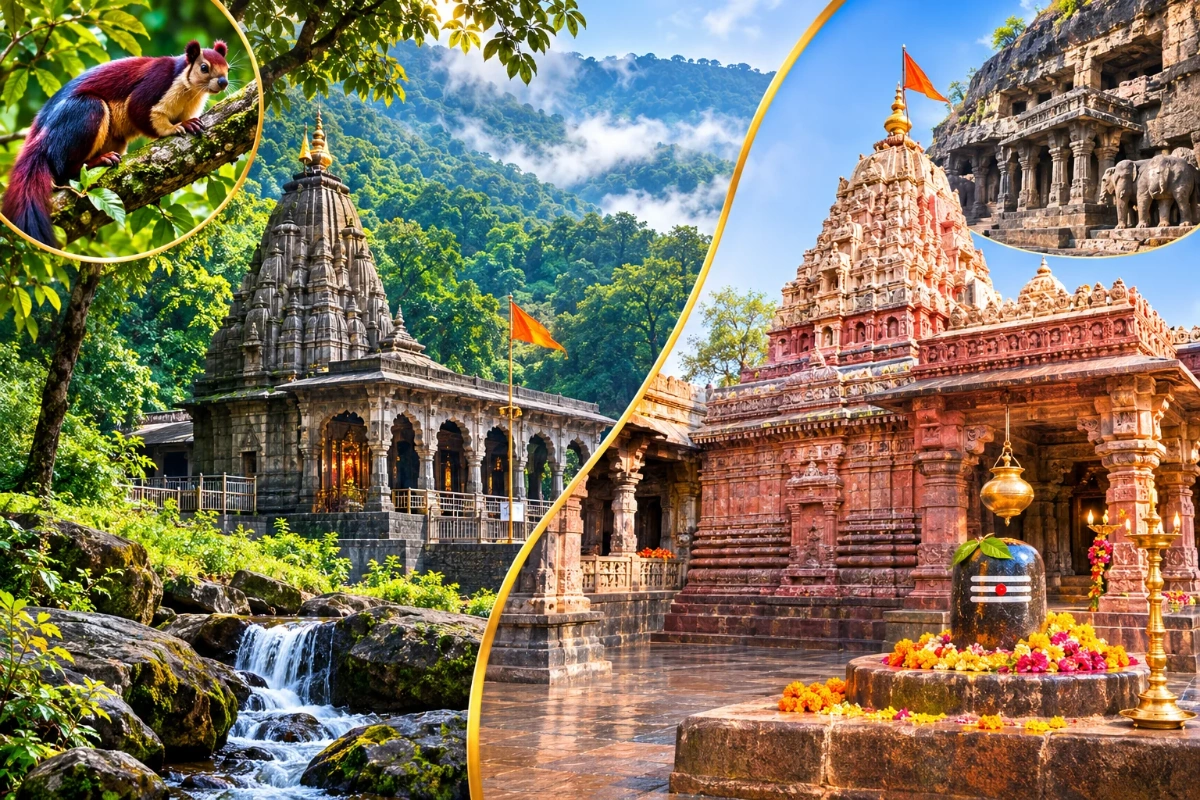
AI Generated Image
The Forest Sanctuary of the Western Ghats and the Healing Red Basalt Shrine
Shree Grishneshwar and Bhimashankar (Maharashtra)
Bhimashankar and Shree Grishneshwar offer two distinct encounters with Maharashtra’s sacred landscape: a Shiva shrine surrounded by Sahyadri forest and a red-stone temple near Ellora. Both are revered Jyotirlingas, but their settings invite different kinds of attention—one towards wildlife and river origins, the other towards architecture and enduring worship. Understanding their geography, traditions, and conservation context makes the journey more meaningful than simply collecting pilgrimage stops.
What Connects Bhimashankar and Grishneshwar?
Bhimashankar and Grishneshwar are connected through their dedication to Shiva and their recognition among India’s twelve Jyotirlingas. They are separate destinations, however: Bhimashankar belongs to the forested Sahyadri landscape, while Grishneshwar stands at Verul, near Ellora. Think of them as complementary chapters in Maharashtra’s religious heritage, not neighbouring attractions within one sanctuary.
That distinction matters when planning. A visit centred on Bhimashankar can give equal weight to worship and a permitted forest experience. At Grishneshwar, the natural companion is an exploration of nearby Ellora’s rock-cut heritage. Allow each place its own time rather than treating the journey between them as a minor transfer.
The Legend and Civilisational Significance
Bhimashankar is tucked into the dense forests of the Sahyadri mountains, where the temple’s sacred identity is closely connected to the surrounding landscape. According to the local religious tradition described by Maharashtra Tourism, this is the site where Shiva destroyed the demon Tripurasura. The legend also associates the emergence of the Bhima River with Shiva’s perspiration after the battle. These are devotional narratives, best understood as expressions of sacred meaning rather than documented historical events.
The geographical connection is independently significant: the Bhima River originates near Bhimashankar Temple in the Western Ghats. The river-source setting gives the shrine a place within both religious imagination and a real watershed. A forest spring is therefore more than a scenic detail here; it connects the pilgrimage landscape with water flowing beyond the hills.
Read together, the legend and geography offer a useful interpretive lens. The forest is not merely a backdrop to the shrine, and the river is not simply an attraction to photograph. Visitors can approach all three—the temple, woodland and water—with the same care, while keeping faith traditions and environmental facts clearly distinguished.
Why Is Bhimashankar an Important Western Ghats Wildlife Sanctuary?
Bhimashankar is important because its protected forests support Western Ghats wildlife, including the Indian giant squirrel, locally known as shekru. The sanctuary surrounds the pilgrimage setting, making it possible to understand the destination as both a sacred place and a wildlife habitat. Official environmental records identify the giant squirrel as a characteristic animal of this forest landscape.
The wider Western Ghats are a biodiversity hotspot recognised for exceptional biological diversity and endemism—the presence of species with restricted geographical ranges. UNESCO also emphasises how substantially species communities vary along the mountain chain. Consequently, no single Western Ghats sanctuary represents the region’s entire ecological richness.
For visitors, this changes the purpose of a forest walk. Rather than expecting a checklist of large animals, make room for patient observation and the possibility of seeing very little. A quieter outing can still be rewarding when you notice the forest’s structure, listen carefully and let a guide explain what is present without demanding an encounter.
If you hope to see a shekru, ask a guide about appropriate viewing opportunities rather than following animals through the vegetation. Keep binoculars ready, remain on the permitted route and accept that an animal may stay hidden. The aim is undisturbed observation, not a closer photograph at any cost.
Wildlife Conservation Begins with Visitor Behaviour
Maharashtra Tourism specifically advises Bhimashankar visitors not to litter, feed animals or disturb wildlife. Those expectations should shape the whole visit, including the approach to the temple and any permitted nature trail. Being on a pilgrimage does not lessen the responsibility to respect the sanctuary around it.
Use this practical checklist:
- Keep food to yourself. Do not offer snacks to wildlife or leave edible offerings where animals can reach them.
- Carry waste back out. Bring a bag for wrappers and other rubbish rather than assuming a disposal point will be available.
- Keep the soundscape quiet. Put away speakers and avoid calling out to attract an animal’s attention.
- Follow access instructions. Ask which paths are permitted instead of treating every visible track as a visitor route.
- Let sightings end naturally. Never block an animal’s movement or pursue it for another photograph.
Make these decisions before entering the forest. Pack so that waste is easy to retain, discuss expectations with your group and choose an outing everyone can complete without rushing. Wildlife conservation becomes more practical when respectful behaviour is built into the plan rather than added as an afterthought.
Grishneshwar’s Red Stone and Architectural Heritage
Grishneshwar shifts attention from the forest canopy to crafted stone. India’s Ministry of Tourism describes the temple as a red-stone structure with a five-tiered shikhara, an east-facing linga and a court hall supported by carved pillars. Maharashtra Tourism describes the building material more specifically as red volcanic rock. ‘Red stone’ is therefore the clearest wording when discussing its appearance without making an unsupported geological identification.
The present temple is associated with Queen Ahilyabai Holkar’s rebuilding and restoration patronage. Its proximity to Ellora also allows visitors to consider different forms of sacred architecture within the same broader excursion: a functioning temple and monumental rock-cut religious spaces. Ellora includes Buddhist, Hindu and Jain monuments, giving that comparison considerable cultural depth.
When you visit, allow time to look beyond the main silhouette. Study the carved pillars, follow the arrangement of the court hall and observe the relationship between sculpture and worship. Keep this architectural attention respectful: the building is not simply an exhibit, and other visitors may be there primarily for prayer.
What Does ‘Healing’ Mean at the Red-Stone Shrine?
‘Healing’ is best used here to describe hoped-for spiritual comfort, renewal or peace—not a verified therapeutic property of Grishneshwar’s stone. The official tourism descriptions present the temple as a place of devotion and spiritual solace; they do not establish that its building material treats illness. Likewise, descriptions of red stone or red volcanic rock do not justify confidently labelling the entire shrine ‘red basalt’.
A respectful account need not diminish a devotee’s personal experience. Prayer can be meaningful without being presented as a guaranteed cure. If you use the language of healing to describe your own visit, make clear whether you mean emotional reassurance, religious hope or a personal sense of restoration rather than a measurable medical outcome.
Chinnar Reveals Another Side of the Western Ghats
Chinnar Wildlife Sanctuary in the Western Ghats provides a useful contrast to Bhimashankar, not an additional stop on the same Maharashtra itinerary. Located in Kerala’s Idukki district, Chinnar lies in a rain-shadow region and experiences predominantly hot, dry conditions. Its setting challenges the assumption that every wildlife sanctuary in the Western Ghats is uniformly wet and densely green.
Kerala Tourism describes a landscape that includes dry forest and river environments, along with Forest Department trekking initiatives involving local tribal eco-development committees. The lesson is straightforward: research the particular sanctuary you intend to visit. Rainfall, vegetation, visitor arrangements and the character of a walk cannot be inferred from the words ‘Western Ghats’ alone.
Plan for Attention, Not a Rushed Checklist
Before setting out, separate what you want from each destination. Decide whether your priority is darshan, architecture, nature observation or a balanced combination. Then leave enough flexibility for worship arrangements, local instructions and the pace of your group.
A simple preparation sequence helps:
- Confirm access directly. Check temple arrangements, sanctuary permissions and any local restrictions before departure.
- Ask about physical demands. Discuss walking surfaces, steps and distances if anyone needs mobility support.
- Check photography expectations. Seek permission rather than assuming every sacred or forest setting permits photographs.
- Leave breathing room. Avoid scheduling a forest outing immediately before an onward departure.
The strongest connection between these places is the attention they invite. Give the forest space, give worshippers respect, and distinguish legend from geography and spiritual language from factual claims. That approach leaves room for wonder without sacrificing accuracy—or the well-being of the places you came to appreciate.
Also Read: Glacial Sanctuary At 15,000 Feet: Sacred Peaks & Traditions
To read more such news, download Bharat Express news apps