AI Generated Image
The Great Living Chola Temple: The 81-Ton Granite Monolith at the Sky’s Edge
The Brihadeeswarar Temple in Thanjavur, Tamil Nadu, is a UNESCO World Heritage monument built by Emperor Raja Raja Chola I and completed in 1010 CE. Its soaring granite tower makes it one of the defining architectural marvels of the Chola age. Understanding its history, famous summit stone and continuing worship reveals why this landmark is much more than an extraordinary engineering achievement.
In Which State Is the Great Living Chola Temple?
The Great Living Chola Temple most visitors have in mind is the Brihadeeswarar Temple in Thanjavur, in the southern Indian state of Tamil Nadu. Strictly speaking, UNESCO’s designation is plural: the Great Living Chola Temples comprise three monuments at Thanjavur, Gangaikondacholapuram and Darasuram. They are related temples, not three names for one building.
That distinction matters when planning a visit. If your main interest is the immense granite tower associated with Raja Raja Chola I, choose the Thanjavur temple. The other two monuments offer complementary perspectives on the development of Chola temple architecture under later rulers.
The Great Living Chola Temple: The 81-Ton Granite Monolith at the Sky’s Edge
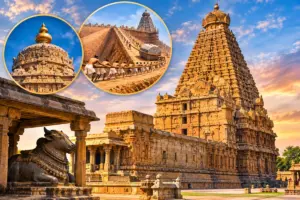
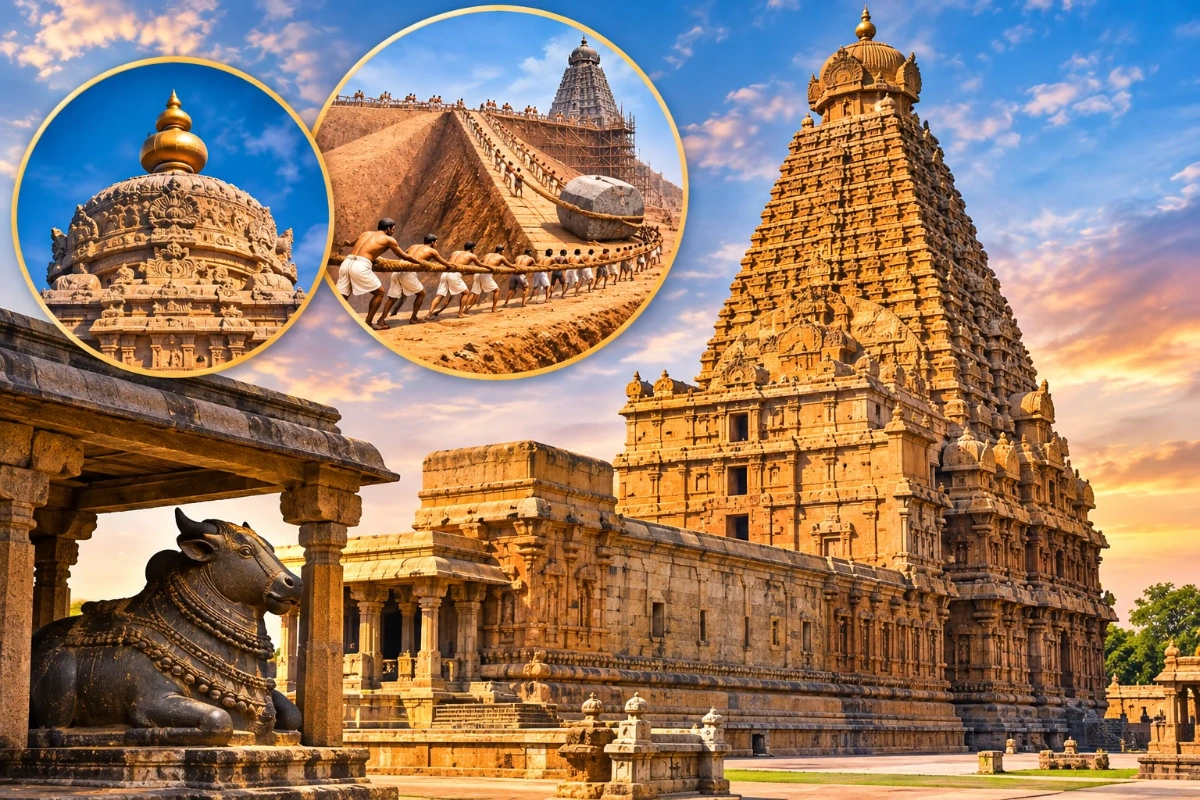
Stand back from the main shrine and let your eye follow its narrowing tiers. The tower rises above the courtyard with a commanding silhouette, drawing attention towards the stone crown. Incredible India describes the summit stone as weighing nearly 80 tons, while a Tamil Nadu government district profile describes a monolithic cupola carved from an 81.3-tonne granite block. The familiar 81-ton monolith description reflects these widely circulated accounts rather than a universally consistent measurement.
The tower is commonly described as 216 feet tall, including in official tourism material, although published measurements differ. Thanjavur’s district administration gives its height as 212 feet, or 64.8 metres. These variations are worth acknowledging rather than presenting every popular figure as exact.
You may also encounter the claim that it was the tallest building in India for centuries. That sweeping record is less securely established than its exceptional scale; the official heritage descriptions cited here do not substantiate an unqualified national ranking. Its importance needs no disputed superlative: the towering sanctuary was already an extraordinary architectural achievement.
How Was the Enormous Summit Stone Raised?
The traditional explanation is that builders raised the summit stone using a 6-kilometre earthen ramp, moving the enormous load gradually upwards rather than lifting it vertically. A Tamil Nadu government district profile records a six-kilometre inclined plane. However, the precise construction method remains a matter of reconstruction, not a fully documented sequence of operations.
Popular accounts call the octagonal capstone the Kumbam and assign it a weight of 81 tons. Architectural terminology deserves care: UNESCO describes the tower’s octagonal crowning element as the sikhara, while accounts of its weight and component stones vary. Treat ’81-ton Kumbam’ as the familiar visitor-facing description, not a substitute for a detailed architectural survey.
The ramp explanation offers a useful way to picture the challenge:
- Gain height gradually: An inclined route replaces a single dramatic lift with a long, controlled ascent.
- Support the moving load: The temporary route must remain stable under immense weight, not merely reach the correct height.
- Control movement: Pulling, restraining and steering matter as much as generating sufficient force.
- Complete the placement: Reaching the summit is different from positioning a heavy stone accurately on its supports.
These are engineering implications of the proposed method, not a surviving construction checklist. An architectural study preserved by the Indira Gandhi National Centre for the Arts discusses competing reconstructions, including a spiral earthen ramp, and questions the literal long-ramp legend. The achievement still invites astonishment from modern architects and visitors, but ‘astonishing’ should not become ‘impossible to explain’. The uncertainty concerns precisely how the work was organised and executed.
An Emperor’s Ambition Expressed in Stone
Emperor Raja Raja Chola I commissioned Brihadeeswarar as a monumental temple dedicated to Shiva. Construction belongs to the opening years of the 11th century, culminating in its consecration in 1010 CE. Tamil Nadu’s Department of Archaeology describes the temple, originally known as Rajarajesvaram, as the grandest temple raised in his capital.
The building can also be read as a symbol of the naval and cultural power of the Chola Empire. Raja Raja developed a powerful navy, and Chola connections extended across the sea towards Sri Lanka, the Maldives and Southeast Asia. At home, monumental temple building gave lasting expression to royal ambition and religious devotion.
That symbolism is an interpretation of the temple in its imperial setting, not a claim that the building records every naval campaign. Its scale suggests the ability to coordinate resources and skilled labour; its sculptures and paintings reveal cultural ambition alongside political strength. Look at the whole complex, rather than only the summit, to appreciate these interconnected achievements.
What Makes Chola Temple Architecture Distinctive Here?
At Brihadeeswarar, the defining feature is the dominance of the vimana, the tower above the sanctuary, rather than the entrance gateways. Its pyramidal profile, sculpted tiers and strong axial arrangement make the main shrine the visual centre of the complex. This relationship is essential to understanding the temple’s architectural character.
Two terms make the layout easier to read: a vimana rises above the sanctuary, while a gopuram marks a gateway. Confusing them can obscure what is unusual about this monument. Here, the sanctuary tower decisively commands the composition.
For a more rewarding visit, focus on three features:
- The approach: Notice how gateways and pillared halls organise movement towards the principal shrine, creating a deliberate sequence rather than a scattered collection of buildings.
- The sculpted surfaces: Look for the relationship between large architectural forms and smaller figures. Decoration helps articulate the structure rather than merely covering it.
- The Nandi shrine: The monumental bull, Shiva’s sacred mount, offers another example of large-scale stone carving within the complex.
A Living Temple, Not a Silent Relic
‘Living’ is central to the UNESCO designation. Worship and ritual continue at all three temples, connecting the monuments to religious practices maintained across roughly a millennium. Their significance includes this continuity, not simply the survival of ancient masonry.
Approach your visit accordingly. Leave room for worshippers, keep conversations discreet near devotional activity, and ask before photographing people. Follow posted directions about footwear, photography and access rather than assuming that every space is open for sightseeing.
The practical distinction is simple: a heritage visit should fit around the place’s religious purpose. If an area is unavailable, appreciate the accessible architecture without pressing for entry. Respectful observation often produces a richer experience than trying to collect every possible photograph.
Great Living Chola Temple Directions and Visit Planning
For Great Living Chola Temple directions, first select the correct monument: Brihadeeswarar Temple in Thanjavur. The district administration identifies Thanjavur Junction as a rail arrival point and Tiruchirappalli, also known as Trichy, as the nearest airport. It also lists the temple as approximately half a kilometre from Thanjavur’s Old Bus Stand.
Use these planning steps to avoid preventable confusion:
- Check the map destination: Confirm that your pin is in Thanjavur, not at the similarly named temple in Gangaikondacholapuram.
- Verify current access: Check opening arrangements and any festival-related changes shortly before travelling; avoid relying on an old itinerary.
- Leave breathing room: Allow time to explore the courtyard, gateways, sculptures and main tower rather than treating the stop as an opportunity for a single photograph.
- Prepare for the visit: Carry water, consider sun protection and choose clothing suitable for a functioning place of worship.
If you are exploring more South Indian temples, consider visiting the other two UNESCO monuments as part of a connected architectural journey. Gangaikondacholapuram offers a contrasting, gracefully curving tower, while Darasuram is distinguished by elaborate sculptures and its chariot-like front hall. Together, they show the development of a tradition rather than the repetition of a single design.
Look Beyond the Famous Stone
Begin with the summit, but do not let its weight become the whole story. Brihadeeswarar rewards attention to proportion, carved detail, imperial history and continuing devotion. Its lasting appeal comes from seeing these elements together: an extraordinary structure that remains a place of worship, not merely a monument to a distant age.
Also Read: Bodhi Tree In Bihar: Sacred Symbolism & History
To read more such news, download Bharat Express news apps