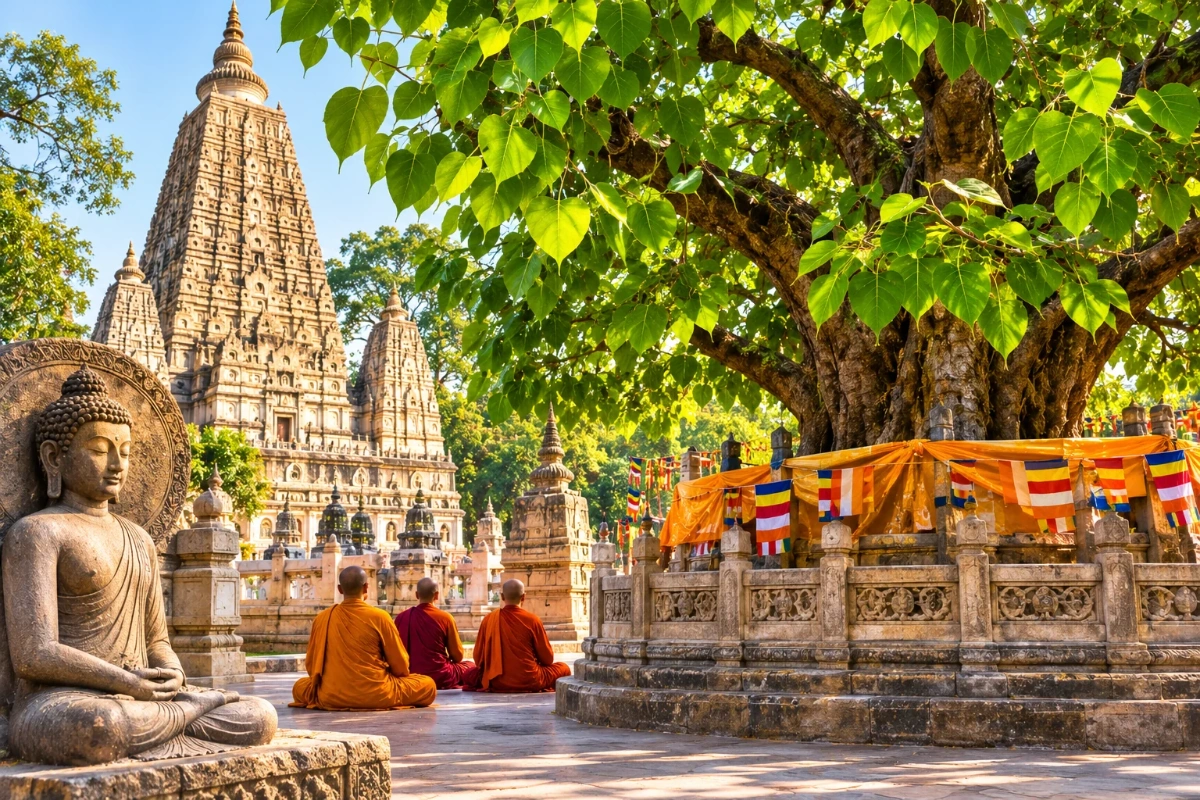
AI Generated Image
The Seat of Awakening: The Bodhi Tree That Illuminated the World
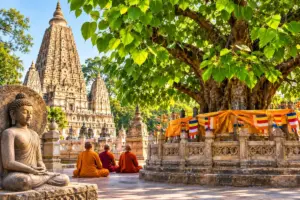
The Bodhi tree at the Mahabodhi Temple in Bodh Gaya, Bihar, marks the place where Buddhist tradition holds that Siddhartha Gautama attained enlightenment. Its significance extends beyond botany: the tree connects a sacred story with centuries of pilgrimage, architecture and meditation. Understanding its meaning helps explain why this living site remains central to Buddhist devotion across the world.
What Is the Bodhi Tree, and What Does Its Name Mean?
The Bodhi tree is a sacred fig, Ficus religiosa, associated with the Buddha’s awakening. The word bodhi is commonly translated as ‘awakening’ or ‘enlightenment’, so the simplest explanation of the Bodhi tree’s meaning is ‘tree of awakening’. The name expresses the spiritual event remembered beneath its branches rather than identifying a separate botanical species.
Also known as pipal, peepal or Pipul, the sacred fig has distinctive heart-shaped leaves with long, tapering tips. These leaves offer a useful way to recognise the species, whether encountered in a temple courtyard or a botanical collection. Their shape is a botanical characteristic; the sacred association comes from the story of the Buddha.
A useful distinction is between the sacred fig as a species and the particular tree revered at Bodh Gaya. Other sacred figs may be called Bodhi trees, but the tree at the Mahabodhi Temple complex is venerated for its connection to the place of enlightenment.
The Seat of Awakening: The Bodhi Tree That Illuminated the World
At the Mahabodhi Temple, the tree’s importance begins with the story of enlightenment. According to Buddhist tradition, Prince Siddhartha attained enlightenment beneath the sacred Pipul, or Bodhi tree, at this location and became the Buddha. The temple commemorates that transformation from spiritual seeker to awakened teacher.
The traditional account describes Siddhartha sitting in meditation, determined to understand suffering and the possibility of freedom from it. Awakening was not simply the discovery of an interesting idea. In Buddhist teaching, it involved liberating insight and the ending of the mental defilements that sustain suffering.
That distinction matters when interpreting the site. The tree is not presented as a magical object that bestowed wisdom; it marks the setting of the Buddha’s realisation. Its shade gives the story a tangible setting: a person seated beneath a living tree, undertaking the work of understanding.
For readers encountering this history for the first time, that human scale is worth keeping in view. The great monument can draw attention upwards, but the enlightenment story directs it back towards a seated figure. The contrast offers a way to understand the whole site: impressive architecture surrounding a remembered act of sustained attention.
From Ashoka’s First Shrine to a Monumental Temple
Emperor Ashoka constructed the first shrine at the site of the Mahabodhi Temple in the 3rd century BCE. The present temple belongs to a later period, principally the 5th–6th centuries CE. Keeping these stages separate avoids the common mistake of attributing the entire surviving building to Ashoka.
The site therefore holds several layers of history rather than a single construction story. An early royal act of commemoration became part of a much larger sacred complex. Later construction, repairs and restoration helped shape the monument encountered today.
Beside the tree, the Vajrasana provides another focus of devotion. This sandstone platform, whose name means ‘diamond throne’, marks the traditional seat of enlightenment and is associated with Ashoka. It helps visitors connect the wider temple landscape with the specific place where the Buddha is believed to have sat.
Three features are particularly useful for understanding the complex:
- The Bodhi tree: the living focus associated with awakening.
- The Vajrasana: the platform marking the traditional meditation seat.
- The main temple: the monumental architectural expression of reverence for that event.
Read together, these features make a visit more meaningful than viewing the temple tower alone.
Is Today’s Tree the Original Tree of Enlightenment?
The living tree at Bodh Gaya is revered as a descendant of the original Bodhi tree, rather than the same unchanged trunk beneath which Siddhartha sat. UNESCO describes the complex as centred on a descendant of that sacred tree. This distinction preserves the significance of its lineage without making an unsupported claim about the age of the present tree.
For visitors, continuity is the more useful idea. A living tree grows, changes and requires protection; it is not preserved in the same way as a stone carving. Thinking in terms of lineage allows the tree to be understood as both a living organism and a sacred connection with the past.
It also encourages care. Reverence need not involve touching the trunk, reaching through barriers or taking leaves. Observing without disturbing the tree is a practical way to honour what it represents.
Bodhi Tree Symbolism: Awakening Made Visible
Bodhi tree symbolism is rooted in the Buddha’s enlightenment. In early Buddhist sculpture, the tree could represent the Buddha and his awakening without depicting his human figure. It was therefore more than a background detail: it could carry the central meaning of an entire scene.
That artistic history offers a useful way of looking at Buddhist reliefs and illustrations. Notice whether a composition emphasises a tree, a seat or a place of reverence. These details may tell the story through symbols rather than portraiture.
For personal reflection, the tree also offers several accessible themes. These are interpretive connections, not a claim that every Buddhist tradition assigns identical meanings:
- Steadiness: its rooted form can prompt reflection on remaining attentive through difficulty.
- Growth: its living branches suggest learning as an ongoing responsibility.
- Care: protecting something revered turns respect into a concrete action.
- Clarity: its association with awakening invites examination rather than unthinking acceptance.
The strongest interpretation keeps the enlightenment story in view instead of reducing the tree to a generic emblem of good fortune.
A Living Sanctuary Beneath the Temple Spire
The Mahabodhi Temple remains a place of religious practice, not merely an archaeological attraction. Monks and pilgrims from Japan, Thailand, Sri Lanka, Tibet and India gather here, including to sit in silent meditation around the majestic pyramidal spire. UNESCO describes the continuing religious life of the complex through daily rituals, prayers and festivals.
The temple is often described as 55 metres tall, including in UNESCO’s public-facing overview. Although its monumental appearance may suggest a stone pyramid, it is celebrated as an early surviving brick Buddhist temple. That distinction in building material is worth preserving when appreciating its architecture.
For visitors, the implication is simple: other people’s worship should shape how they move through the space. A courtyard that appears to offer a striking photograph may also be someone’s place of concentrated prayer. Allow others room, keep conversations subdued and let observation come before documentation.
Visiting the Bodhi Tree in Bihar With Respect
If you are researching the Bodhi tree in Bihar, distinguish Bodh Gaya, the temple’s location, from the wider Gaya area. Bihar Tourism identifies the Mahabodhi Temple at Bodh Gaya and advises modest dress, silence, removal of footwear where required and respect for photography restrictions.
Build your visit around respectful attention rather than a rushed checklist:
- Verify current arrangements. Check official guidance for entry, security and permitted belongings before leaving.
- Follow posted instructions. Do not assume the rules are identical across every part of the complex.
- Protect meditation space. Avoid blocking paths or standing close to seated practitioners.
- Observe without collecting. Leave leaves, branches, offerings and sacred objects undisturbed.
- Make time to pause. A short period of quiet observation can complement an appreciation of the architecture.
You do not need to imitate an unfamiliar ritual to behave respectfully. When uncertain, wait, observe or ask an authorised attendant rather than guessing.
Separating the Sacred Tree From Business Searches
Online searches can mix unrelated subjects. Bodhi Tree Systems identifies itself as an investor-operator platform; it is a business entity, not the sacred tree or temple.
Likewise, searches for ‘Bodhi Tree share price’ or ‘Bodhi Tree Multimedia share price’ belong to a different research task. Bodhi Tree Multimedia Limited has its own exchange listing and investor disclosures. Use the full company name when researching it, and do not infer an affiliation with the temple from the shared words.
Carrying the Meaning Beyond the Branches
The most useful takeaway is not a photograph or a memorised date. It is the invitation to approach the tree’s story with attention: distinguish tradition from architectural history, symbolism from botany, and reverence from possession. Whether you visit Bodh Gaya or encounter its story from afar, begin with that care and give yourself time to look beyond the monument.
Also Read: Sacred Mountain: Jyotirlinga & Shakti Peetha United
To read more such news, download Bharat Express news apps