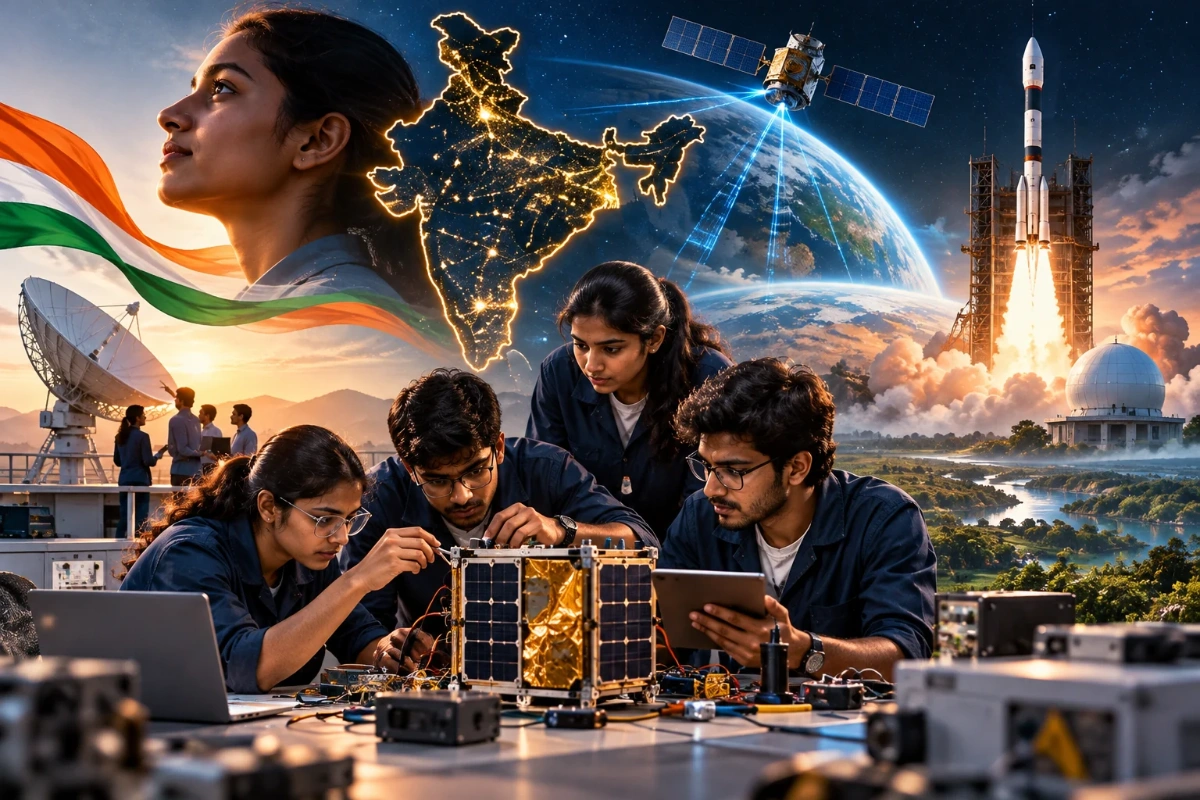
AI Generated Image
From Atal Labs to Deep-Tech Startups: The 19-Year-Olds Building India’s Space Tech Pipeline
India’s next space founders are not waiting until their thirties to enter the industry. A growing number of students and very young engineers are learning robotics, electronics, coding, satellite data, propulsion basics, and product thinking early enough to imagine a space company before they finish college. That shift matters because India’s space tech startups need more than capital; they need a long pipeline of builders who can move from tinkering benches to clean rooms, test ranges, data platforms, and commercial missions.
Why Are 19-Year-Olds Entering India’s Space Economy Now?
Nineteen-year-olds are entering India’s space economy because the path from curiosity to company-building has become more visible, practical, and connected than it used to be. School labs, college incubators, open hardware communities, hackathons, ISRO’s public inspiration, and policy reforms have made space feel less like a distant government-only domain and more like a field where disciplined young teams can contribute. India’s 2020 space-sector reforms opened the door wider for non-government entities, while IN-SPACe was created to promote, authorise, and oversee private participation in the sector.
That does not mean a teenager can build a launch company overnight. Space is still hard, capital-intensive, and unforgiving. But the starting point has changed. A student who once might have built a line-following robot can now work on a CubeSat subsystem, analyse satellite imagery, design a payload enclosure, simulate an orbit, or contribute software to a downstream space data product. The result is a younger, wider base for the space technology sector India can build on over the next decade.
The Pipeline Starts Before the Startup Pitch Deck
The most important story about space tech startups in India is not only the number of companies being formed. It is the learning pipeline behind them. Atal Tinkering Labs, college innovation cells, engineering clubs, maker spaces, hackathons, and startup incubators are giving students a way to practise the habits that deep-tech companies need: testing, documenting, failing safely, improving designs, and working across disciplines.
Atal Innovation Mission says Atal Tinkering Labs are designed for students from Classes 6 to 12 and use tools such as 3D printing, robotics, miniaturised electronics, Internet of Things kits, and rapid prototyping to build curiosity and innovation. AIM also says 10,000 Atal Tinkering Labs have been established in schools across India.
For space, this early exposure matters because aerospace thinking is not a single subject. A satellite needs mechanical design, embedded systems, thermal understanding, communications, software, power systems, mission planning, and operational discipline. A rocket adds propulsion, structures, materials, manufacturing, safety, range coordination, and regulatory approvals. Even a downstream satellite-data company needs domain knowledge, AI, geospatial reasoning, customer discovery, and reliability.
The 19-year-old founder is often not a finished expert. More often, they are an early integrator: someone who can connect classroom physics, code, hardware, mentors, and a practical problem. If that person finds the right ecosystem, they can become part of the talent base that fuels Indian space startups for years.
India’s Private Space Ecosystem Is Moving From Inspiration to Execution
India’s public imagination around space has long been shaped by ISRO missions. What is new is the rising confidence that private companies can build serious products around launch, satellites, components, ground systems, analytics, and applications. The sector is no longer just a symbolic arena for national pride; it is becoming a commercial and technical marketplace.
Government data reported in 2026 put India’s space technology startup count at around 440, while a January 2026 PIB release had put the number at 399 at that time. The exact count changes as definitions, registrations, and active companies evolve, but the direction is clear: the base of Indian space tech startups has expanded sharply from the small group that existed before the reform period.
This growth is visible across multiple layers of the space value chain:
- Launch Vehicles and Propulsion: Teams are working on small satellite launchers, engines, materials, and manufacturing methods.
- Satellites and Payloads: Startups are building platforms, sensors, deployers, communication payloads, and mission-ready subsystems.
- Ground Infrastructure: Companies support tracking, telemetry, command, earth stations, and mission operations.
- Space Data and Analytics: Downstream firms turn imagery, weather data, location intelligence, and monitoring tools into products for agriculture, insurance, climate, logistics, defence, and urban planning.
- In-Space Services: Emerging ideas include debris monitoring, servicing concepts, propulsion for satellites, and orbital operations.
For young builders, this breadth is important. Not everyone needs to start a rocket company. In fact, many of the strongest opportunities in India’s space startup ecosystem may lie in less glamorous but commercially useful areas: testing equipment, satellite software, geospatial APIs, precision components, simulation tools, and customer-specific analytics.
What Makes Young Space Founders Different From Earlier Startup Founders?
Young space founders are entering the field with a different mental model: they see space as a platform, not just a mission. Earlier startup waves in India were often shaped by consumer internet, SaaS, fintech, and marketplaces. Those sectors rewarded speed, distribution, and software iteration. Space rewards those skills too, but it also demands patience, engineering depth, compliance, and long feedback loops.
A 19-year-old building in this environment must learn two languages at once. One is the language of startups: customers, capital, hiring, pricing, partnerships, and market timing. The other is the language of aerospace: reliability, redundancy, quality assurance, test data, certification, and risk management. The founders who mature fastest are usually those who respect both.
This is where India’s pipeline becomes interesting. A student may begin by entering a robotics challenge, then join a college satellite team, then intern at an aerospace startup, then build a small subsystem, then understand that a narrow component can become a company. The path is rarely linear, but each stage makes the next one less intimidating.
The Strengths Young Founders Often Bring
Young teams can be unusually comfortable with new tools. They may adopt simulation software, AI-assisted design workflows, open-source geospatial libraries, low-cost electronics, and rapid prototyping faster than traditional organisations. They are also more likely to collaborate across online communities and learn from global technical content.
They can also be more flexible in their approach to problems. Instead of insisting on one grand idea, a student founder may discover that the real opportunity is a smaller bottleneck: a test jig, a deployment mechanism, a data-cleaning workflow, a thermal model, or a field application for satellite imagery. In deep tech, such “small” problems can become high-value building blocks.
The Gaps They Need to Close
The same youth that brings energy can also create blind spots. Space hardware requires a culture of verification, not just clever design. Founders must learn procurement, documentation, safety, export controls, intellectual property, supplier qualification, and realistic timelines. They also need mentors who can tell them when a prototype is exciting but not yet reliable.
For India’s aerospace startups to scale, this mentoring layer is critical. A country can produce many enthusiastic teams, but only a smaller number will survive the transition from student project to commercial product. That transition depends on patient capital, test access, experienced advisers, strong universities, public-private collaboration, and customers willing to try new Indian suppliers.
The Atal Lab Mindset Is Becoming a Deep-Tech Advantage
Atal Labs are not space labs by default, and most students who use them will not become space founders. Their importance is broader: they normalise building. When a student learns to move from an idea to a working prototype, they also learn that technology is not magic. It is a process.
That mindset is extremely relevant to India’s space technology sector. Rockets, satellites, and payload systems are built through repeated cycles of design, testing, failure analysis, redesign, and validation. The ability to persist with a difficult problem may be as important as the technical skill of writing code or machining a part.
A useful pipeline might look like this:
- School Exposure: Students experiment with robotics, sensors, electronics, 3D printing, and basic programming.
- College Exploration: They join aerospace, robotics, astronomy, AI, or satellite clubs and begin working in teams.
- Mentored Projects: They build payload concepts, ground-station experiments, model rockets, image-analysis tools, or subsystem prototypes.
- Internships and Incubators: They enter startups, labs, or accelerators where quality, documentation, and customer needs become real.
- Focused Venture Creation: They choose a narrow problem, validate demand, build a technical roadmap, and form a company only when the problem is strong enough.
- Commercial Scaling: They pursue partnerships, regulatory clarity, testing access, funding, and early customers.
This sequence matters because it avoids a common deep-tech mistake: starting with the company before understanding the problem. The best student founders are not simply young entrepreneurs. They are young problem-solvers who keep increasing the seriousness of the problems they take on.
Private-Sector Milestones Have Made the Dream More Believable
Role models change what students believe is possible. When Indian private companies demonstrate real progress, they give younger builders a reference point. Skyroot Aerospace’s Vikram-S suborbital launch in November 2022 marked the first launch of a launch vehicle built by a private company in India, according to ISRO. Agnikul’s 2024 Agnibaan SOrTeD mission also drew attention for its semi-cryogenic engine and 3D-printed engine approach, with PIB describing it as India’s first semi-cryogenic engine-powered rocket launch.
These examples are not just headlines. They show students that Indian teams can move from CAD models and lab tests to launch pads and flight data. They also reveal the seriousness of the journey: years of engineering, regulatory work, manufacturing discipline, and repeated testing sit behind every visible milestone.
For young founders, that lesson is healthy. Inspiration opens the door, but execution keeps it open. The next generation of Indian space startups will need to combine ambition with humility: learn from ISRO, learn from private pioneers, learn from global competitors, and still build for specific Indian and international markets.
The Commercial Opportunity Is Bigger Than Rockets
Public attention naturally goes to launches. Rockets are dramatic, easy to understand, and symbolically powerful. But the space economy is much wider, and many practical opportunities for 19-year-olds may begin far from the launch pad.
Satellite data is one major area. Earth observation can support crop monitoring, disaster response, infrastructure planning, maritime awareness, climate risk, forestry, water management, and insurance assessment. Communications and navigation applications can support remote connectivity, logistics, fleet management, and resilient networks. Space hardware companies can supply structures, sensors, avionics, software, solar arrays, propulsion components, and testing services.
This is where the term space technology India should not be reduced to one category. A strong ecosystem needs upstream companies that build and launch assets, midstream companies that operate infrastructure, and downstream companies that turn space-enabled information into decisions. The more complete the value chain becomes, the more room there is for young founders with different skills.
A student who loves machine learning may find a place in satellite analytics. A mechanical engineer may work on deployable structures. An electronics student may build power systems or radio modules. A policy-minded founder may help companies navigate compliance and procurement. A designer may make complex geospatial tools usable for non-technical customers. Space is deep tech, but it is also a market with many practical jobs to be done.
Skills Young Builders Should Develop Now
Students who want to contribute to India’s space startup ecosystem do not have to wait for permission. They can begin building a foundation early, even with limited resources. The key is to combine technical depth with proof of disciplined work.
A Practical Skill Checklist for Aspiring Space-Tech Founders:
- Engineering Fundamentals: Strengthen physics, mathematics, electronics, mechanics, materials, coding, and systems thinking.
- Hands-On Prototyping: Build small but complete projects, document test results, and explain design trade-offs clearly.
- Software Fluency: Learn Python, embedded programming, simulation tools, data pipelines, and basic cloud deployment.
- Geospatial Literacy: Understand satellite imagery, GIS tools, remote sensing concepts, coordinate systems, and data quality.
- Aerospace Basics: Study orbital mechanics, payload design, communication links, thermal constraints, propulsion concepts, and mission operations.
- Quality Mindset: Practise version control, test plans, failure logs, peer reviews, and repeatable documentation.
- Customer Discovery: Talk to farmers, insurers, city planners, logistics firms, researchers, defence suppliers, or climate teams before assuming what the market needs.
- Regulatory Awareness: Learn that space is governed by authorisations, safety rules, spectrum issues, liability, and national security considerations.
- Communication: Explain complex ideas simply. Investors, customers, regulators, and teammates must understand what the product does and why it matters.
The most valuable student portfolio is not a collection of buzzwords. It is a trail of working prototypes, thoughtful failures, clear documentation, and evidence that the builder can learn quickly without pretending to know everything.
The Ecosystem Must Make Room for Serious Young Talent
If India wants more high-quality space tech startups, it needs to support young talent without romanticising youth. Being 19 is not a business model. The ecosystem should celebrate ambition, but it should also help young founders become rigorous.
Universities can do more to connect student projects with real industry problems. Incubators can help teams understand whether an idea is a research project, a service business, a component company, or a venture-scale startup. Established companies can create internships that involve real engineering work, not just observation. Investors can learn to evaluate deep-tech milestones instead of expecting consumer-app speed. Government bodies can continue clarifying processes so founders understand the path from prototype to authorised activity.
Mentorship is especially important. A young founder may not know how to choose suppliers, negotiate with a manufacturing partner, write a test protocol, protect intellectual property, or estimate financial runway. Experienced engineers and operators can prevent expensive mistakes. The goal is not to make young teams cautious; it is to make their ambition survivable.
India’s Advantage Is a Full-Stack Talent Story
The future of Indian space tech startups will not be built by one type of founder. It will need school students who discover the joy of making, undergraduates who take on hard projects, PhD researchers who turn science into products, former ISRO and industry veterans who mentor and build, investors who understand long timelines, and customers who adopt space-enabled tools.
India’s advantage is that this stack is beginning to connect. Atal Labs can spark curiosity. Universities can deepen capability. Startups can create urgency. ISRO and IN-SPACe can provide institutional support. Markets can push companies towards useful products. When these layers work together, a 19-year-old does not have to carry the whole ecosystem alone; they can grow within it.
There is still a long road ahead. Many space startups will fail, pivot, merge, or remain small. Some will discover that their technology is impressive but their market is weak. Others will face capital gaps between prototype and commercial readiness. That is normal in deep tech. The measure of the ecosystem is not whether every young founder succeeds, but whether the system keeps producing better-prepared founders over time.
The Next Generation Is Already in the Workshop
The image of a teenager building India’s space future can sound romantic, but the real story is more practical and more powerful. It is a student learning soldering after school. A college team debugging telemetry at midnight. A young founder realising that a small satellite component may be a better business than a grand mission concept. A mentor insisting on better test data. A customer asking whether satellite intelligence can solve a real field problem.
That is how pipelines are built: not through one breakthrough, but through thousands of small capability gains. From Atal Labs to deep-tech startups, the rise of young builders gives India a wider base for space innovation. If the ecosystem keeps pairing youthful ambition with engineering discipline, the next wave of Indian space startups may not just chase the global space economy; it may help define what practical, affordable, and application-driven space technology looks like for the world.
Also Read: Digital Handloom Preservation By Banaras’ Gen-Z Artisans
To read more such news, download Bharat Express news apps