



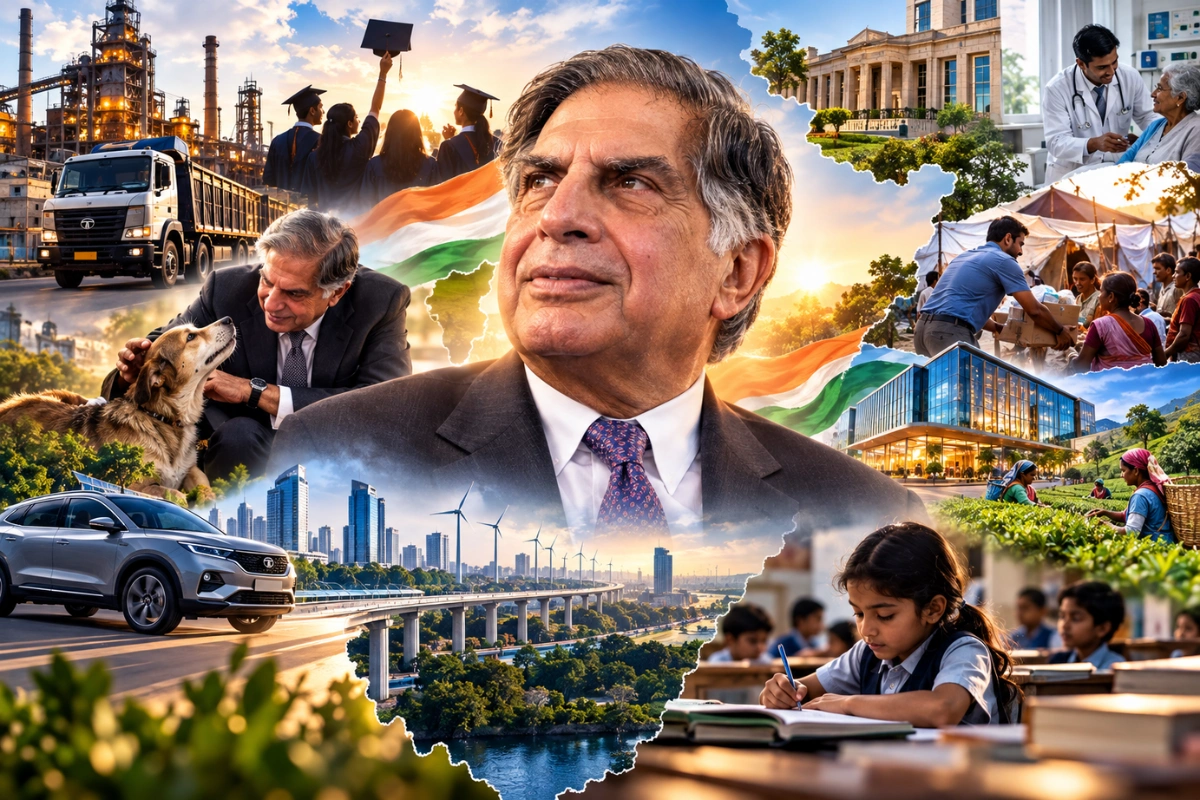
AI Generated Image
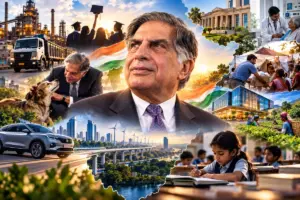
Dear fellow Indian, this is an open letter to everyone who grew up seeing the Tata name not only on trucks, tea, steel, software, hotels, watches, salt and cars, but also in hospitals, scholarships, relief work and quiet acts of national service. Ratan Tata’s story is not finished because the values he stood for still need ordinary people to practise them in boardrooms, classrooms, workshops, startups, farms, homes and public life. The Ratan Tata legacy is less about remembering a famous industrialist and more about choosing the harder path of integrity, compassion, courage and nation-building.
What Does It Mean to Carry Ratan Tata’s Unfinished Legacy?
To carry Ratan Tata’s unfinished legacy means to treat success as a responsibility, not a trophy. It means building institutions, products, careers and communities that solve real problems while preserving dignity, ethics and empathy. Ratan Naval Tata, who lived from December 28, 1937, to October 9, 2024, became a symbol of this approach because his public life joined enterprise with humility and philanthropy with long-term national purpose.
There is a temptation, after a great person passes away, to turn that person into a statue. We garland their memory, share their quotes, repost their photographs and slowly reduce a life of difficult decisions to a handful of polished lines. But the legacy of Ratan Tata asks for something more demanding. It asks us not only to admire him, but also to examine ourselves.
Are we honest when dishonesty is profitable? Are we kind when no one is watching? Are we ambitious for ourselves alone, or are we ambitious for India? Do we treat employees, customers, animals, strangers and vulnerable people as living beings with dignity, or as interruptions in the pursuit of growth?
These questions matter because the Tata legacy has never been only a corporate story. Tata Group history begins with Jamsetji Nusserwanji Tata, who started a trading company in 1868, and the group’s public narrative has long connected enterprise with institution-building, education, science, industry and social development. Ratan Tata inherited that moral architecture, but he also modernised its meaning for a liberalising, globalising and impatient India.
A Legacy Built Before Him, Strengthened Through Him
Ratan Tata did not create the Tata legacy from nothing. He was born into a tradition already shaped by Jamsetji Tata’s belief that business could serve national progress. The early Tata vision was not limited to private wealth; it imagined steel, power, education, research and philanthropy as building blocks of a stronger India. Tata’s own heritage pages describe Jamsetji as the founder whose philosophy of humane enterprise influenced the group’s later structure and its connection to social development initiatives.
That background matters because it reminds us that legacies are rarely one-generation miracles. They are handed down, tested, renewed and sometimes rescued. Ratan Tata’s greatness lay partly in receiving a demanding inheritance without treating it as an entitlement. He took a name that already carried trust and asked what it needed to mean in a new India.
When he became chairman of Tata Sons and the Tata Group in 1991, India itself was entering a new economic era. The country was opening up, competition was intensifying, and Indian companies had to decide whether they would remain protected domestic players or learn to compete globally. Ratan Tata’s achievements are often discussed through business milestones, but the deeper story is about a leader trying to make an old institution future-ready without stripping away its conscience.
This is where Tata leadership becomes distinct. It is not leadership by noise. It is not leadership by spectacle. It is not leadership that confuses aggression with strength. At its best, it is leadership that combines vision with restraint, scale with trust and ambition with a sense of public duty.
The Quiet Force of Tata Leadership
Ratan Tata’s public personality was famously understated. He did not need to dominate every room to influence it. He showed that authority can be calm, conviction can be courteous, and a leader can be admired without being theatrical.
For a generation raised in the age of constant self-promotion, this may be one of his most radical lessons. We often imagine leadership as visibility: the loudest voice, the sharpest quote or the most dramatic announcement. Ratan Tata reminded India that leadership can also look like listening, absorbing criticism, standing by difficult decisions and letting work speak longer than publicity.
His style also challenged the idea that kindness is weakness. In public memory, he is associated not only with corporate expansion but also with decency. People remember his affection for animals, his concern for employees, his dignified responses to setbacks and his ability to appear human despite occupying one of the most powerful positions in Indian industry. Not every memory is a balance-sheet item, yet these softer impressions are part of why the Ratan Tata legacy continues to feel personal to millions.
Leadership That Protects Trust
Trust is slow to earn and fast to lose. The Tata name has become valuable not merely because of its market presence, but because many Indians associate it with reliability and ethical conduct. Tata Group materials describe the group as strengthened by a culture of ethics and integrity, while Tata’s community pages note that a majority of Tata Sons’ equity is held by Tata Trusts, linking business dividends to philanthropic work.
That structure does not mean every company or leader is beyond criticism. No institution is perfect, and honest admiration does not require blind worship. But the principle is powerful: business can be designed so that wealth creation feeds a wider social purpose. That idea is worth defending at a time when public trust in institutions is often fragile.
For young founders, professionals and students, this lesson is practical. Your personal brand may bring attention, but your trustworthiness brings staying power. A company can sell once through clever marketing; it earns generations of loyalty through fairness, consistency and accountability.
Leadership That Thinks Beyond One Lifetime
The strongest institutions are built by people who know they will not live to see every result. Tata philanthropy began long before Ratan Tata’s chairmanship, including the JN Tata Endowment, established in 1892 to support higher education for Indians. That single fact reveals a mindset India still needs: invest in people whose names you may never know, because their growth becomes the nation’s growth.
Ratan Tata’s unfinished work belongs to this same long arc. It is unfinished not because he failed, but because no serious national mission can be completed by one leader. Healthcare, education, rural opportunity, ethical entrepreneurship, scientific temper, animal welfare, climate responsibility and dignified employment remain ongoing responsibilities.
What Were the Values Behind Ratan Tata’s Achievements?
The values behind Ratan Tata’s achievements were courage, humility, service, innovation and trust. His business journey included bold moves and difficult periods, but what made it meaningful to the public was the perception that ambition did not erase humanity. The best way to understand Ratan Tata’s legacy is to see achievement not as fame or size alone, but as impact anchored in values.
The word ‘achievement’ can become too narrow if we use it only for acquisitions, revenues, factories or market share. Those matter in business, but they do not explain why so many people felt personal grief when he passed away. Ratan Tata’s achievements live in a broader field: the confidence he gave Indian enterprise, the dignity he brought to leadership, the global imagination he encouraged and the example he set for using privilege with restraint.
His story also shows that achievement often includes failure, criticism and risk. Public respect does not come from never being questioned. It comes from how one behaves when plans are challenged, markets are unforgiving or dreams prove harder than expected. In that sense, his life offers a more mature definition of success: not perfection, but perseverance with principles.
Courage to Imagine India at Global Scale
A central part of Ratan Tata’s business legacy is the idea that Indian companies could compete with confidence beyond India’s borders. During his tenure, the Tata Group became more globally visible, and his leadership is widely associated with a period in which Indian enterprise became more outward-looking. The official Tata tribute describes him as a leader whose contributions shaped both the Tata Group and the nation’s fabric.
This mattered psychologically. Nations do not rise only through policies and infrastructure; they also rise through confidence. When Indian companies act with quality, professionalism and ethical seriousness, they change how the world sees India and how Indians see themselves.
For today’s entrepreneurs, the lesson is not simply ‘go global’. It is: build something worthy of trust anywhere. Whether you run a small manufacturing unit, a software startup, a design studio, a farm enterprise or a neighbourhood service business, the standard matters. Excellence is patriotism when it improves how people live and work.
Humility in Public Life
Humility is often praised and rarely practised. In Ratan Tata’s case, humility became part of his public identity because he seemed to resist the flamboyance that often surrounds wealth and power. He projected a kind of restraint that made people feel he belonged not only to the elite world of industry, but also to the moral imagination of ordinary Indians.
This does not mean humility requires small dreams. Ratan Tata showed the opposite. One can think on a national and global scale while remaining personally grounded. One can lead large organisations and still speak gently. One can be powerful without making others feel small.
That may be one of the most useful lessons for the next generation of Indian leaders. If your success makes you inaccessible, cruel or arrogant, it is incomplete. If your growth enlarges your empathy, your achievement becomes a form of service.
Tata Philanthropy and the Indian Idea of Giving
Tata philanthropy is not a decorative side note to the group’s business history; it is central to the Tata identity. Tata Trusts traces its philanthropic journey to 1892, and Tata community materials state that 66% of Tata Sons’ equity is held by Tata Trusts, allowing dividends to support philanthropic work. This structure has helped make giving part of the institution’s design rather than an afterthought.
In India, charity is often personal, emotional and immediate. We give to temples, schools, families in crisis, hospital bills, disaster relief and strangers in need. That spirit is precious. But Tata philanthropy points to another layer: organised, long-term, institution-building philanthropy that tries to address systems, not only symptoms.
This is important for every Indian carrying the Ratan Tata legacy forward. You do not need to be wealthy to practise philanthropy. Giving is not only the transfer of money. It is the transfer of time, attention, knowledge, opportunity and dignity.
Practical Ways to Practise Everyday Philanthropy
If we want the legacy of Ratan Tata to remain alive, we need to make giving more practical and less performative. Here are simple ways ordinary citizens can participate:
- Mentor one person without expecting anything back. Help a student, junior colleague, artisan or first-generation professional understand opportunities you already know how to access.
- Support education with consistency. A single donation helps, but steady support, tutoring, books, digital access or career guidance can change a person’s path.
- Treat workers with dignity. Pay fairly, speak respectfully and remember that domestic workers, drivers, delivery partners, security guards and contract staff are not invisible infrastructure.
- Give skills, not only sympathy. If you know finance, design, coding, languages, law, marketing, farming or administration, your knowledge can help someone become independent.
- Respond to suffering without spectacle. Help quietly when possible. Public posting is not always wrong, but the person being helped should never become a prop.
- Care for animals and public spaces. Compassion is not selective. Ratan Tata’s public affection for animals helped many Indians connect his leadership with gentleness.
- Build ethical workplaces. If you employ people, your policies become philanthropy in action when they protect health, fairness, learning and safety.
Everyday philanthropy begins when we stop asking, ‘How much must I give?’ and begin asking, ‘What can I repair, share or strengthen?’
The Responsibility of Young India
Young India inherits a country of enormous possibility and deep contradiction. We have world-class talent and painful inequality, digital ambition and educational gaps, startup energy and social distrust, global aspirations and local anxieties. In such a country, the Tata legacy cannot be treated as nostalgia. It must become a working ethic.
Ratan Tata belonged to a generation that saw India change dramatically. Today’s generation will see changes just as intense: artificial intelligence, climate stress, new manufacturing ambitions, healthcare demands, migration, urban expansion and new forms of work. The question is whether we will approach these changes only as opportunities to profit or also as opportunities to serve.
Build, but Build with Conscience
India needs builders. It needs people who create companies, research labs, farms, tools, schools, hospitals, software, clean energy systems, cultural platforms and public institutions. But building without conscience can deepen inequality and damage trust.
A Ratan Tata-inspired builder asks better questions:
- Does this solve a real problem? Hype fades, but genuine usefulness endures.
- Who might be harmed if this grows? Responsible innovation considers side effects early.
- Are workers and suppliers treated fairly? Scale should not depend on exploitation.
- Can quality be improved without excluding everyone? Affordability and excellence should not always be enemies.
- Will I be proud of this decision ten years from now? Time is a sharper judge than applause.
These questions apply beyond business. A teacher can build with conscience. A bureaucrat can build with conscience. A doctor, engineer, journalist, investor, lawyer, artist or student can build with conscience. The point is not your job title; the point is your standard.
Choose Credibility Over Shortcuts
India’s impatience is understandable. Many people are trying to rise from difficult circumstances, support families, repay loans and prove themselves. Under that pressure, shortcuts can look like strategy.
But the Ratan Tata legacy warns us that reputation is a long game. You may win a quick advantage by cutting corners, but you lose something more valuable: the ability to be trusted when it matters. In a crowded, noisy economy, credibility is a competitive advantage.
This is why ethics should not be taught as a moral lecture alone. Ethics is practical. It reduces fear. It attracts better people. It helps institutions survive leadership changes. It allows customers, citizens and colleagues to believe that a promise means something.
National Service Beyond Slogans
Ratan Tata’s appeal across India came partly from the feeling that he loved the country without turning patriotism into performance. His idea of national service seemed rooted in contribution: create jobs, build capability, support communities, invest in knowledge and act with dignity. This is a useful corrective in an age when public love for the nation is sometimes measured by volume rather than value.
India does not need every citizen to become famous. It needs millions of citizens to become dependable. Dependable parents, dependable employers, dependable engineers, dependable public servants, dependable neighbours, dependable voters and dependable friends. A nation is not built only by icons; it is built by habits repeated at scale.
The Indian Dream Needs Trust
The Indian dream is not only about individual upward mobility. It is about whether a child born in a small town, a remote village, a crowded basti or a struggling household can still imagine a life of dignity. That dream requires schools that function, hospitals that care, employers who do not cheat, roads that connect, laws that protect and citizens who refuse to normalise cruelty.
This is where the legacy of Ratan Tata becomes deeply civic. We honour him not by saying India needs another Ratan Tata, but by asking how many small pieces of his ethic can be distributed across society. One person’s integrity is admirable. A million people’s integrity is transformative.
The Private Sector Has a Public Soul
The Tata story also challenges a simplistic divide between business and public good. Private enterprise can generate jobs, innovation, products, taxes and global confidence. But when enterprise forgets society, it becomes extractive. When society distrusts all enterprise, it discourages builders. India needs a better balance: business that is ambitious and accountable, profitable and principled.
Tata Group history offers one influential Indian model for that balance. It shows how a business house can be remembered not only for what it sold, but also for what it strengthened. The details will differ for every company, but the direction remains relevant: build value, share value and protect trust.
How Can Ordinary Indians Keep the Tata Legacy Alive?
Ordinary Indians can keep the Tata legacy alive by practising ethical ambition in daily life. That means doing excellent work, refusing corruption where possible, helping others rise, respecting labour, supporting education and using personal success to widen opportunity. The Tata legacy survives when it moves from admiration into action.
This is both inspiring and uncomfortable. It is easy to praise a great man. It is harder to become a little more honest in our own transactions. It is easy to post a tribute. It is harder to pay someone fairly, return what is not ours, admit a mistake or choose quality when mediocrity would pass.
Yet this is exactly where legacy lives. Not in the grand speech, but in the small decision. Not in the anniversary post, but in the daily discipline.
A Personal Checklist for Carrying the Legacy Forward
Use this checklist not as a moral performance, but as a private audit:
- Work: Am I delivering quality, or only managing appearances?
- Money: Am I earning in a way that lets me sleep peacefully?
- Power: Do people with less power feel safe around me?
- Speech: Do I use my voice to encourage, clarify and defend fairness?
- Learning: Am I still improving, or am I hiding behind past success?
- Giving: Have I made service a habit, not an occasional emotional reaction?
- Country: Does my idea of patriotism include patience, responsibility and respect for fellow citizens?
- Nature and Animals: Is my compassion wide enough to include beings who cannot repay me?
- Legacy: If younger people copy my behaviour, will my community become better or worse?
No one will answer perfectly every day. The point is not perfection. The point is direction.
The Unfinished Work of Compassion
Compassion may seem like a soft virtue, yet practising it demands strength and effort. It asks us to notice pain we could ignore. It asks us to slow down when speed benefits us. It asks us to design systems around human beings, not just metrics.
People remember Ratan Tata for his gentleness because they long for powerful leaders who retain their humanity despite their authority. In a harsh world, kindness becomes memorable. In a competitive economy, decency becomes revolutionary.
This unfinished work of compassion belongs to all of us. It belongs to the manager deciding whether to humiliate an employee or coach them. It belongs to the customer deciding whether to abuse a service worker. It belongs to the school that notices a child falling behind. It belongs to the resident welfare group deciding whether stray animals are a nuisance to be removed or living beings to be handled humanely. It belongs to the entrepreneur deciding whether growth must come at the cost of burnout.
Compassion does not mean avoiding hard decisions. Ratan Tata’s own life in business would have required many difficult calls. But compassion changes how hard decisions are made. It asks whether clarity can exist without cruelty, whether efficiency can exist without disrespect, and whether ambition can exist without indifference.
Memory Must Become Method
India is good at remembrance. We know how to mourn, praise, quote and celebrate. What we must become better at is conversion: turning memory into method.
If Ratan Tata inspired us, then our systems should show it. Companies should strengthen ethics training and grievance mechanisms. Schools should teach entrepreneurship with social responsibility. Families should teach children that success without character is fragile. Investors should reward governance, not only growth. Citizens should respect honest institution-building, even when it is slow.
The legacy of Ratan Tata should also encourage more nuanced public conversations. We can admire without myth-making. We can critique without cynicism. We can learn from a life without pretending that any human being or institution is flawless. Mature respect allows both gratitude and thoughtfulness.
This matters because blind hero worship can weaken the very legacy it wants to protect. If we reduce Ratan Tata to a perfect symbol, we may miss the practical lessons of his journey: the patience to build, the courage to change, the humility to listen and the responsibility to give back.
A Letter to the Indian Who Wants to Do More
If you are reading this as a student, do not wait to become powerful before you become useful. Help a classmate. Learn deeply. Build discipline. Respect your teachers without surrendering your curiosity. Your future leadership begins in how you handle small responsibilities today.
If you are a young professional, do not confuse exhaustion with excellence. Work hard, but also work honestly. Choose mentors carefully. Refuse to become cynical too early. The country needs skilled people who can remain ethical under pressure.
If you are a founder, build for more than valuation. Build products that deserve trust. Hire people as human beings, not disposable fuel. Let governance grow with ambition. Remember that the company culture you tolerate in the first few years may become the character of the institution later.
If you are already successful, widen the circle. Fund learning. Create access. Share networks. Back people who lack social capital but have ability. The most meaningful privilege is the privilege that becomes a bridge.
If you are a public servant, remember that efficiency and empathy can coexist. A file may look routine to you, but it may carry someone’s livelihood, treatment, education, land, pension or dignity. Tata leadership extends beyond companies to every place where people exercise power and accept responsibility.
If you are an ordinary citizen with no title, you are still not powerless. You can vote thoughtfully, refuse everyday corruption, keep your surroundings cleaner, support local problem-solvers, speak respectfully and help someone take one step forward. Nations take shape through everyday acts of responsibility in places that rarely attract attention.
The Promise We Owe the Future
Ratan Tata’s passing on October 9, 2024, marked the end of a life, not the end of a responsibility. The real tribute is not to freeze him in memory, but to release his values into action. India does not need his admirers to become identical to him. It needs them to become more courageous, more ethical, more compassionate and more useful in their own fields.
The Ratan Tata legacy is not a museum. It is a workshop. It asks each of us to pick up a tool: a skill, a rupee, an hour, a decision, a company, a classroom, a policy or a kindness. It asks us to build something that outlives applause.
So, to every Indian carrying this unfinished work forward: do not wait for a perfect moment or a grand platform. Begin where you stand. Build what you can. Give what you have. Lead without arrogance. Succeed without losing tenderness. When the easier path tempts you to sacrifice integrity for speed, remember that we build our strongest legacy through the values we uphold and the positive change we create during our lives.
Also Read: From The Nano To The Skies: How Ratan Tata Dreamed For The Last Citizen Of Bharat
To read more such news, download Bharat Express news apps