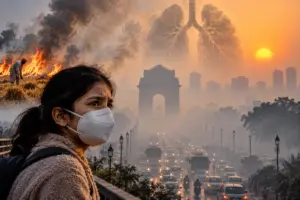




A thick layer of smog enveloped the Indian capital on Friday morning, dragging the Air Quality Index (AQI) back into the very poor category and posing fresh health risks for residents.
Delhi recorded overall AQI levels around 329–332 in the early hours, signalling hazardous particulate concentrations across large swathes of the city.
Among the worst‑affected localities, Jahangirpuri registered an AQI above 400, placing it in the severe category and highlighting the gravity of the pollution surge.
People in Anand Vihar, Ghazipur and Rohini reported dense haze and low visibility, especially during the morning commute.
The sudden deterioration comes after a brief period of comparatively better air quality, when levels dipped into the poor range.
However, a drop in wind speeds and stagnant atmospheric conditions have trapped pollutants close to the ground, exacerbating air quality woes.
Meteorologists from the India Meteorological Department (IMD) forecast that shallow fog and lingering haze are likely to persist over the next couple of days, with minimum temperatures expected to hover around seasonal norms.
Medical professionals have advised sensitive groups, including children, the elderly and individuals with respiratory ailments, to limit time spent outdoors.
Fine particulate matter (PM2.5), known for penetrating deep into lung tissue, remains the dominant pollutant driving the dangerous readings.
Regional Spread Beyond Delhi
The air quality downturn was not confined to Delhi alone. Surrounding cities in the National Capital Region (NCR) also reported troubling figures.
Noida recorded average AQI levels in the very poor category, while Greater Noida’s air quality hovered at similarly elevated levels.
Nearby urban centres such as Meerut and Ghaziabad also showed high pollution indices, prompting concerns about broader regional air quality management.
Authorities have cautioned that the air quality may remain in the very poor band through the weekend, with little short‑term improvement expected due to prevailing weather patterns.
The IMD has indicated no immediate shift in wind conditions that might help disperse the smog layer.
The Central Pollution Control Board (CPCB) is urging residents to follow its latest air quality updates and to take precautions to avoid prolonged exposure to harmful pollution levels.
With Delhi’s smog season once again underway, public health advisories remain in effect as winter settles in across the region.
Also Read: Delhi Air Quality Dips Closer To ‘Very Poor’ As AQI Hits 285
To read more such news, download Bharat Express news apps