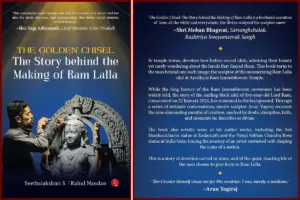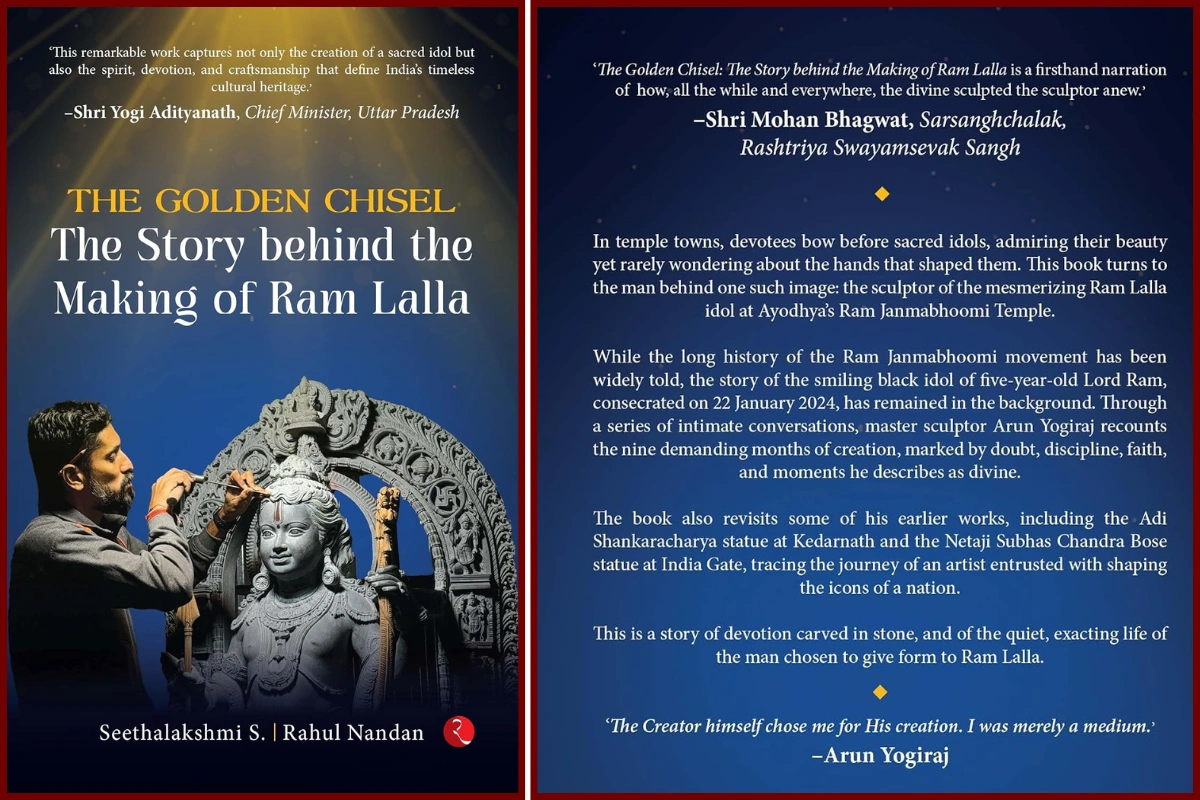
In the crowded landscape of books chronicling India’s Ram Janmabhoomi movement and the consecration of the Ayodhya temple, The Golden Chisel: The Story Behind the Making of Ram Lalla by Seethalakshmi S and Rahul Nandan occupies a distinctive and quietly powerful space.
Published by Rupa, this 168-page work shifts the focus from the larger historical and political narrative to the intimate, human story of the hands that shaped the smiling black stone idol of five-year-old Lord Ram—the image that now resides in the sanctum of the Ram Janmabhoomi Temple.
The Sculptor Behind Ram Lalla
The book’s central figure is master sculptor Arun Yogiraj of Mysuru, a fifth-generation artisan from a family of traditional shilpis.
An MBA graduate who briefly worked in the corporate world before returning to stone in 2008, Yogiraj had already created nationally significant works—the 30-foot Netaji Subhas Chandra Bose statue at India Gate and the 12-foot Adi Shankaracharya statue at Kedarnath—when he was selected as one of three sculptors for the Ram Lalla project.
Through months of intimate conversations, the authors record the nine demanding months of creation: the discipline, the doubt, the long hours away from family, the physical risks (including a stone chip that injured his eye) and the moments Yogiraj himself describes as divine.
The title draws from a striking detail that captured public imagination: the silver hammer and golden chisel used for the netronmilana—the ceremonial opening of the eyes.
Yogiraj has spoken of his nervousness about carving a child’s eyes and of drawing inspiration from photographs of children dressed as Krishna.
The finished 51-inch idol, carved from Krishna Shila (a non-reactive black schist chosen after careful geological consideration), depicts the child Ram standing on a lotus, holding a bow and arrow, with an expression of serene innocence that many devotees found immediately moving.
Craftsmanship Beyond Technique
What makes the book valuable is its refusal to treat the sculptor as a mere technical instrument. It situates Yogiraj within a living tradition of Indian craftsmanship while acknowledging the extraordinary public responsibility he carried.
The authors, both seasoned journalists—Seethalakshmi S, former metro editor of The Times of India in Bengaluru, and Rahul Nandan, former deputy news editor—bring a reporter’s eye for detail and sensitivity to the quieter aspects of faith and labour. Their account revisits Yogiraj’s earlier commissions, tracing the journey of an artist gradually entrusted with shaping some of the nation’s most visible icons.
The endorsement on the cover by Uttar Pradesh Chief Minister Yogi Adityanath captures the book’s larger claim: that it records not only the making of a sacred idol but also ‘the spirit, devotion, and craftsmanship that define India’s timeless cultural heritage’.
At a time when monumental public projects often reduce individuals to footnotes, The Golden Chisel restores agency and interiority to the craftsman. It reminds readers that behind every widely worshipped form lie months of solitary, exacting work, with doubt balanced by discipline and skill guided by faith.
For those interested in the intersection of art, devotion and contemporary Indian history, the book offers a focused, human-scale narrative that complements the grander chronicles of the temple’s construction. It is less a political tract than a portrait of quiet excellence: the story of a sculptor who, in giving form to Ram Lalla, revealed something of the enduring power of traditional craftsmanship in modern India.
To read more such news, download Bharat Express news apps