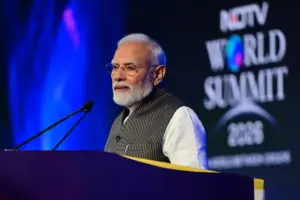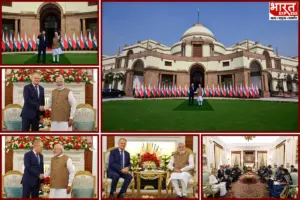




Prime Minister Narendra Modi on Tuesday declared that the vision of a Viksit Bharat by 2047 has evolved beyond a government programme and has firmly taken root as a nationwide aspiration.
Addressing a gathering of eminent economists and experts at NITI Aayog, the Prime Minister said the idea of a developed India now reflects the ambitions, choices and expectations of citizens across social and economic strata.
Prime Minister Narendra Modi observed that this transformation is visible in changing patterns of education, consumption and global mobility.
He noted that an increasingly aspirational society demands stronger institutions, faster decision-making and proactive infrastructure planning to match its rising expectations.
According to him, India’s growth journey now requires policies that anticipate future needs rather than merely respond to present challenges.
The Prime Minister called for sustained, mission-mode reforms across sectors to secure long-term growth.
He stressed that policymaking and budgeting must remain firmly anchored to the 2047 horizon, ensuring that short-term measures align with the broader national objective of building a developed India.
PM Modi also underlined the importance of positioning India as a key hub for the global workforce and international markets.
The interaction, themed ‘Aatmanirbharta and Structural Transformation: Agenda for Viksit Bharat,’ witnessed wide-ranging discussions on strengthening India’s economic foundations.
Economists and experts shared strategic insights on boosting productivity and competitiveness across manufacturing and services, highlighting the urgency of accelerating structural transformation.
2047 Vision Drives Aspirations
Participants emphasised the role of higher household savings, large-scale infrastructure creation and the adoption of advanced technologies in sustaining growth momentum.
The discussions also examined how artificial intelligence can serve as a powerful catalyst for cross-sector productivity, from manufacturing efficiency to service delivery and governance innovation.
The group deliberated on the continued expansion of India’s Digital Public Infrastructure, recognising it as a defining strength of the Indian growth model.
Experts noted that scalable digital platforms have already reshaped financial inclusion, public service access and business efficiency, and can further deepen economic participation.
According to an official statement, participants acknowledged that the unprecedented wave of cross-sector reforms undertaken in 2025, and their consolidation in the coming year, will play a decisive role in keeping India among the world’s fastest-growing major economies.
They agreed that these reforms strengthen institutional capacity while unlocking new opportunities for investment, employment and innovation.
Leading Economists Participate in Dialogue
Several leading economists and policy thinkers participated in the interaction, including Shankar Acharya, Ashok K Bhattacharya, NR Bhanumurthy, Amita Batra, Janmejaya Sinha, Amit Chandra, Rajani Sinha, Dinesh Kanabar, Basanta Pradhan, Madan Sabnavis, Ashima Goyal, Dharmakirti Joshi, Umakant Dash, Pinaki Chakraborty, Indranil Sen Gupta, Samiran Chakraborty, Abhiman Das, Rahul Bajoria, Monika Halan and Siddhartha Sanyal.
Prime Minister Narendra Modi’s remarks reinforced a clear political message: Viksit Bharat is no longer a distant policy goal but a collective national mission shaped by aspiration, reform and confidence in India’s future.
Also Read: PM Narendra Modi Holds High-Level Talks With Economists Ahead Of Union Budget 2026–27
To read more such news, download Bharat Express news apps