



In an age dominated by algorithms, natural language processing, and artificial intelligence, it is easy to forget that the foundations of systematic language science were laid more than two millennia ago in ancient India.
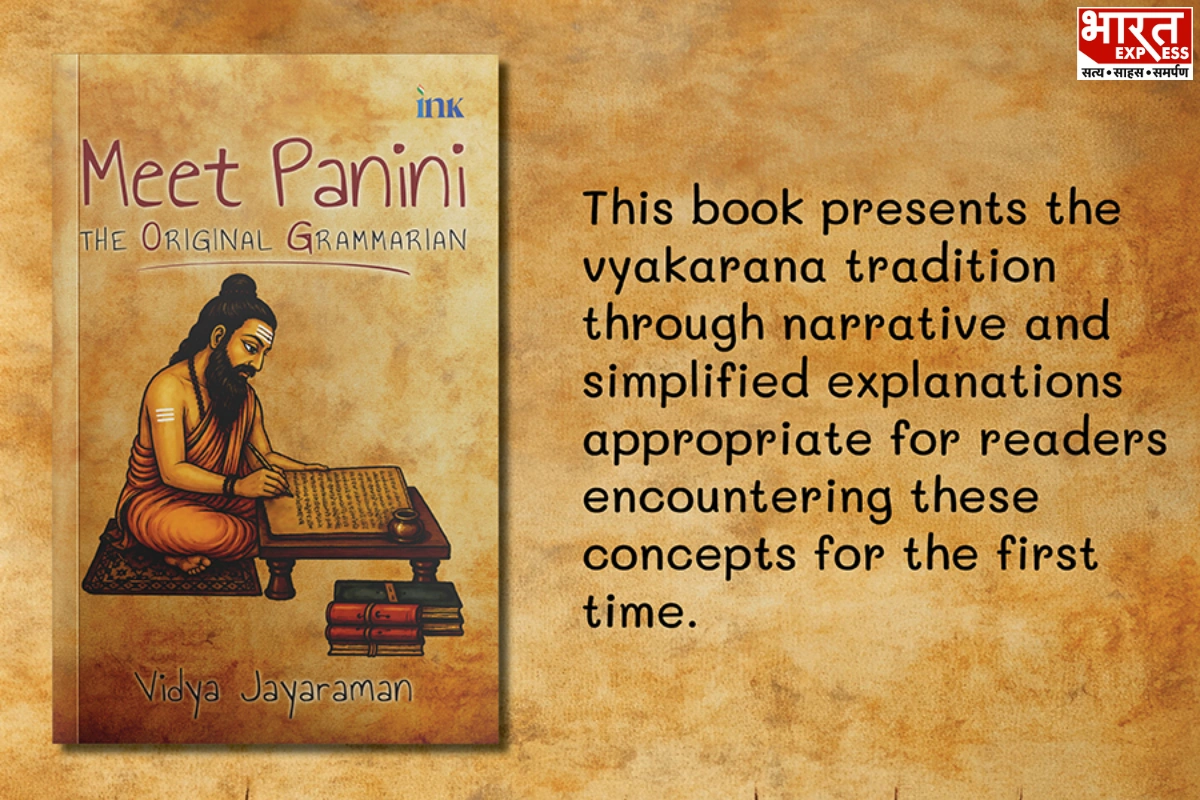
Vidya Jayaraman’s Meet Panini: The Original Grammarian (BluOne Ink, 2026) brings this extraordinary intellectual tradition to life in a compact, engaging, and accessible form.
Aimed particularly at young readers and those new to the subject, the book succeeds in making one of the world’s greatest minds approachable without diluting the depth of his achievement.
Pāṇini (often rendered as Panini), who flourished around the 5th–4th century BCE in Śalātura (in the region of ancient Gandhara), is widely regarded as the father of linguistics. His monumental work, the Aṣṭādhyāyī (‘Eight Chapters’), consists of nearly 4,000 highly concise rules that describe the phonology, morphology, and syntax of Sanskrit with remarkable precision and generative power.
Long before modern formal language theory, Pāṇini created a system that is algorithmic in spirit—rules that operate with meta-rules, exceptions, and ordered application, anticipating concepts later formalised in computer science.
A Journey Through Sanskrit Grammar
Jayaraman’s book takes readers on a journey through the eyes of a young boy in Śalātura whose fascination with words blossoms into the creation of this seminal grammar.
The narrative is fictionalised for engagement yet rests firmly on textual foundations. It does not stop with Pāṇini.
The author traces the living tradition of Sanskrit grammar: Kātyāyana, who refined and commented upon the rules; Patañjali, whose Mahābhāṣya elaborated and defended the system with philosophical insight; and Bhartṛhari, who illuminated the deeper metaphysical dimensions of language and meaning.
What sets the book apart is its deliberate bridging of ancient and modern. Jayaraman draws clear parallels between Pāṇini’s generative system and contemporary computational linguistics and computer science.
Concepts such as recursive rule application, formal grammars, and the efficient encoding of linguistic knowledge find echoes in the Aṣṭādhyāyī.
The author, who holds a Vyakarana Acharya degree and has a background in computer science and IT consulting, uniquely positioned to make these connections authentic and illuminating.
At just over 100 pages, the book serves as an entry point rather than an exhaustive treatise. It demonstrates that the Indian grammatical tradition is not a frozen relic but a dynamic, living intellectual system that continued to evolve through centuries of commentary and application.
By presenting this history of ideas in narrative form, Jayaraman invites readers—especially the young—to discover the original works for themselves.
The author’s own journey adds quiet credibility. Her earlier work on the Carnatic composer Muttusvami Dikshitar and her deep engagement with traditional Sanskrit texts, philosophy, and pedagogy inform the book’s clear, purposeful voice.
The presentation of the first copy to the Jagadguru Shankaracharya of the Kanchi Kamakoti Peetham underscores the work’s rootedness in living tradition while remaining oriented towards contemporary youth.
A Timely Contribution
Meet Panini arrives at a timely moment. As interest in Indian Knowledge Systems grows and computational linguistics flourishes, there is a genuine need for accessible introductions that neither romanticise nor oversimplify.
Jayaraman’s book meets that need. It is neither a dry academic survey nor a children’s fairy tale; it is a thoughtful invitation to encounter a mind whose precision and systematic brilliance continue to astonish scholars and technologists alike.
For anyone curious about the origins of rigorous linguistic thought, the continuity of India’s intellectual traditions, or simply the power of a well-told story about a boy who loved words, this slender volume offers a rewarding starting point. It shows that some of the most sophisticated ideas about language had already taken shape when much of the world was still finding its voice.
Also Read: What Does Sanātana-Dharma Actually Say? A New Book Looks Beyond The Headlines
To read more such news, download Bharat Express news apps