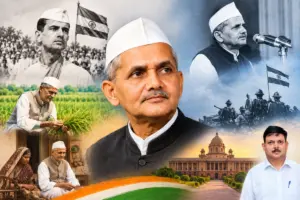




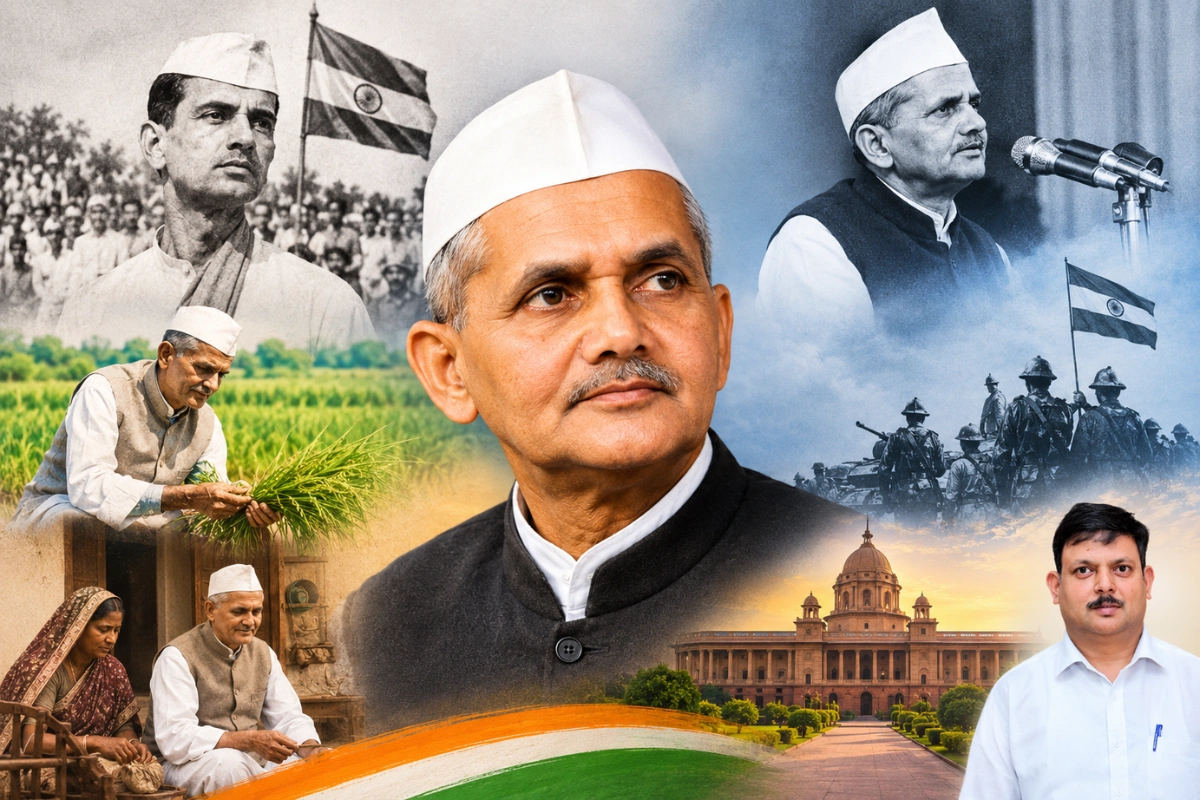
When Lal Bahadur Shastri, known for his ethos of ‘simple living and high thinking’ in Indian politics, was once asked about his choice of placing green grass on his table rather than beautiful flowers, he replied, “Flowers attract people, but they wither and fall within a few days, whereas grass is the foundation; it remains green even in adverse circumstances. I want to be like grass in people’s lives.”
This profound statement provides a significant insight into a person’s nature and work culture. It echoes his stoic, service-oriented nature towards his countrymen without any ostentation.
Inspired by the impactful speeches delivered by Mahatma Gandhi and Pandit Madan Mohan Malviya in Banaras in January 1921, Lal Bahadur actively joined the Indian Independence Movement and remained a dedicated participant for the entirety of his life.
Simultaneously, while pursuing his studies at Kashi Vidyapeeth in 1925, he wrote a profound research article on the Bharat-Ratna Bhagavan Das’ book ‘Essential Unity of All Religions’. In recognition of his scholarly contribution, he was honoured with the title of ‘Shastri’. This title, reflecting his intense scholarship, remained with his name throughout his life.
Shastri Ji faced imprisonment on seven occasions during 1930-1945 because of his active participation in the independence movement. Throughout this period, his family endured considerable hardship, yet he never sought any concessions from the British Government. He firmly believed in prioritising loyalty to the Nation over all other allegiances, considering this loyalty to be absolute, unconditional and non-contingent on anticipated returns.
Shastri Ji and the Prime Minister’s Office
After the demise of Sri Jawaharlal Nehru on 27 May 1964, the Congress Working Committee unanimously chose Shastri Ji for the post of Prime Minister on 2nd June 1964. When Shastri Ji sensed doubts of a few in this regard, he said, “The job of a Prime Minister is difficult, but not impossible. Let us try. If we succeed, well and good. If I fail, I shall resign and go.”
We should mark these words as they succinctly reflect his absolute ethical integrity. For success, he used the word ‘WE ’, whereas for failure he used ‘I’. Such honest acceptance is what places him in the ‘rarest of the rare’ category.
It is inspiring and equally intriguing to know about a person who started his career as the legislative secretary for the Chief Minister of Uttar Pradesh and assumed the Prime Minister’s office after serving as the Union Minister thrice. Despite all these accomplishments, he retained an exceptional simplicity in Indian politics, like an altruistic saint.
Despite being the Home Minister, he did not own a home, did not have enough money to buy a car, and his son stood in line for getting admission in a college of Delhi University, just like an ordinary student. Ironically, such instances are mere stories now.
Moral Values and Public Life
Today’s political and social environment shows a disturbing decline in moral values, with ostentation and pretence becoming increasingly common. Young people often get caught up in the glare and dazzle of life.
In a country where village sarpanches, police inspectors, patwaris and tehsildars often consider themselves the ‘God’ of the public and spend their lives accumulating wealth and power through corrupt means, where people often define service as advancing their own family or caste, and where society considers drug-consuming artists, with a few exceptions, to be ‘Stars’, hardly anyone can imagine that a truthful Prime Minister like Shastri Ji once served this country.
The significance of a democratic government and its officials, ministers etc. depends upon the accountability that they hold towards the public. In the absence of such accountability, the entire system becomes a mere formality.
As Shastri Ji aptly stated, “Those who rule, they must pay careful attention to the response of the public, as it is the public who have the final authority.” This statement reflects his real understanding of democracy.
Leadership During a Time of Crisis
In 1962 facing defeat against China, the death of Jawaharlal Nehru, a severe food crisis, and Pakistan’s aggression in 1965, Lal Bahadur Shastri not only confronted all these challenges with courage, but also elevated India’s pride. When our countrymen were facing food shortage, he asked his own family to fast for a day before requesting the nation to do the same. About this sensible gesture, former Prime Minister Atal Bihari Vajpayee said, ‘Shastri Ji has seen hunger, so he knew how to address it’.
His order to Indian army to launch a counter-attack on Pakistan and to march towards Lahore on 6th September 1965 is considered the ‘tallest decision made by the shortest man’ in Indian History. During this critical phase of India, when on the morning of January 11, 1966, at 1:32 AM, Shastri Ji took his last breath in Tashkent, it felt like the end of a glorious era for India.
In his short 19-month tenure as Prime Minister, he left behind a profound legacy for the future generations. As one of the national dailies wrote a tribute on 12 January 1966-
“He was a leader who because of his unusual attributes was ideally suited to guide his country in a time of crisis and fluidity, and it is no derogation of aspiring contestants to the prime ministership to observe that he will be difficult to replace.”
The Legacy of Lal Bahadur Shastri
Our country and several other countries train their civil servants at the Lal Bahadur Shastri National Academy of Administration (LABSNAA), Mussoorie. The academy’s motto, ‘Sheelam Param Bhushanam’ (character is the utmost virtue), perfectly reflects the character of this altruistic man. However, it remains a matter of grave concern that many civil servants, despite receiving training at this academy, fail to incorporate Shastri Ji’s simplicity and ethical firmness into their own lives.
Shastri Ji lived a remarkably humble life. People know much about his poverty, but he himself probably never spoke or wrote much about it. On the day of his marriage on May 16, 1928, he simply told his wife, Lalita Ji, that she came from an affluent family and could have enjoyed a wedding in a prosperous household. However, after their marriage, he told her that they needed to pay attention to people below their own status. During his school days, one of his teachers once told him, ‘Poverty is not an ornament to be exhibited’. Shastri Ji made this principle his life-mantra.
He practised humility without making it superficial or artificial. Instead, his family values naturally shaped his humility. Through his immaculate lifestyle and integrity, Shastri Ji proved that even a life of scarcity can remain stainless, pure and elevated. Every individual from every stratum of society can learn something valuable from this altruistic saint of Indian politics, provided they show an eagerness to learn.
Dr Satyendra Srivastava, Assistant Professor, Dept of Philosophy, Kirori Mal College, University of Delhi
To read more such news, download Bharat Express news apps