



Dr Indresh Kumar asserted that if India does not lead with the principles of peace, harmony and coexistence, the world will remain caught in cycles of violence.
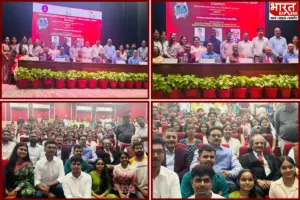
He made these remarks during the concluding session of the two-day international conference Manthan 5.0, organised by the Forum for Awareness of National Security at the University of Delhi.
Highlighting India’s rich heritage, he described the country as a civilisation shaped by the depth of the Sindhu and the vastness of the Himalayas. He noted that conflicts stem from ignorance, while wisdom offers solutions. Referring to Lord Rama, he underlined the widespread cultural reverence associated with the name across India and beyond.
Dr Kumar emphasised the importance of mother tongues, stating that individuals dream in their native languages, reflecting a lifelong connection with cultural roots. He linked linguistic identity to civilisational continuity and social cohesion.
The conference, held on 27–28 March 2026 at the Sir Shankar Lal Concert Hall, explored the theme ‘Culture, Climate, and History: Lessons from Greater India’.
It was jointly organised by the Forum for Awareness of National Security, Galgotias University, and Vivekananda Global University, with participation from Jamia Millia Islamia and other institutions.
Key Discussions and Insights
Scholars and experts deliberated on civilisational heritage, environmental perspectives, and global challenges.
Mehtab Alam Rizvi highlighted the role of India’s armed forces and stressed that national security extends beyond military strength to include cultural and social unity. References to ‘Vasudhaiva Kutumbakam’ reinforced India’s tradition of peaceful engagement.
Academics, including Amrita Tyagi and Malvika Dudi Bagaria, spoke about the Indian knowledge system and human-centric development.
Political analyst Awadhesh Kumar Singh stressed the need for decolonising thought, while MLA Devyani Singh Rana highlighted the influence of digital narratives on youth.
The conference examined themes such as global dialogue, ecological ethos, and cultural continuity, while addressing challenges like climate change, maritime security, and geopolitics.
It concluded with a vote of thanks, marking Manthan 5.0 as a significant platform for intellectual exchange and reflection on India’s global role.
Also Read: PM Modi Claims Kerala Tilting Towards NDA, Launches Fresh Attack On LDF And UDF
To read more such news, download Bharat Express news apps