



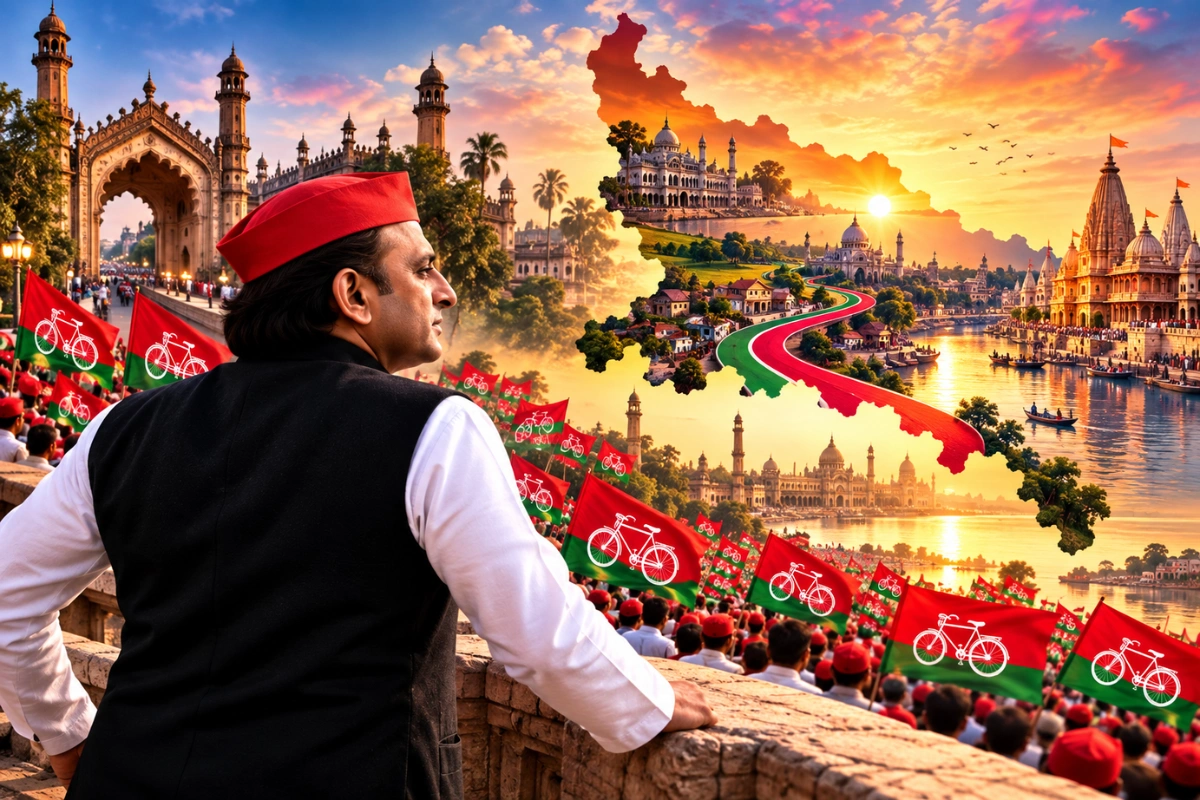
AI Generated Image
Akhilesh Yadav’s route back to power in Uttar Pradesh runs through the Awadh region, where the Samajwadi Party’s 2024 Lok Sabha surge opened a real contest but did not settle it. The question now is whether the SP chief can convert parliamentary momentum, family-led control and the PDA social coalition into Assembly-scale gains before 2027. Recent Uttar Pradesh news from Faizabad, Milkipur and the wider central belt shows both the opportunity and the warning signs.
Why Is Awadh the Test Akhilesh Cannot Avoid?
Awadh matters because it is not just another electoral belt; it is where symbolism, caste arithmetic, welfare delivery and party organisation collide. The region includes politically resonant ground around Ayodhya, Lucknow and neighbouring districts, though its exact political boundaries vary by analyst. In one post-2024 assessment, Awadh was treated as a 20-seat Lok Sabha region where the BJP won nine seats but suffered the headline defeat in Faizabad, the constituency that includes Ayodhya.
That makes the Akhilesh Yadav Awadh Reclaim question larger than a seat count. If Yadav can hold the non-Yadav OBC, Dalit and minority consolidation that helped the SP in 2024 while adding local upper-caste and floating voters, Awadh could become the launchpad for a broader Uttar Pradesh challenge. If he cannot, the BJP’s recovery in key pockets may turn 2024 into a missed opening rather than a turning point.
The 2024 Result Gave SP Its Strongest Opening in Years
The 2024 Lok Sabha election changed the political mood around Akhilesh Yadav. In Uttar Pradesh, the Samajwadi Party finished ahead of the BJP in seat tally, winning 37 of 80 seats, while the BJP won 33 and the Congress won six as part of the INDIA bloc’s comeback in the state.
Several Awadh-linked results carried strategic weight. SP’s Awadhesh Prasad won Faizabad by 54,567 votes, Lalji Verma won Ambedkar Nagar, and Ram Shiromani Verma won Shrawasti; Congress also posted major wins in nearby Barabanki, Rae Bareli, Amethi and Sitapur. The political analysis after the result was clear: the BJP’s temple-centred messaging did not automatically translate into electoral advantage across the central belt.
The ‘family’ part of the SP story also strengthened. Akhilesh Yadav won Kannauj by a large margin, while Dimple Yadav retained Mainpuri, reinforcing the party’s traditional fortress even as the SP expanded beyond its old base. But a family-centred command structure is a double-edged asset: it brings coherence, name recall and discipline, while giving opponents an easy line of attack on dynastic control.
Milkipur Exposed the Limits of the 2024 Wave
The BJP’s 2025 Milkipur bypoll victory complicated the SP’s Awadh narrative. The seat fell under the Faizabad Lok Sabha constituency and was vacated after Awadhesh Prasad entered Parliament. BJP candidate Chandrabhanu Paswan defeated SP candidate Ajit Prasad, Awadhesh Prasad’s son, by 61,710 votes, turning a prestige fight into a sharp warning for the SP.
The result mattered because it struck at the heart of Akhilesh’s PDA pitch: Pichhda, Dalit, Alpsankhyak, or backward classes, Dalits and minorities. Reporting from the constituency indicated that Muslim and Yadav voters may have largely stayed with SP, but Pasi and other Scheduled Caste voters moved towards the BJP in enough numbers to change the contest.
That defeat also sharpened criticism of family-based ticket distribution. Ajit Prasad’s candidature allowed the BJP to frame the contest as an ordinary party worker against a political heir, a contrast that resonated in local accounts of the campaign. For Akhilesh, the lesson is blunt: Awadh cannot be reclaimed on symbolism alone, and Dalit outreach cannot be treated as transferable from one election to the next.
PDA Is Being Stretched into a Wider Coalition
Recent Akhilesh Yadav news points to an effort to widen the SP’s social appeal before the 2027 Assembly election. The party has tried to deepen Dalit outreach through the PDA formula, including visible symbolic shifts such as adding blue accents associated with Ambedkarite politics to SP’s traditional red-and-green identity.
Akhilesh has also shown signs of blending social justice politics with softer religious messaging. India Today reported in May 2026 that he was attempting to combine the PDA framework with visible expressions of Hindu faith, a move aimed at reducing the BJP’s ability to polarise Hindu voters against the SP.
There is another layer: Brahmin outreach. Reports in 2026 described Akhilesh as trying to expand the meaning and reach of PDA while appealing to Brahmins who may feel politically neglected or dissatisfied. This is a delicate pivot. If handled well, it can help SP soften its old ‘Yadav-Muslim party’ image; if handled clumsily, it can dilute the clarity of its social justice message without bringing enough new support.
The Route to Reclaiming Awadh Runs Through Candidate Choice and Booth Work
For SP, the next phase is less about slogans and more about execution. The party already has the 2024 proof that a wider anti-BJP coalition can work in Uttar Pradesh. What it lacks, especially after Milkipur, is assurance that this coalition will behave the same way in Assembly constituencies, where local candidates, caste subgroups and village-level networks matter more.
Key pressure points for Akhilesh include:
- Candidate credibility: Awadh voters have shown they can reward symbolic choices, as in Faizabad, but Milkipur suggests they may resist tickets seen as entitlement or inheritance.
- Dalit consolidation: The SP must go beyond high-profile gestures and build booth-level relationships with Pasi, non-Jatav Dalit and other Scheduled Caste voters.
- Non-Yadav OBC reach: Kurmi, Maurya, Nishad, Rajbhar and other communities cannot be treated as a single bloc; each constituency will require local negotiation.
- Congress coordination: The SP-Congress equation helped the INDIA bloc in 2024, but uncertainty over the alliance remains a strategic risk before 2027.
- Local grievance politics: Issues such as jobs, welfare access, policing, land, caste dominance and administrative behaviour will decide whether anti-incumbency becomes vote transfer.
This is where the ‘fortress’ metaphor becomes useful but incomplete. Mainpuri, Kannauj and the Yadav family base can anchor Akhilesh, but Awadh demands expansion into constituencies where the SP cannot depend on inherited loyalty. In an Assembly election, every ticket becomes a local referendum.
BJP Is Treating Awadh as Recoverable Ground
The BJP’s response has been aggressive because it understands what the Faizabad defeat represented. Milkipur showed the party can recover if it combines welfare messaging, caste balancing, organisational force and the personal involvement of senior leaders. In that bypoll, Chief Minister Yogi Adityanath reportedly took direct charge of the campaign, visiting repeatedly and deploying Ministers and MLAs to the constituency.
The BJP also has a tested advantage in upper-caste consolidation and a strong welfare-delivery narrative. At the same time, post-2024 analyses show that the INDIA bloc made gains among Yadavs, Muslims and non-Jatav Dalits, while the BJP retained strength among upper castes and many non-Yadav OBC groups. That means the Awadh battle is not simply Hindutva versus PDA; it is a layered fight over trust, local power and whether voters see SP as a viable governing alternative.
For the BJP, the challenge is to prevent Faizabad from becoming a repeatable model. For SP, the challenge is to prove Milkipur was a setback, not a correction.
What Happens Next Will Decide the Future of SP’s Awadh Push
The coming months will test whether Akhilesh Yadav can shift from momentum politics to durable organisation. Watch for three signals: early candidate selection, clarity on the Congress alliance and whether Dalit outreach produces leaders on the ground rather than just images on stage.
The SP enters this phase with a real opening, not a guaranteed path. Its 2024 performance changed the conversation in Uttar Pradesh, and its victories in Faizabad and other central seats gave Akhilesh a powerful story to tell. But the BJP’s Milkipur counterpunch proved that Awadh remains contested territory.
So, can Akhilesh Yadav reclaim Awadh? Yes, but only if the SP turns the family fortress into a broader social machine. In the Awadh region, symbolism may open the door, but candidate discipline, caste negotiation and booth-level credibility will decide whether Akhilesh walks through it.
Also Read: From Lohia’s Socialism To Youth Politics: The Untold Evolution Of The Samajwadi Party
To read more such news, download Bharat Express news apps