



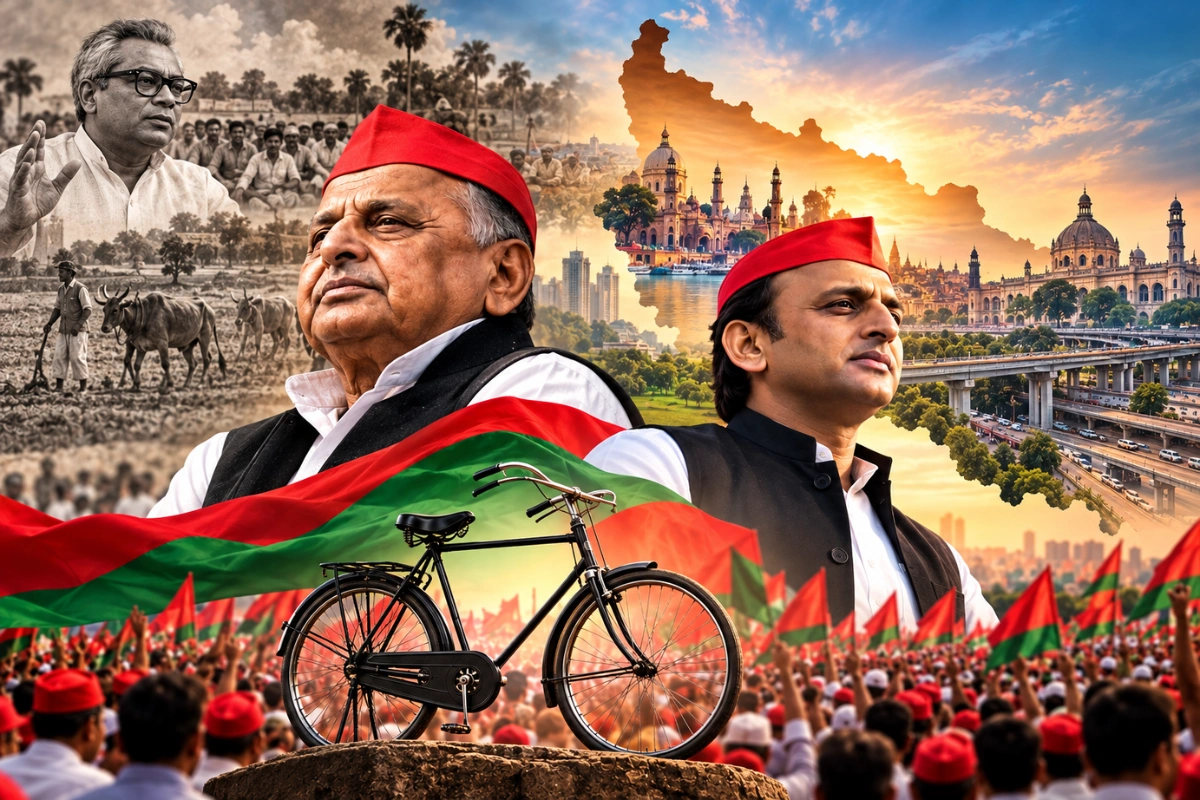
AI Generated Image
The Samajwadi Party is one of India’s most recognisable socialist political parties, rooted in Uttar Pradesh and shaped by the language of equality, secularism, social justice, and regional assertion. Its story begins with the Lohiaite socialist tradition, moves through Mulayam Singh Yadav’s mass politics, and continues today under Akhilesh Yadav’s more youth-facing, development-oriented leadership. This page offers a clear, balanced overview of Samajwadi Party history and the broader Samajwadi Party evolution without reducing it to slogans or election-season shorthand.
What Does the Samajwadi Party Stand for?
The Samajwadi Party describes itself as a secular, democratic party committed to building a socialist society based on equality. Founded on 4 October 1992 by Mulayam Singh Yadav, the party is based in Uttar Pradesh and identifies with the socialist ideas associated with Dr Ram Manohar Lohia, especially social justice, anti-caste politics, and the political empowerment of communities left outside elite power structures. Its official account also notes that Akhilesh Yadav has served as party president since January 2017, marking the party’s move from founder-led politics to a newer generational phase.
At its core, the party’s public identity rests on a few recurring commitments:
- Social justice: representing backward classes, minorities, farmers, workers, and other communities that seek a larger share in political power.
- Secular politics: framing citizenship and governance beyond religious majoritarianism.
- Democratic socialism: connecting economic opportunity with dignity, welfare, and access to public resources.
- Regional strength: treating Uttar Pradesh not only as an electoral base but as the main theatre where national political questions are contested.
- Youth participation: using younger leadership, digital communication, and employment-focused language to reach new voters.
A Party Born from the Lohiaite Socialist Stream
To understand the Samajwadi Party, one must first understand the political vocabulary it inherited. Dr Ram Manohar Lohia’s socialism was not simply about state control or economic redistribution. It was also about caste, language, decentralisation, gender, civil liberties, and the right of ordinary people to challenge concentrated power. Summaries of Lohia’s political thought emphasise equality, decentralised governance, and resistance to caste hierarchy as central parts of his socialist imagination.
That inheritance mattered deeply in north Indian politics. Lohiaite socialism created a language through which backward classes could demand more than symbolic representation. It argued that democracy was incomplete if social status, caste location, access to education, and economic opportunity continued to decide who could lead. The Samajwadi Party drew from this tradition and adapted it to the conditions of post-Mandal, post-1990s Uttar Pradesh.
This is why Samajwadi Party history cannot be told only as a timeline of Chief Ministers, alliances, or seats. It is also the history of how socialist vocabulary entered everyday political speech: samajwad, samta, representation, reservation, farmer dignity, minority security, and the idea that political power should move downwards rather than remain with older elites.
Mulayam Singh Yadav Built the Organisational Foundation
Mulayam Singh Yadav gave the party its first durable structure and political personality. Before founding the Samajwadi Party in 1992, he had already emerged from the socialist stream of north Indian politics and had served as a major leader in Uttar Pradesh. The party’s own history identifies October 1992 as the moment when the organisation formally came into being, with Mulayam Singh Yadav as the central figure who turned Lohiaite language into a mass political platform.
His politics combined ideological positioning with grassroots mobilisation. The party spoke to farmers, backward classes, minorities, small-town voters, and sections of the rural poor who wanted political recognition. Its rise also came at a time when Indian politics was being reshaped by coalition governments, caste mobilisation, Mandal-era social justice, and debates over secularism after the early 1990s.
The early Samajwadi Party was therefore not merely a new electoral machine. It became a political home for groups that wanted assertive representation in the state’s power structure. For supporters, this was the party’s great contribution. For critics, it also raised questions about caste consolidation, patronage, and whether social justice politics could be broadened beyond core support groups. Both readings are part of any serious account of Samajwadi Party evolution.
Key features of the Mulayam phase included:
- Cadre-style mobilisation: local networks, district-level leaders, and community-based organising played a major role.
- Farmer and rural language: the party drew heavily from agrarian concerns and small-town political culture.
- Secular positioning: it consistently presented itself as a force against communal polarisation.
- Backward-class leadership: it helped normalise the idea that non-elite caste groups could lead Uttar Pradesh politics.
- Coalition pragmatism: like many regional parties, it navigated alliances, splits, and tactical arrangements in changing national conditions.
The Party Grew with Uttar Pradesh’s Changing Political Map
Uttar Pradesh is not just the Samajwadi Party’s base; it is the political landscape that shaped its identity. The state’s size, caste diversity, religious composition, rural economy, and parliamentary weight made every organisational decision consequential. A shift in one region, a change in alliance arithmetic, or a new youth issue could alter the party’s future.
The party’s early years followed the turbulence of the 1990s, when older Congress dominance had weakened, and regional parties were becoming central to Indian democracy. The Samajwadi Party positioned itself as a socialist, secular, OBC-led alternative in this new order. Over time, it contested not only against national parties but also against other regional forces competing for the language of social justice.
This phase also created the party’s enduring strength and its enduring challenge. Its strength was a recognisable identity: voters knew what broad social bloc and ideological tradition the party claimed to represent. Its challenge was expansion: how to speak beyond a core base without losing the emotional loyalty that gave it organisational depth.
Akhilesh Yadav Brought a Generational Shift
Akhilesh Yadav’s rise changed the tone of the party. The official party profile records that he became Chief Minister of Uttar Pradesh on 15 March 2012 at the age of 38, describing him as the youngest person to hold that office in the state. His later role as party president from January 2017 formalised a generational transition from Mulayam Singh Yadav’s founder-led politics to a younger leadership style.
This did not mean the party abandoned its socialist base. Instead, Akhilesh’s leadership tried to update the party’s vocabulary. Alongside traditional themes of equality, secularism, and social justice, the party increasingly spoke about infrastructure, education, employment, technology, urban aspirations, and the expectations of first-time voters.
The shift mattered because Uttar Pradesh itself had changed. Young voters were more connected to smartphones, competitive exams, migration, coaching centres, start-up language, and the promise of better public services. A party rooted in Lohiaite socialism had to explain what socialism meant in a world of expressways, digital campaigns, unemployment debates, and aspirational youth.
The youth-politics phase can be understood through several changes:
- Modern campaign style: stronger use of media, digital outreach, and leader-centric communication.
- Development vocabulary: more emphasis on roads, laptops, education, and administrative delivery.
- A broader social coalition: attempts to connect backward-class politics with youth, women, minorities, farmers, and urban voters.
- Cleaner visual identity: a shift towards simpler, more contemporary messaging while retaining the party’s red-and-green symbolism.
- National relevance through Uttar Pradesh: using state-level performance to influence wider opposition politics.
The 2024 Moment Renewed National Attention
The party’s national profile rose again after the 2024 general election, when official government election summaries listed the Samajwadi Party with 37 Lok Sabha seats. That result made the party one of the most significant opposition forces in Parliament and showed that a regional party rooted in Uttar Pradesh could still influence national alignments.
The significance of this moment lies beyond the number itself. It suggested that the party’s mix of social justice, alliance-building, youth messaging, and anti-incumbency politics could travel beyond its older image. It also placed new responsibility on the organisation: a party that performs strongly in parliamentary elections must speak not only to local grievances but also to national questions such as federalism, jobs, institutional accountability, social harmony, and economic opportunity.
For readers studying Samajwadi Party history, this moment is a reminder that the party has never been static. It has moved from socialist formation to regional consolidation, from founder-led mobilisation to generational transition, and from caste-based recognition politics to a wider vocabulary of youth aspiration and constitutional politics.
The Organisation Balances Memory with Renewal
Every political party with a long public life carries two burdens: memory and reinvention. The Samajwadi Party’s memory is tied to Lohia, Mulayam Singh Yadav, rural mobilisation, backward-class assertion, secular politics, and the turbulence of Uttar Pradesh’s post-1990 political order. Its reinvention is tied to Akhilesh Yadav, younger voters, contemporary campaigning, and the demand to translate old socialist ideals into present-day governance language.
The Election Commission of India lists political party documents, organisational election information, and party-related compliance material as part of its public political party records. Its organisational election listing includes the Samajwadi Party for the September 2022 to September 2027 period, while the party’s own website states that its constitution was revised at the eighth national conference in Agra in 2011.
For a citizen or researcher, these details matter because political identity is not only built through speeches. It is also built through constitutions, internal elections, leadership structures, public records, and the way a party explains itself to voters. The more transparent and accessible these materials are, the easier it becomes to judge the gap between stated values and political practice.
A Practical Way to Read the Samajwadi Party Evolution
The party’s evolution unfolds in layers rather than along a straight line. Each layer adds something, while also creating tensions that the party must manage.
- Ideological layer: Lohiaite socialism gives the party its language of equality, caste critique, and decentralised power.
- Founder layer: Mulayam Singh Yadav gave the party organisational roots, mass appeal, and a durable social base.
- Regional layer: Uttar Pradesh shaped the party’s priorities, alliances, conflicts, and electoral style.
- Generational layer: Akhilesh Yadav brought younger leadership, modern messaging, and a more development-oriented tone.
- National layer: stronger parliamentary performance renewed the party’s role in opposition politics and national debate.
This layered reading avoids two common mistakes. The first is treating the party only as a caste-based formation, which misses its socialist and secular self-description. The second is treating its modern youth politics as a complete break from the past, when much of its current appeal still depends on older networks, memories, and ideological claims.
Why This Story Still Matters
The Samajwadi Party matters because it represents a larger transformation in Indian democracy: the movement of power from older elites towards regional, caste-conscious, and socially assertive political formations. Whether one supports or opposes the party, its journey reveals how ideas travel from thinkers to movements, from movements to organisations, and from organisations to new generations of voters.
That is the untold part of the story. The Samajwadi Party represents more than a party founded in 1992, a vehicle for one family, or an election symbol on a ballot. It is a continuing experiment in translating Lohia’s language of equality into the hard realities of Uttar Pradesh politics, coalition arithmetic, youth expectations, and national democratic competition.
For readers, students, journalists, and politically curious citizens, the best way forward is to read the party through both its claims and its record. Start with its official history, compare it with Election Commission records, follow its leadership changes, and examine how its promises speak to the lived concerns of voters. That approach gives a fuller, fairer view of Samajwadi Party evolution than campaign noise alone ever can.
Also Read: Cycle Of Power: How Mulayam Singh’s Wrestling Mat Gave Birth To The Samajwadi Empire
To read more such news, download Bharat Express news apps