



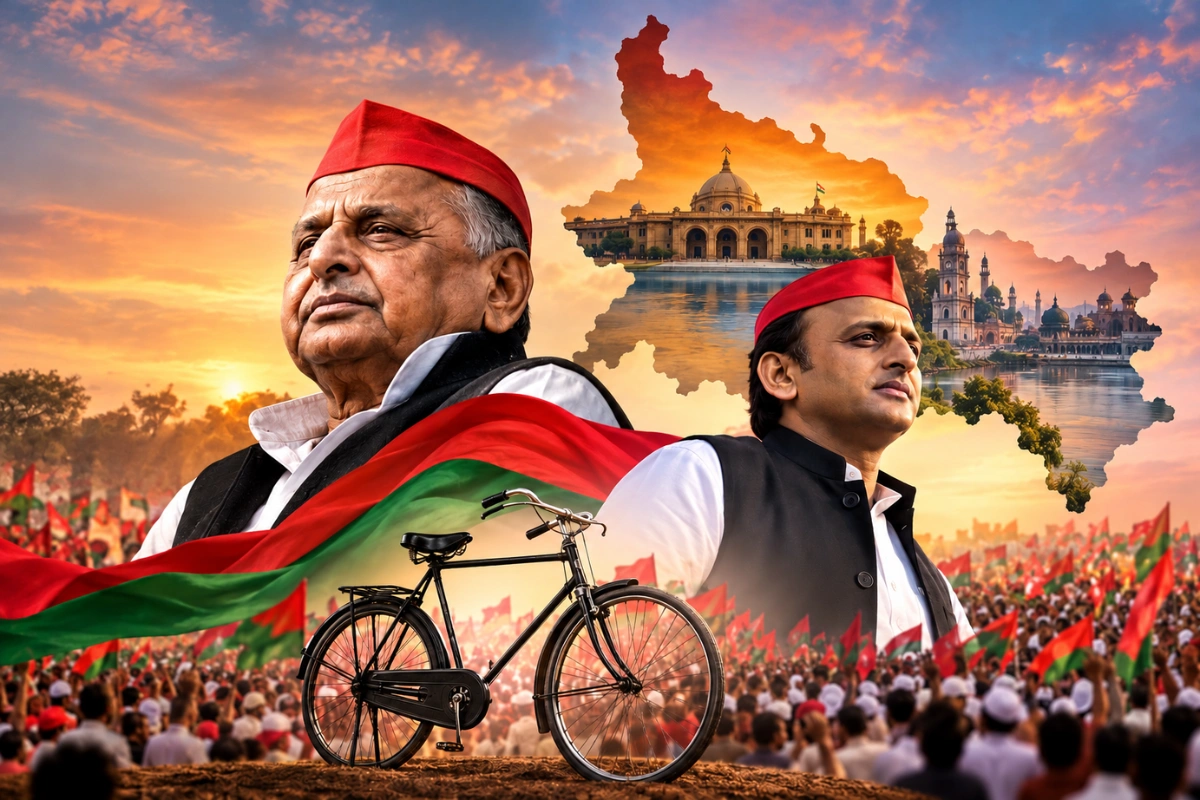
AI Generated Image
The story of Mulayam Singh Yadav to Akhilesh Yadav is not a simple handover from one Chief Minister to another. It is a long political transition in which ideology, caste arithmetic, religious mobilisation, leadership discipline, and changing voter expectations reshaped Uttar Pradesh politics over three decades. Calling it a ‘secret plan’ may be dramatic, but the deeper pattern is clear: the BJP learned how to convert a movement into a durable governing model.
What Does the Cycle of Power Mean in Mulayam Singh Yadav’s Story?
In this context, the cycle of power means the repeated movement of authority between mass support, party control, family succession, electoral strongholds, and welfare symbolism. Mulayam Singh Yadav was born on 22 November 1939 in the Etawah region of Uttar Pradesh, entered public life through socialist politics, first became a Uttar Pradesh MLA in 1967, and later served three terms as Chief Minister of Uttar Pradesh as well as Defence Minister of India.
The phrase works because his career did not move in a straight line. It moved like a wrestling bout: grip, retreat, counter, alliance, recovery, and transfer. Reports and profiles repeatedly link his early life as a wrestler and student leader with the style of politics he later practised: grounded, tactical, patient, and intensely aware of local loyalties.
The cycle has five defining characteristics:
- Rural origin as political capital: Saifai and the Etawah belt became more than a birthplace; they became a symbolic centre of power.
- Socialist vocabulary: Mulayam drew from Ram Manohar Lohia’s socialist tradition and presented his politics as a platform for farmers, backward classes, minorities, and neglected groups.
- A disciplined organisation: The Samajwadi Party, founded in 1992, gave his personal following a formal electoral vehicle.
- Family as succession structure: Akhilesh Yadav, Shivpal Singh Yadav, Dimple Yadav, and others became part of the broader Mulayam Singh Yadav family tree that shaped the party’s public image.
- Symbolic welfare and identity politics: Schemes, slogans, the bicycle symbol, and youth-facing programmes such as the laptop distribution drive under Akhilesh helped connect old rural socialism with a newer aspirational electorate.
The Wrestling Mat as Political Training Ground
Mulayam Singh’s wrestling background matters because it offers a metaphor for how he understood contest. In kushti, strength alone is rarely enough; timing, balance, endurance, and the ability to read an opponent decide the bout. Political observers used similar language when describing his long public career, noting that he carried lessons from the akhara into political manoeuvring.
This does not mean wrestling ’caused’ the Samajwadi Party in a literal sense. Rather, the wrestling mat helps explain the style of leadership that later became recognisable: physical stamina, local familiarity, direct contact with supporters, and a strong instinct for tactical alliances. In Uttar Pradesh’s competitive politics, those qualities mattered because elections were shaped not only by speeches but also by caste arithmetic, local networks, candidate selection, and the ability to survive reversals.
The bridge from akhara to Assembly came through mentorship and socialist mobilisation. Mulayam’s early association with leaders influenced by Ram Manohar Lohia gave him ideological language, while village wrestling and student politics gave him social credibility. That combination helped him appear both as an organiser and as a son of the soil, a reason supporters often called him ‘Netaji’.
How Did Mulayam Singh Yadav Build the Samajwadi Empire?
Mulayam Singh Yadav built the Samajwadi empire by converting personal popularity into a party structure, caste-community support into electoral strategy, and family loyalty into succession power. The Samajwadi Party says it was founded on 4 October 1992 by Mulayam Singh Yadav and describes its ideology as socialist, secular, democratic, and based on equality.
The timing was crucial. The early 1990s were a period of intense churn in Uttar Pradesh, with Mandal politics, Mandir politics, backwards-class assertion, and minority insecurity all reshaping voter behaviour. Mulayam positioned himself as a socialist defender of backward communities and minorities, while also holding on to the Yadav base that became central to the party’s electoral identity.
His ’empire’ was not just a set of offices. It included a party headquarters, a cadre network, a loyal vote base, recurring alliances, a family presence across constituencies, and strongholds such as Mainpuri. It also included a political memory: the image of a man who could lose power, wait, reorganise, and return.
Key building blocks included:
- Local credibility before statewide ambition: His early career began in Assembly politics, not Delhi-centred celebrity politics.
- Control over party narrative: By founding the Samajwadi Party, he gave his followers a distinct banner rather than remaining dependent on older socialist formations.
- Strategic flexibility: His career included alliances and breaks that showed a willingness to adapt to changing arithmetic.
- Cultivation of heirs and lieutenants: Family members and close associates became part of the wider system.
- Symbolic continuity: The bicycle, the Saifai connection, and the ‘Netaji’ identity kept the party rooted in memory even as leadership shifted.
The Samajwadi Party Turned Biography into Organisation
The Samajwadi Party is central to understanding Mulayam Singh because it translated his life story into a repeatable political structure. The party’s own history records Mulayam as founder and notes major milestones including his second and third Chief Minister terms, his 1996–1998 tenure as Defence Minister, and Akhilesh Yadav’s later rise as party president.
This mattered because charismatic leaders often fade when they cannot institutionalise their following. Mulayam’s achievement was to make his identity usable by candidates, workers, and successors. The party could campaign on his name, invoke his rural background, claim socialist continuity, and appeal to voters who saw him as a protector of specific social groups.
At the same time, the organisation carried built-in tensions. A party built around one patriarch must eventually decide how authority moves after him. That question became visible when Akhilesh Yadav emerged as the modern face of the party and eventually became party president in 2017, according to the Samajwadi Party’s own account.
Family Succession Became Both Strength and Strain
The Mulayam Singh Yadav family tree is important because Uttar Pradesh politics often treats family networks as both organisational assets and symbols of dynasty. Akhilesh Yadav, Mulayam’s son, became Chief Minister of Uttar Pradesh in 2012 and later the Samajwadi Party’s president. Dimple Yadav, Akhilesh’s wife, has also held parliamentary office, including from Mainpuri after the by-election that followed Mulayam’s death.
Shivpal Singh Yadav, Mulayam’s younger brother, has long been a major figure in the party’s organisational politics. Other relatives, including Ram Gopal Yadav and younger-generation family members, have also been associated with electoral politics, making the family a visible political network rather than a private background detail.
A simplified family-and-politics view looks like this:
- Mulayam Singh Yadav: Founder of the Samajwadi Party; three-time Chief Minister of Uttar Pradesh; Defence Minister of India.
- Akhilesh Yadav: Son of Mulayam; former Uttar Pradesh Chief Minister; Samajwadi Party president since 2017, according to the party.
- Dimple Yadav: Akhilesh Yadav’s wife; associated with Kannauj and Mainpuri parliamentary politics.
- Shivpal Singh Yadav: Mulayam’s brother; senior Uttar Pradesh politician and influential organisational figure.
- Ram Gopal Yadav: Senior family-linked leader associated with the party’s parliamentary and organisational presence.
- Aparna Yadav: Mulayam’s daughter-in-law through Prateek Yadav; she joined the BJP in January 2022, showing that the family’s political identities have not always moved in one direction.
The family network strengthened the party by giving it recognisable faces across regions and elections. But it also produced public factionalism, especially when generational change placed Akhilesh’s authority beside older organisational loyalties. That tension is part of the cycle: power is created by family unity, then tested by succession.
Welfare Symbols Modernised the Old Socialist Appeal
The phrase Mulayam Singh laptop usually refers not to a personal device but to the free laptop scheme associated with the Samajwadi Party government led by Akhilesh Yadav. In 2013, reports described the distribution of laptops to students as a major promise of the SP government, with Akhilesh arguing that the scheme was meant to give students equal opportunity and help those lacking resources.
The scheme is politically important because it updated the Samajwadi image. Mulayam’s older appeal came from rural assertion, socialist rhetoric, and backwards-class mobilisation. The laptop scheme spoke to a different aspiration: English, internet access, college education, employability, and the idea that a poor or rural student should not be excluded from technology.
It also carried visible political branding. Reports at the time noted that some distributed laptops displayed images associated with Akhilesh and Mulayam, making the programme not only a welfare intervention but also a memory device.
Practical examples of how welfare became political symbolism include:
- Education as aspiration: A laptop gave young voters a tangible object linked to a government promise.
- Rural-urban bridge: The scheme let the party speak to students outside elite urban spaces.
- Brand recall: Devices associated with the ruling party kept the leadership visible in daily life.
- Generational shift: Akhilesh could present himself as more modern while still standing under Mulayam’s legacy.
- Promise fulfilment narrative: Distribution events allowed the party to say it had delivered on a campaign commitment.
The scheme also attracted criticism and scrutiny, including questions about cost, delivery, and political branding. For definition purposes, the key point is that welfare under the Samajwadi model was not only about benefits; it was also about creating a lasting emotional and visual link between the voter and the party.
Medical Institutions and Place-Based Memory
Mulayam Singh Yadav Medical College is another example of how political memory becomes attached to institutions. A Government of India letter of permission from May 2018 referred to the establishment of Mulayam Singh Yadav Medical College & Hospital at Meerut for the 2018–2019 academic session with an annual intake of 150 MBBS students.
Later institutional material identifies the National Capital Region Institute of Medical Sciences, Meerut, as formerly known as Mulayam Singh Yadav Medical College and Hospital.
Why does this matter in the cycle of power? Because names preserve influence. Roads, colleges, hospitals, sports facilities, and development projects can keep a leader present in public memory after electoral office ends. In Mulayam’s case, institutions named after or associated with him sit inside a wider pattern of Saifai, Mainpuri, Etawah, and western Uttar Pradesh being used as landscapes of memory.
This is common in Indian politics, but the Mulayam case is distinctive because the personal story is so strongly geographic. The village, the akhara, the constituency, the family, and the party are all part of the same narrative map.
Why Was the 2019 Election Important?
Mulayam Singh Yadav’s 2019 election matters because it became his last Lok Sabha victory and a final demonstration of his hold over Mainpuri. In the 2019 general election, Mulayam Singh Yadav won the Mainpuri seat for the Samajwadi Party with 524,926 votes, defeating BJP candidate Prem Singh Shakya, who received 430,537 votes.
The result was significant beyond the numbers. By 2019, the BJP had become the dominant force in Uttar Pradesh, and the Samajwadi Party was operating in a much harder environment than during its earlier peaks. Mulayam’s victory showed that some legacy strongholds could still withstand a wider political wave.
Mainpuri later became even more symbolic after his death on 10 October 2022. Parliamentary records noted his passing as the sitting Lok Sabha member from Mainpuri, and Dimple Yadav was later declared elected from the constituency in the by-election.
That handover captures the cycle in miniature: Mulayam holds the seat, his death creates a vacancy, the family and party mobilise memory, and the constituency becomes a vessel for continuity.
The ‘Samajwadi Empire’ Is a Network, Not Just a Dynasty
Calling it an empire can sound dramatic, but the phrase points to a real structure of influence. It includes electoral bases, organisational posts, public welfare memories, caste-community coalitions, family networks, and the emotional authority of Netaji’s image. The Samajwadi Party’s own description of itself emphasises equality, secularism, democracy, and socialist principles, while external accounts place Mulayam within the broader history of Uttar Pradesh’s caste and community politics.
The empire is not only dynastic because it depends on voters, workers, local leaders, alliances, and opponents. But it is not merely ideological either, because family succession has clearly shaped its continuity. The best definition is therefore mixed: Mulayam’s power system was a party-led, family-centred, regionally rooted socialist formation.
What it includes:
- The Samajwadi Party as the formal institution.
- The Yadav and backwards-class base that helped anchor the party.
- Muslim support that became electorally important in several phases.
- The Mainpuri-Saifai-Etawah belt as symbolic geography.
- Akhilesh Yadav’s modernisation of the brand through youth and development language.
- Welfare memories such as the laptop scheme.
- Named institutions and public honours, including the posthumous Padma Vibhushan in public affairs in 2023.
What it does not include:
- It is not a formal empire in a constitutional sense.
- It is not only a family story, because millions of voters and party workers sustained it.
- It is not only a caste story, because ideology, minority politics, welfare promises, and anti-BJP positioning also mattered.
- It is not frozen in Mulayam’s lifetime, because Akhilesh’s leadership changed the party’s tone and strategy.
Common Misconceptions About Mulayam Singh Yadav’s Power
The first misconception is that Mulayam’s rise was sudden. In reality, his career stretched across decades, from his 1967 entry into the Uttar Pradesh Assembly to multiple terms as Chief Minister and a national role as Defence Minister.
The second misconception is that the Samajwadi Party was only a personal vehicle. It certainly carried Mulayam’s imprint, but it also emerged from a wider socialist tradition and from the political churn of post-Mandal North India. The party’s official account presents its foundation in 1992 as rooted in socialist principles and equality.
The third misconception is that Akhilesh’s rise erased Mulayam’s relevance. Instead, Akhilesh inherited both an asset and a burden: the emotional force of Netaji’s legacy, and the challenge of making it work for younger voters. That is why references to Mulayam Singh Yadav, Mulayam Singh, the laptop scheme, the medical college, the family tree, and the 2019 Mainpuri election continue to appear together in public searches.
The Lasting Definition of Mulayam’s Cycle of Power
Mulayam Singh Yadav’s cycle of power is best defined as the conversion of rural strength into socialist politics, socialist politics into party machinery, party machinery into family succession, and family succession into continuing electoral memory. The wrestling mat did not create the Samajwadi Party by itself, but it shaped the image of a leader who understood grip, timing, endurance, and comeback.
His legacy remains contested, admired, criticised, and constantly reinterpreted. Yet the structure he built is unmistakable: Saifai gave the story its soil, the akhara gave it its metaphor, the Samajwadi Party gave it its vehicle, Mainpuri gave it its fortress, and the family gave it continuity after him.
Also Read: Why The Road To Delhi Always Runs Through Lucknow: The BJP’s UP Formula
To read more such news, download Bharat Express news apps