



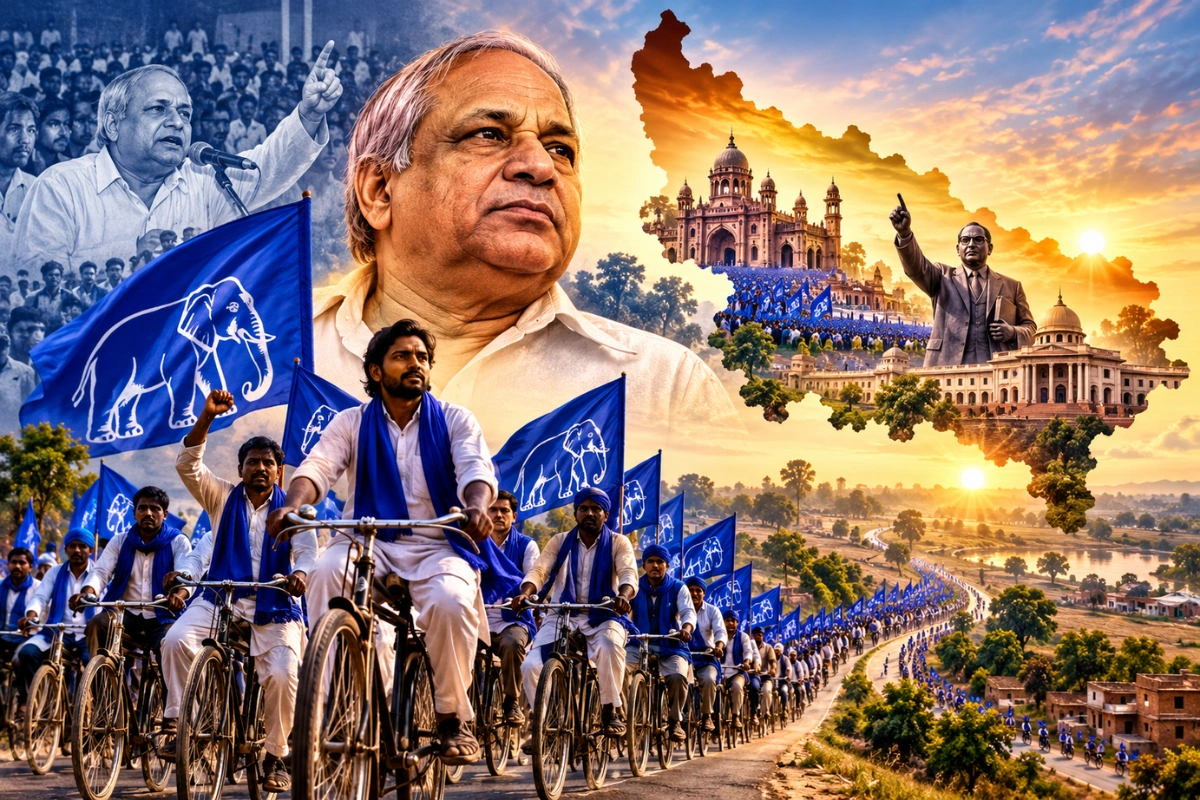
AI Generated Image
Kanshi Ram’s bicycle-led mobilisation is back in political conversation as Uttar Pradesh parties prepare for the 2027 Assembly election and compete to claim the legacy of the Bahujan Samaj Party founder. What began as a low-cost public-contact campaign became a defining force in Dalit-Bahujan politics, challenging entrenched caste and party hierarchies across India’s most electorally consequential state. The renewed focus shows why the Kanshi Ram movement still carries strategic weight decades after its most visible road campaigns.
Why Does the Bicycle Movement Still Matter in UP Politics?
The Kanshi Ram bicycle movement matters because it turned political access into something portable, visible, and difficult for established parties to ignore. In a state where money, caste networks, and party machinery often decided who could reach voters, the bicycle became both transport and message: ordinary people could move, organise, and assert a claim to power without waiting for elite permission. That is why the ‘bicycle revolution’ is remembered not merely as campaign theatre, but as a practical method of building a new political community from below.
The timing of the renewed attention is significant. In March 2026, reports from Uttar Pradesh described major parties invoking Kanshi Ram ahead of the 2027 Assembly polls, with the BSP, Samajwadi Party, Congress, BJP, and emerging Dalit formations all seeking proximity to his symbolic capital. The contest is not only about memory; it is about who can speak credibly to Dalit, backward-caste, minority, and other marginalised voters in a state where social coalitions decide power.
From Cadre Work to Road Politics
Kanshi Ram’s rise did not begin with a single election. It grew through layered organisation: employee networks, social mobilisation, ideological training, and then electoral consolidation. He worked through formations associated with Bahujan assertion, including BAMCEF, the Dalit Shoshit Samaj Sangharsh Samiti, and later the Bahujan Samaj Party, founded in 1984.
The bicycle entered this story as a tool that matched the movement’s social base. It was cheap, familiar, and available in villages and small towns where a fleet of cars would have signalled distance rather than solidarity. Academic accounts note that Kanshi Ram led a 40-day cycle yatra in 1983, covering about 3,000 kilometres across seven north Indian states and presenting the bicycle as a vehicle for people shut out of elite political transport.
That decision gave the campaign a grammar voters could read instantly. The cyclist was not arriving from above; he was moving through the same roads as agricultural workers, clerks, students, artisans, and small traders. The message was organisational as much as ideological: if supporters could pedal from village to village, they could also distribute pamphlets, hold street-corner meetings, identify local grievances, and build booth-level networks.
The Method That Unsettled the Old Order
The Kanshi Ram movement challenged UP’s power elite because it treated political dignity as a daily discipline rather than a slogan reserved for rallies. The road campaign helped convert dispersed anger into repeated contact. Every stop became a small political classroom where caste hierarchy, representation, voting power, and self-respect could be discussed in language that did not depend on television studios or elite newspapers.
For the established order, this was disruptive. Traditional parties had long relied on patronage chains, local notables, and caste intermediaries. Kanshi Ram’s approach aimed to produce voters who did not simply receive instructions from above but understood themselves as a numerical and moral force. His framing of ‘Bahujan’ politics sought to gather Scheduled Castes, Scheduled Tribes, Other Backward Classes, minorities, and other oppressed communities under a shared political identity.
The bicycle made that claim visible. A procession of cycles through a market or village road showed organisation before a ballot was cast. It made the movement appear disciplined, frugal, and close to the ground. In a political culture where spectacle often meant money, the bicycle offered a counter-spectacle: endurance.
Key Points From the Bicycle Revolution
- Low-Cost Reach: The campaign reduced dependence on expensive vehicles and helped organisers reach places where formal party infrastructure was thin.
- Symbolic Equality: The bicycle positioned activists alongside ordinary voters rather than above them, reinforcing the movement’s anti-elite message.
- Cadre Discipline: Long journeys required planning, local hosts, route coordination, and repeat messaging, which strengthened organisational habits.
- Narrative Control: The movement could carry its own slogans, meetings, and explanations directly to voters instead of relying only on mainstream media coverage.
- Electoral Preparation: Public-contact networks built through such mobilisation later helped the BSP convert social assertion into legislative presence.
These points explain why the phrase ‘bicycle revolution’ still works as shorthand. It describes more than transport. It captures a model of political work in which movement, message, and mass contact reinforced one another.
Electoral Consequences in Uttar Pradesh
The impact became clearer as the BSP moved from mobilisation to electoral bargaining power. Accounts of the party’s early electoral rise note that it began contesting elections in the mid-1980s, struggled initially, and then broke through in Uttar Pradesh. In 1989, the BSP contested hundreds of Assembly seats in the state, won 13, and secured nearly a tenth of the vote; by 1993, it won 67 seats and became central to coalition politics.
Those numbers mattered because they showed that the campaign had not merely created noise. It had built a vote that could not be dismissed as symbolic protest. The old power elite had to negotiate with a party rooted in communities that had often been treated as vote banks rather than decision-makers.
The rise also opened the path for Mayawati, Kanshi Ram’s protégé, to become Chief Minister of Uttar Pradesh in 1995. Her ascent marked a major turning point in north Indian politics: a Dalit woman leading India’s largest state by population was no longer an unimaginable outcome but a fact of power politics.
Why Parties Are Revisiting Kanshi Ram Now
The current fight over Kanshi Ram’s legacy is rooted in changing social arithmetic. Uttar Pradesh’s Dalit voters remain central to statewide competition, and the weakening of the BSP’s recent electoral position has encouraged rivals to court communities once seen as part of its core base. Reports in 2026 described parties marking or invoking Kanshi Ram’s birth anniversary as part of their positioning ahead of the 2027 Assembly election.
The Samajwadi Party has linked its outreach to its PDA formulation, a shorthand for backward classes, Dalits, and minorities. The BJP has also sought to invoke Dalit icons, including Kanshi Ram, as part of a broader attempt to deepen its connection with Scheduled Caste communities. Congress and other formations have similarly tried to place themselves within the social-justice conversation.
For the BSP, this creates both challenge and opportunity. The challenge is that Kanshi Ram’s name is no longer invoked only within the party he founded. The opportunity is that renewed discussion of his legacy can remind voters of the original architecture of the BSP: organisation first, self-respect as politics, and power as the measure of representation.
A Movement Remembered for Method, Not Nostalgia
Reducing the Kanshi Ram bicycle movement to nostalgia misses its sharper lesson. The campaign worked because it connected ideology with logistics. It did not assume that marginalised voters would automatically unite; it invested in repeated explanation, local networks, and visible presence.
That remains relevant in an era of digital campaigning. Social media can amplify a message quickly, but it cannot replace trust built through face-to-face contact. Kanshi Ram’s model showed that political transformation requires a route map, not just a manifesto. The bicycle was the technology of its time, but the underlying strategy was durable: go where people are, speak in their idiom, and make participation feel possible.
The movement also changed how opponents read the electorate. Communities once approached through symbolic gestures increasingly demanded tickets, leadership roles, administrative respect, and a share in state power. Kanshi Ram’s language of political ‘hissedari’, or share, continues to shape discussions of representation across parties and social blocs.
What Comes Next in the Battle for the Blue Legacy
As Uttar Pradesh moves towards the 2027 Assembly election, Kanshi Ram’s legacy is likely to remain a contested political resource. Parties may organise commemorations, rename outreach drives, and quote his vocabulary, but voters will judge whether those gestures translate into credible representation. Candidate selection, grassroots engagement, and the ability to address everyday caste and economic insecurity will test the difference between tribute and inheritance.
The bicycle revolution still carries an uncomfortable lesson for power elites: politics can rebuild itself from the road upwards. Kanshi Ram’s campaigns showed that a disciplined movement could turn neglected citizens into negotiators of power. That is why the blue surge continues to unsettle UP politics long after the cycles first rolled through its towns and villages.
Also Read: The Family, The Fortress And The Future: Can Akhilesh Yadav Reclaim Awadh?
To read more such news, download Bharat Express news apps