



AI Generated Image
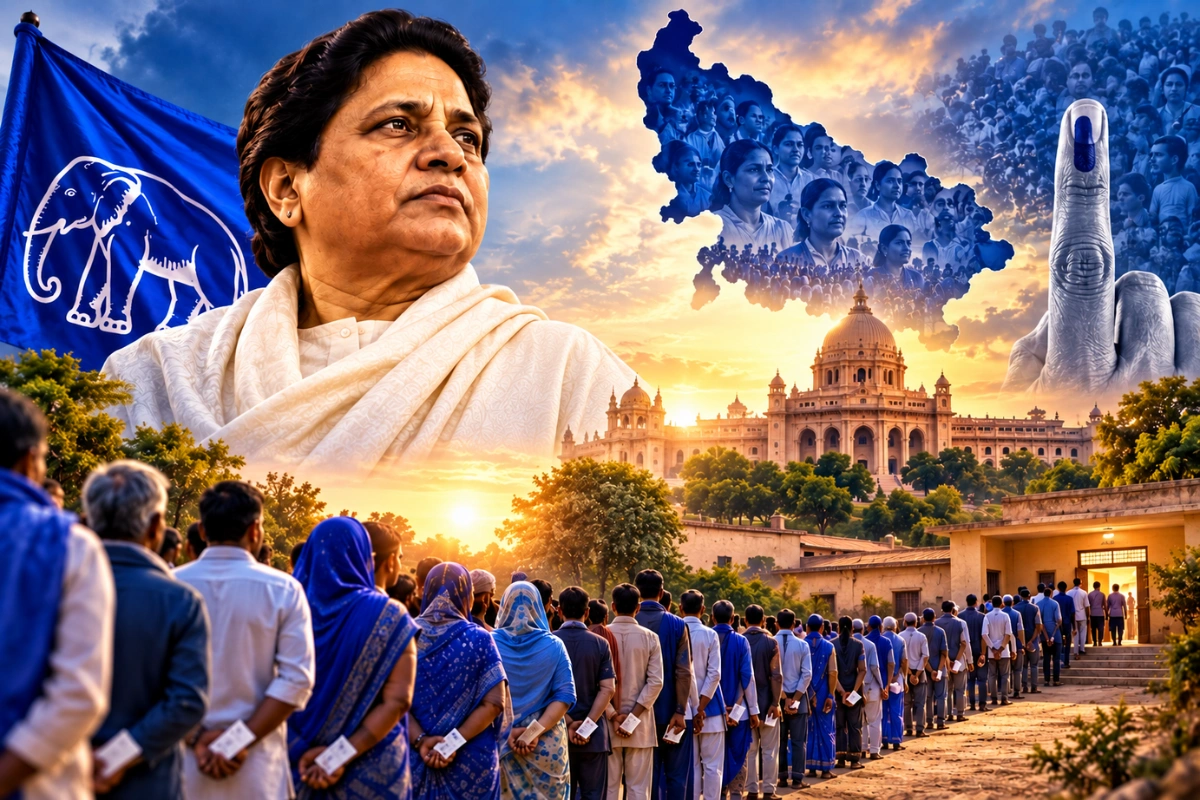
The Bahujan Samaj Party’s quiet voter base is one of the most discussed yet often misunderstood forces in North Indian politics. The phrase ‘silent voters’ does not mean a hidden army that appears by magic on counting day; it refers to voters whose preferences are shaped by identity, memory, local candidate choices, dignity, and strategic silence rather than loud campaign visibility. Understanding BSP silent voters helps explain why the BSP can look weak in headlines yet still influence margins, alliances, and the emotional map of elections.
Who Are BSP Silent Voters?
BSP silent voters are voters who may not dominate rallies, television debates, WhatsApp chatter, or public political arguments, but who still retain some degree of emotional, ideological, or tactical attachment to the BSP. They are often discussed in relation to Dalit politics in Uttar Pradesh, especially the party’s historic Jatav support base, but the idea is broader than one community. It includes voters who see the BSP as a vehicle of representation, a bargaining tool, a protest option, or a familiar political home even when they are unsure whether it can win.
The word ‘silent’ matters. Some voters stay quiet because politics in their area is socially sensitive. Some do not want to reveal their choice in a village, workplace, caste network, or family environment where another party appears dominant. Others are not silent out of fear but out of habit: they do not perform politics loudly, yet they vote consistently.
That is why the BSP vote cannot be read only through rally size, social media excitement, or the number of television panels discussing Mayawati. The party’s political presence has often lived in booth-level networks, community respect, and memory of power rather than constant spectacle.
The Elephant Is Not Just a Symbol; It Is Political Memory
The BSP’s elephant symbol carries more than party branding. For many supporters, it represents a period when Dalit assertion moved from the margins of public life into the centre of power. The BSP’s ideological language has long been associated with ‘social transformation and economic emancipation’ of the Bahujan Samaj, including Scheduled Castes, Scheduled Tribes, Other Backward Classes, and minorities.
That memory matters even when vote share falls. Parties built on social dignity do not disappear from voter psychology the moment they lose seats. A voter may shift tactically in one election, return in another, or use the BSP candidate to signal dissatisfaction with both major fronts. This is why ‘decline’ and ‘irrelevance’ are not the same thing.
The BSP’s challenge is that memory alone cannot convert into seats. In a first-past-the-post system, votes must be concentrated, alliances must make arithmetic sense, and candidates must remain locally competitive. A dispersed loyal vote can preserve identity but still fail to produce representation.
Why Are BSP Voters So Hard to Read?
BSP voters are hard to read because their choices often sit at the intersection of caste identity, local respect, tactical calculation, and distrust of public political performance. Unlike voters who announce preferences through flags, online posts, or visible campaign participation, some BSP-leaning voters reveal their decision only at the polling booth.
Several factors make the BSP vote particularly difficult to measure:
- Low-Noise Voting Behaviour: Some supporters are not rally-driven. Their politics may be private, disciplined, and local.
- Candidate-Specific Shifts: A BSP candidate’s caste, reputation, accessibility, and local alliances can matter more than broad national messaging.
- Strategic Voting Pressure: In elections framed as a direct fight between two larger blocs, some BSP sympathisers may vote tactically against the party they most oppose.
- Social Pressure: In areas where one party dominates public conversation, voters may avoid openly expressing a different preference.
- Fragmented Bahujan Politics: Dalit, OBC, minority, and sub-caste interests do not always move together, even when parties speak in broad social justice language.
This is where the myth of ‘electoral magic’ begins. Commentators sometimes expect the BSP’s vote to appear suddenly, almost mysteriously. In reality, there is no magic. There are only networks, memories, grievances, identities, and local calculations that are not always visible from a distance.
Recent Numbers Show Influence Without Victory
The BSP’s recent electoral data tells a complicated story. In the 2024 Lok Sabha election, the party contested widely across India but won no seats, while its national vote share stood a little above two per cent; in Uttar Pradesh, it contested 79 seats, won none, and recorded 9.39 per cent vote share.
Those numbers show weakness, but not absence. A party with nearly ten per cent vote share in a state like Uttar Pradesh can still affect outcomes, especially in closely fought seats. The difference between winning and losing may be smaller than the votes secured by a third candidate.
This is why analysts continue to track the BSP even when it is not winning. A party can be electorally diminished and still strategically important. Its vote can decide whether a contest becomes triangular, whether an alliance gains momentum, or whether a dominant party survives a narrow margin.
Are BSP Silent Voters Still Electorally Magical?
They are not magical, but they can still be decisive when their votes are concentrated, when contests are close, or when the BSP candidate draws from a social bloc that another party needs. The danger is treating these voters as a fixed deposit that automatically belongs to the BSP forever. The wiser approach is to see them as a layered electorate: loyal at the core, movable at the edges, and deeply responsive to local context.
In 2024, reports noted that the BSP’s vote count exceeded the winning margin in 16 Uttar Pradesh seats, even though the party itself did not win any seat in the state. That does not mean every BSP vote would have shifted neatly to another party if the BSP had not contested. Voters are not mathematical objects. Some would have stayed home, some might have chosen different parties, and some may have voted BSP precisely because it was a separate option.
Still, the margin effect is important. It shows how BSP silent voters can shape the result without appearing on the winner’s podium. Their political power may show up indirectly, through the defeat or survival of another candidate.
The Mechanics of Hidden Influence
To understand the BSP’s electoral role, look at how votes behave in real constituencies rather than only at state-level headlines. Elections are built from thousands of small social decisions. A local leader’s credibility, a candidate’s caste location, a history of conflict, or anger over representation can move voters in ways that broad opinion polls miss.
BSP influence often works through five mechanisms:
-
Vote Retention in Loyal Pockets
Even during a weak election, the party may retain voters who see switching as a loss of political identity. These voters may not expect a BSP victory, but they vote to preserve representation.
-
Vote Cutting in Triangular Contests
When two larger parties are fighting closely, the BSP candidate can pull enough votes to alter the final margin. This effect is not automatically negative or positive; it depends on which social groups the candidate attracts.
-
Symbolic Protest Voting
Some voters use the BSP to reject both major fronts. This is especially relevant when they feel ignored, humiliated, or taken for granted.
-
Candidate-Led Mobilisation
A respected local candidate can outperform the party’s broader mood. In such cases, voters are not simply choosing the elephant symbol; they are choosing a familiar person through that symbol.
-
Alliance Arithmetic
When the BSP allies with another party, its vote transfer becomes the central question. When it contests alone, its ability to hold or split votes becomes equally important.
These mechanics are why BSP silent voters remain a serious subject for campaign strategists. They may not decide every election, but ignoring them can lead to bad readings of close contests.
The BSP’s Core Challenge Is Conversion
The BSP’s problem is not merely that some voters have left. Its deeper problem is converting sympathy into winnable coalitions. A party can have recognition, respect, and residual loyalty yet still fail if voters believe it cannot cross the finish line.
This creates a difficult cycle. If voters think the BSP cannot win, some may vote tactically for another party. As more voters do that, the BSP’s win probability falls further. Then the next election begins with an even stronger perception problem.
Breaking that cycle requires more than nostalgia. It requires visible local leadership, credible candidates, renewed booth networks, and a message that speaks to younger voters who may respect Mayawati’s legacy but want proof of future relevance. The party also has to address the tension between independent identity and alliance politics. Going alone preserves distinctiveness, but it can also isolate the vote. Alliances can improve seat prospects, but they may dilute the party’s separate appeal.
Pollsters and Pundits Often Miss the Quiet Vote
Political commentary rewards visible energy. Large rallies, viral speeches, aggressive social media campaigns, and dramatic slogans are easy to measure. Silent loyalty is harder. A voter who quietly waits in line and presses a button does not produce content before polling day.
This is why BSP voters can be underread in public discussion. But they can also be overimagined. Not every quiet voter is a BSP voter, and not every former supporter remains loyal. The analytical mistake goes both ways: some people dismiss the BSP because it lacks noise, while others exaggerate its hidden strength because they remember its peak.
A better method is to ask grounded questions:
- Is the BSP candidate socially relevant in this constituency?
- Does the party still have functioning booth-level workers?
- Are Dalit voters consolidating behind the BSP, splitting, or voting tactically?
- Are minority voters treating the BSP as viable or as a risk?
- Is the contest triangular, bipolar, or fragmented among many smaller players?
- Are young voters emotionally connected to BSP history, or are they searching for new platforms?
These questions produce a more realistic picture than simply asking whether the ‘silent vote’ exists.
What Should Observers Watch in the Next Election Cycle?
Observers should watch whether BSP support is merely present or actually organised enough to win. Vote share alone can be misleading. The key is whether that vote is geographically concentrated, socially transferable, and backed by campaign machinery.
A practical checklist for reading BSP performance includes:
- Candidate Selection: Does the candidate match local caste arithmetic and public mood?
- Booth Activity: Are workers visible beyond nomination day and rallies?
- Youth Engagement: Is the party speaking to first-time and younger voters in their language?
- Dalit Consolidation: Are core voters staying, splitting, or drifting towards tactical alternatives?
- Non-Dalit Outreach: Is the BSP rebuilding broader Bahujan and Sarvajan appeal, or relying only on memory?
- Alliance Posture: Is the party contesting alone as a statement, or as a viable strategy?
- Margin Relevance: In close seats, are BSP votes larger than the victory margin?
This checklist matters because the BSP’s future will not be decided by one grand slogan. It will be decided constituency by constituency, through whether silent sympathy can become organised voting power.
The Real Lesson Behind the ‘Electoral Magic’
The story of BSP silent voters is ultimately a story about visibility. Indian elections are not decided only by those who shout the loudest. They are also shaped by voters who carry historical memory, caste experience, local loyalties, and private calculations into the booth.
The BSP’s elephant in the room is both its strength and its burden. It still has a recognisable social base and symbolic power, but symbolism must be renewed through organisation, leadership, and winnable strategy. Silent voters can influence elections, but they cannot replace political momentum forever.
So the next time the BSP is declared finished or secretly unstoppable, pause. The truth is more interesting. The party may not possess electoral magic, but its quiet voters still hold enough weight to disturb easy predictions, reshape close races, and remind Indian politics that silence is not the same as absence.
Also Read: Iron Lady Of Uttar Pradesh: The Untold Story Of Mayawati’s Rise To The Lucknow Throne
To read more such news, download Bharat Express news apps