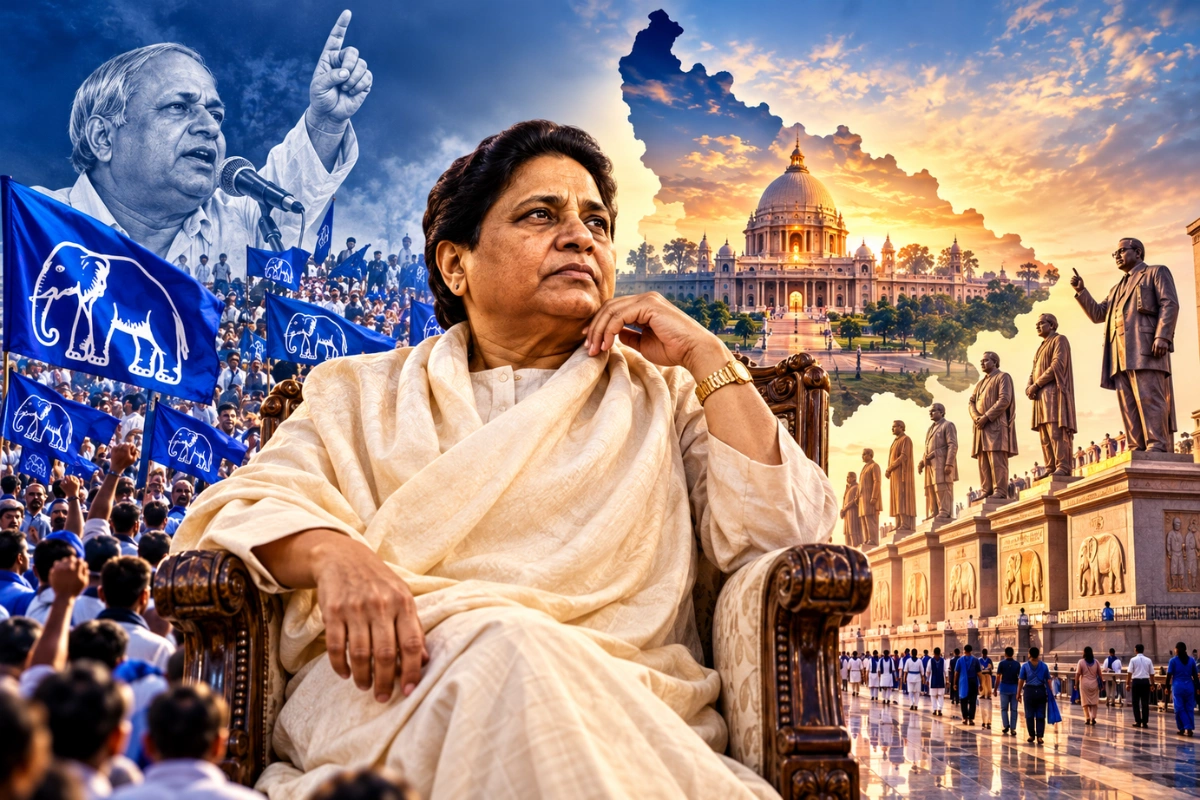
AI Generated Image
A Mayawati biography is more than the story of one politician; it is a window into caste, power, representation, and ambition in modern Uttar Pradesh. Mayawati’s journey from a Delhi-based student and teacher to a four-time Chief Minister of India’s most politically consequential state remains one of the most striking rises in Indian democracy. This article traces that rise, explains the appeal of ‘Behenji’, and looks at the Mayawati achievements and debates that still shape her legacy.
Why Does Mayawati’s Rise Still Matter?
Mayawati’s rise matters because she changed who could imagine holding power in Lucknow. As a Dalit woman leading the Bahujan Samaj Party, she did not merely enter a male-dominated political arena; she forced that arena to negotiate with a social base long treated as peripheral. Official records identify her as a former Chief Minister of Uttar Pradesh and list four separate Chief Ministerial terms, including a full term from May 2007 to March 2012.
Her story also matters because it unsettles easy categories. To supporters, she represents dignity, assertion, administrative control, and Dalit self-respect. To critics, she represents centralised power, expensive symbolism, and a style of politics that could be both disciplined and distant. A serious Mayawati biography has to hold both truths at once.
From Delhi Roots to Public Life
Mayawati was born on January 15, 1956, in New Delhi. Her official Uttar Pradesh Legislative Assembly profile lists her father as Prabhudas, her mother as Ramrti, and her academic qualifications as BA and B Ed; it also describes her profession as a political and social activist and advocate.
Before becoming a national political figure, she was known as an educated young woman from a modest background who entered public life at a time when Dalit politics was searching for a sharper electoral form in North India. The turning point came through Kanshi Ram, the founder of the Bahujan Samaj Party, whose movement aimed to convert social numbers into political authority. Mayawati became his most visible political heir.
This is the part of the story that many readers look for when searching ‘mayawati biography hindi’ or ‘mayawati biography in hindi’. The emotional core is simple: a woman from a community pushed to the margins became the face of a party that told the marginalised they could rule, not just request representation.
The Making of ‘Behenji’
The name ‘Behenji’ was not a soft nickname in Mayawati’s politics. It became a political identity: stern, direct, protective, and commanding. It suggested kinship with supporters while also creating a controlled distance from rivals, journalists, and even allies.
Ajoy Bose’s Behenji: A Political Biography of Mayawati remains one of the best-known books on this subject. Penguin describes the book as an account of Mayawati’s journey over four decades, from her early role as Kanshi Ram’s disciple to becoming Chief Minister of Uttar Pradesh and later facing political decline.
That arc explains why the phrase ‘mayawati biography book’ continues to draw readers. People are not only searching for dates and offices; they are trying to understand how discipline, symbolism, caste mobilisation, and political timing combined to produce a leader unlike most others in Indian politics.
How Did Mayawati Reach the Lucknow Throne?
Mayawati reached the Lucknow throne by turning Bahujan politics into an electoral machine and then adapting it to Uttar Pradesh’s complex caste arithmetic. Her early Chief Ministerial terms were short, shaped by coalition arrangements and the instability of the 1990s. The official Chief Ministerial list records her terms beginning in June 1995, March 1997, May 2002, and May 2007.
The 1995 moment was historic because it marked the arrival of BSP power at the top of Uttar Pradesh’s government. It was also turbulent, showing how difficult it was for a new social coalition to survive in an environment dominated by older parties and competing caste blocs.
Her 2007 victory was different. The BSP did not rely only on a narrow base; it reached beyond its core Dalit support and built a broader ‘Sarvajan’ appeal, including outreach to Brahmins and other communities. Contemporary reporting described the 2007 result as a decisive BSP majority that ended a long phase of fractured mandates in the state.
A simplified timeline helps explain the climb:
- 1989: First elected to the Lok Sabha, marking her arrival in national parliamentary politics.
- 1995: Became Chief Minister of Uttar Pradesh for the first time.
- 1997 and 2002: Returned to the Chief Minister’s office through later political arrangements.
- 2007: Led the BSP into its strongest phase of power in Uttar Pradesh.
- 2007–2012: Served her longest and most stable term as Chief Minister.
Mayawati Achievements and the Debates Around Them
Any discussion of Mayawati’s achievements depends on what one values most in politics. If representation is the measure, her rise was extraordinary: a Dalit woman not only led a major state but became one of the most recognisable national leaders of her generation. If organisation is the measure, she helped turn the BSP into a disciplined party with a strong command structure.
Supporters usually point to three broad achievements:
- Political Representation: She made Dalit leadership visible at the highest level of state power.
- Administrative Image: Her governments are often remembered by supporters for strict control and a reputation for order.
- Social Symbolism: Memorials, statues, and public architecture placed Dalit icons and Bahujan identity in spaces of state power.
- Coalition Innovation: Her 2007 ‘Sarvajan’ strategy showed that a party rooted in Bahujan assertion could also seek wider caste alliances.
The same record is also contested. Critics questioned the cost and priorities of memorial construction, and later legal and political debates around statues and public spending kept the issue alive. The Indian Express has described the ‘memorials scam’ debate as involving allegations of financial irregularities in Dalit memorials and statues built during her 2007–2012 government; it also reported that the Supreme Court later dismissed a PIL connected to these allegations.
That tension is central to understanding Mayawati. For many supporters, the memorials were not vanity projects but monuments to dignity in a society where Dalit icons had long been ignored. For critics, they symbolised misplaced priorities. The legacy sits in that unresolved argument.
Mayawati Quotes, Slogans, and Political Language
Searches for Mayawati quotes often lead to short lines, slogans, and rally phrases. The most important idea associated with her later politics is ‘Sarvajan Hitay, Sarvajan Sukhay’, usually understood as welfare and happiness for all. Media reports have repeatedly connected this phrase with the BSP’s attempt to present itself as a party for all communities, not only one section.
Her language has often been direct rather than ornamental. She built authority through repetition, discipline, and message control: Bahujan dignity, social justice, law and order, and suspicion of rival parties. That is why authentic Mayawati quotes should come from speeches, press statements, or reliable reports rather than unsourced quote pages.
Reading Mayawati Beyond Admiration or Criticism
The most useful way to read Mayawati is not as a simple hero or villain. Her career is a study in power: how it is denied, how it is captured, how it is displayed, and how it is judged differently depending on who holds it.
For students, journalists, and general readers, a balanced Mayawati biography should ask practical questions:
- What social conditions made the BSP’s rise possible?
- How did Kanshi Ram’s movement shape Mayawati’s leadership style?
- Why did the 2007 social coalition succeed when earlier arrangements were unstable?
- How should symbolic representation be weighed against welfare priorities?
- Why did a leader once discussed nationally later face electoral decline?
These questions keep her story alive because they are not only about the past. They are about the future of caste politics, women’s leadership, regional parties, and social justice in India.
The Larger Takeaway
Mayawati’s rise to the Lucknow throne remains one of the defining political stories of Uttar Pradesh. She transformed the meaning of representation for millions, built a formidable party identity, and proved that power could move upwards from communities long pushed downwards.
Her legacy is still debated, and it should be. The strongest biographies do not flatten her into praise or criticism; they show how Behenji became a symbol of aspiration, authority, controversy, and political possibility all at once.
Also Read: The Blue Surge: How Kanshi Ram’s Bicycle Movement Shook UP’s Power Elite
To read more such news, download Bharat Express news apps