



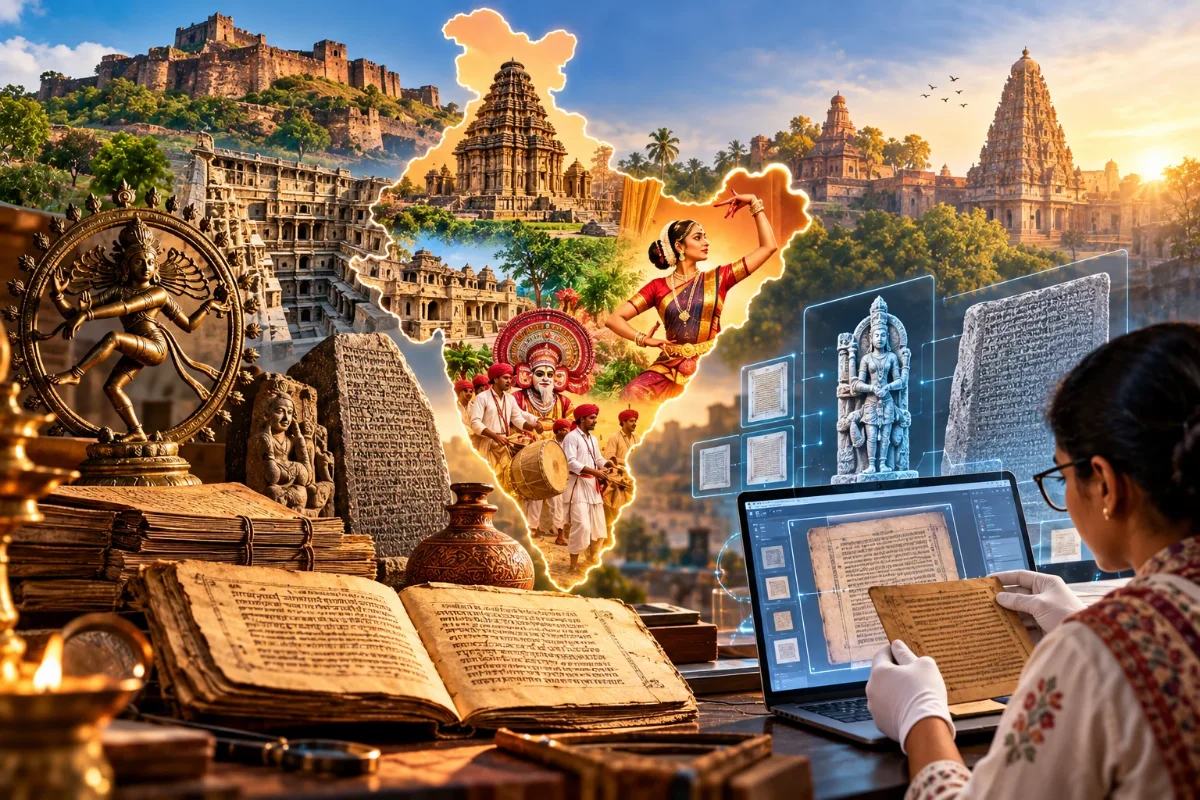
AI Generated Image
Unbroken Continuity: Reclaiming Bharat’s Civilisational Heritage in the Age of Digital Memory
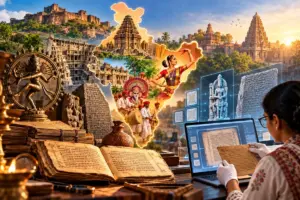
India’s efforts to preserve its civilisational heritage are moving beyond digital photography towards searchable manuscripts, online inscription collections and new forms of public access. An August 2026 parliamentary report called for stronger standards and wider scholarly participation in this transition. A separate UNESCO discussion held on 15 October reinforced a related concern: technology must support the people who sustain cultural traditions, not replace them. Together, these developments bring a practical question into focus: how can inherited knowledge be made accessible without stripping away its evidence, context or living custodians?
What Is Changing in India’s Approach to Digital Heritage?
India is developing a connected approach to cultural preservation that combines locating collections, conserving original materials, creating digital records and helping people discover their contents. The Ministry of Culture’s Gyan Bharatam Mission addresses manuscripts, while the Archaeological Survey of India’s BharatSHRI initiative focuses on inscriptions. Other platforms bring together museum collections, archival documents and interpretive material. These programmes serve different purposes, but collectively broaden access beyond the physical institutions holding the objects.
The distinction matters because preserving an image is not the same as preserving usable knowledge. A photographed manuscript may remain unreadable to someone unfamiliar with its script. An inscription may be visible online but difficult to interpret without a transcription, location record or explanation. Gyan Bharatam’s stated objectives include transcription and provenance tools, while BharatSHRI envisages access to digitised impressions, transcripts and metadata.
The practical implication is a change in what a successful heritage project should deliver. Instead of treating an upload as the endpoint, institutions need to consider whether users can identify the material, understand its limitations and trace an interpretation back to its source. A clear catalogue entry can be as important as an impressive interface.
This does not mean every collection must become part of a single database or adopt the same presentation style. The stronger objective is compatibility: a reader following a person, place, text or tradition should be able to move between related records without losing the identity of the original source. Digital memory becomes useful when connections remain verifiable rather than merely convenient.
A National Survey Brings Dispersed Manuscripts into View
The Ministry of Culture launched the Gyan Bharatam National Manuscript Survey on 16 March 2026 to identify and document manuscripts across India. Its stated purpose is to establish a geographically tagged inventory of repositories, including collections outside major public institutions. The Ministry identifies private homes, temples, monasteries, libraries and other institutions as locations where manuscript knowledge remains dispersed and, in many cases, undocumented.
The survey’s initial stage focuses on identifying manuscripts and their locations through submissions to a digital platform. This creates a foundation for subsequent preservation, research and digitisation rather than implying that every reported item has already been conserved or placed online. For smaller custodians, identification is therefore an entry point into a larger process, not evidence that all subsequent work has been completed.
The parliamentary committee’s report, presented on 12 August 2026, recorded 2.25 crore manuscript entries from the March–June survey, of which 1.16 crore had been verified and entered into the national database. It also reported that approximately eight lakh manuscripts had been digitised. These figures describe different stages of work and should not be treated as interchangeable measures of public access.
That distinction is essential to responsible reporting. A reported holding, a verified catalogue record, a photographed manuscript and a fully transcribed text represent separate achievements. Combining them into a single headline figure would obscure the work that remains to be done.
For readers interested in Bharat’s history, the survey’s importance lies partly in broadening the scope of what becomes visible. Collections need not be famous to deserve documentation. A small, carefully described holding can become a valuable research lead, while a large but poorly identified collection may remain difficult to use. The next challenge is turning geographical coverage into dependable, item-level knowledge.
From Scanned Pages to Readable Knowledge
A Ministry of Culture working-group report describes digital preservation as an organisational and technological responsibility, not simply an imaging exercise. It notes that manuscript materials, surface condition, binding, equipment and illumination affect the quality of the resulting digital record. Resolution and colour representation also influence readability and subsequent processing. These are practical constraints, not cosmetic details.
The same report treats long-term accessibility, transcription and the integrity of files and metadata as complementary concerns. A useful digital surrogate must preserve enough information for future readers and tools, while its accompanying documentation must explain what was captured. Improving an image for reading should not erase the distinction between the original capture and a processed version.
For a researcher, that separation makes scrutiny possible. If an uncertain letter has been interpreted in a transcription, the underlying image should remain available for comparison wherever access conditions permit. If a page is missing or damaged, the record should say so rather than allowing a seamless interface to imply completeness.
The National Mission for Manuscripts maintains resources covering digitisation guidelines, conservation standards, repository management and emergency preparedness. Their existence underscores how much professional work surrounds the apparently simple act of placing a page online. Training and handling procedures belong alongside cameras and software in any serious preservation programme.
The central editorial test is straightforward: can a reader distinguish what the object shows from what an editor or machine has inferred? A reliable platform should make that distinction easier. Users should not have to guess whether they are reading a direct transcription, a translation, a summary or a reconstructed passage.
Gyan Bharatam Links Conservation with Institutional Capacity
Gyan Bharatam was announced in the Union Budget on 1 February 2025. In a parliamentary reply dated 8 December 2025, the Ministry of Culture reported sanctioned funding of ₹491.66 crore for 2025–2031 and collaboration agreements with 31 institutions. Its five work areas cover survey and cataloguing; conservation and capacity-building; technology and digitisation; linguistics and translation; and research, publication and outreach.
That structure recognises that manuscript preservation requires several kinds of expertise. A conservation specialist assesses physical condition; a cataloguer establishes a dependable description; a script expert reads the text; and a technologist builds systems for storage and discovery. The mission’s design places these activities within a common institutional programme rather than presenting digitisation as an isolated technical contract.
Earlier manuscript-preservation work also included explicit objectives to conserve collections using modern and indigenous methods and train a new generation of conservators. The National Mission for Manuscripts identifies locating, documenting and making manuscript knowledge accessible as related responsibilities. The current effort therefore builds on an established field of conservation and scholarship rather than starting with an empty archive.
The policy implication is that equipment purchases alone cannot establish lasting capacity. Institutions also need staff who can assess quality, document decisions and continue the work after an initial project ends. Otherwise, a large collection of files may outlive the expertise required to interpret it.
For public accountability, reporting should distinguish infrastructure from outcomes. An agreement establishes a partnership; a trained team develops capability; a verified record improves knowledge; and accessible material enables use. Each deserves recognition, but none automatically proves that the others have been achieved. Keeping these categories separate would make progress easier to understand and shortcomings easier to address.
Inscriptions Give Cultural History a Traceable Foundation
BharatSHRI, or the Bharat Shared Repository of Inscriptions, offers another route into Indian heritage. The Archaeological Survey of India describes the project as an initiative to digitise estampages preserved by its Directorate of Epigraphy in Mysuru. Estampages are paper impressions that record inscription details. The project’s stated objectives include public access, academic interpretation, systematic documentation and the creation of a national digital epigraphy repository.
The range of material extends beyond royal proclamations. The ASI portal identifies donation records, copper-plate charters, memorial inscriptions, pilgrims’ records, seals and other categories. It also outlines a documentation process involving surveys, photography, impression-making, transcription, scholarly study and digital archiving. These steps connect a readable online entry to evidence recorded at a particular place.
The ASI also reports efforts to recopy damaged or missing estampages, including inscriptions originally copied during earlier survey campaigns. This is an important reminder that digital access may depend on renewed fieldwork. Uploading an old impression does not remove the need to check gaps, revisit documentation or improve an inadequate record.
For the public, inscriptions can make cultural history more concrete. Rather than relying solely on a broad account of a dynasty or region, readers can examine the documentary basis of a particular claim. The most useful presentation would place the image, reading, translation and explanation together while showing where scholarly uncertainty remains.
Such access should encourage careful interpretation rather than automatic certainty. A contemporary inscription records a historical act of communication, and understanding its purpose still matters. A donation, commemoration or statement of authority should be read in its own context. Digital availability improves opportunities to examine evidence, but it does not make critical reading unnecessary.
Heritage Sites Need Interpretation as Well as Visibility
The inscription of the Maratha Military Landscapes of India on UNESCO’s World Heritage List in July 2025 illustrates why context matters. The property comprises 12 fortifications across Maharashtra and Tamil Nadu. UNESCO describes them as a connected defence system shaped by terrain, military planning, territorial control and the protection of trade, rather than a collection of visually striking but unrelated monuments.
That network offers a useful model for digital interpretation. A photograph of a fort can show its surviving architecture, but a map can explain its relationship to a coastline, mountain passage or another stronghold. Presenting these relationships helps visitors understand historical significance instead of encountering each site as an isolated attraction. This approach follows the landscape-based understanding set out in UNESCO’s assessment.
India’s digital heritage platforms also include remote experiences of monuments. An April 2026 government backgrounder describes virtual walkthroughs and 360-degree tours available through the Indian Culture Portal. Examples include the Katarmal Sun Temple and Shaniwarwada. Such formats can introduce a place before a visit or make aspects of it accessible to people unable to travel.
Their value depends on the information accompanying the view. Dates, locations, building phases, sources and conservation context should not disappear behind navigation controls. A visually engaging experience becomes educational when it helps users notice something meaningful and explains why it matters.
Digital visibility should therefore complement the responsibilities associated with physical heritage sites. A virtual visit is a representation, not the place itself. Clear labelling helps readers understand whether they are seeing present conditions, historical documentation or an interpretive reconstruction. It also prevents a polished screen experience from standing in for evidence about conservation on the ground.
Three-Dimensional Records Connect Documentation with Conservation
Established examples show how digital recording can serve purposes beyond public presentation. Historic Environment Scotland’s account of Rani ki Vav describes the Scottish Ten team’s digital documentation of the stepwell in 2011. It states that the resulting three-dimensional data contributed to the monument’s management plan during the nomination process preceding its 2014 World Heritage inscription.
The significance is practical: documentation can support decisions about a place, not merely reproduce its appearance. A conservation record should help specialists understand what was recorded, when it was recorded and how it relates to other evidence. For public-facing projects, explaining that purpose can make an otherwise technical model more meaningful.
A separate project described by UNESCO tested digital and analogue methods for recording traditional settlements in China and India between 2017 and 2020. It combined mobile laser scanning, photogrammetry and voice recordings with interviews, collaborative workshops and hand drawings. Its focus included the relationship between built environments and the people who inhabit them.
That combination challenges the assumption that the most sophisticated device necessarily captures the most complete history. A measured surface and a resident’s account answer different questions. Neither should be forced to substitute for the other; both need their own documentation and interpretive boundaries.
For future projects, the useful question is what information a recording method preserves and what it leaves out. A detailed model might explain spatial relationships while saying little about customary use. An interview might illuminate remembered meaning without establishing a precise construction date. Bringing these sources together can enrich understanding, provided the platform makes their different evidential roles clear. Technology works best here as an addition to field knowledge, not a replacement for it.
Living Memory Extends Beyond the Written Archive
Indian culture cannot be adequately represented through manuscripts and monuments alone. UNESCO’s intangible cultural heritage listings for India encompass performance, craftsmanship, festivals and oral traditions, including Kutiyattam, Chhau, Buddhist chanting of Ladakh and the traditional brass and copper craft of the Thatheras of Jandiala Guru. These entries point to forms of knowledge carried through practice and social relationships.
Vedic chanting provides a particularly clear example of the distinction between a text and its transmission. UNESCO’s account describes techniques involving tonal accents, pronunciation and particular combinations of speech, taught from childhood to preserve recitation. A written transcript cannot, by itself, convey all the features that practitioners learn through listening and repeated performance.
The Indira Gandhi National Centre for the Arts has documented recitation techniques through audiovisual recordings. Its published account describes recordings across several Vedic recensions and situates that documentation within efforts to safeguard oral traditions and ritual practices. This is a different archival task from photographing a folio: sound, sequence and performance become central elements of the record.
The practical implication is that preservation formats should reflect the nature of the knowledge. A performance may require contextual notes about the occasion, practitioner and teaching tradition. A craft demonstration may need an explanation of stages that a finished object does not reveal. Recording only the most visually attractive moment risks making an archive easier to watch but less useful for learning.
Continuity should therefore not be measured solely by the survival of recordings. The more important question is whether people can continue to learn and practise the tradition. An archive can support that process, but the existence of a file should never be mistaken for proof that the conditions for transmission are secure.
Community Authority Becomes a Central Digital Question
UNESCO’s TechCul Dialogues webinar on 15 October 2026 examined how artificial intelligence could support intangible cultural heritage while respecting the communities that sustain it. Published on 19 October, UNESCO’s account highlighted opportunities in documentation, learning and storytelling alongside concerns about ownership, consent, context and misrepresentation. It stressed that AI cannot replace practitioners’ embodied knowledge or the relationships through which heritage is transmitted.
That warning has a direct implication for digital heritage strategy: access should not be confused with unrestricted extraction. A recording made for preservation does not, by itself, settle every question about subsequent publication, adaptation or technological reuse. Those decisions require explicit discussion rather than assumptions based on the availability of a file.
UNESCO’s ethical principles assign communities a primary role in safeguarding their intangible heritage. They call for transparent collaboration and free, prior, sustained and informed consent. They also recognise customary practices governing access, including circumstances in which those practices limit wider public access, and acknowledge communities’ moral and material interests in the use of their heritage.
A responsible project should translate these principles into clear arrangements. Participants need to know what will be recorded, where it will appear, how it may be used and whom to contact if a description is incorrect. Credit should be meaningful rather than buried in an administrative field.
This is not an argument against public access. It is an argument for access that sustains trust. A platform that treats custodians as continuing partners is better aligned with living heritage than one that consults them only during collection. The objective should be a durable relationship in which documentation serves the community as well as external audiences.
Multilingual Access Must Preserve the Route Back to Sources
Language technology is increasingly part of the government’s cultural-access agenda. A Press Information Bureau backgrounder dated 9 February 2026 identifies BHASHINI, Anuvadini, Gyan Bharatam and Adi Vaani among initiatives connecting AI with languages and knowledge. For manuscripts, it describes handwritten text recognition, optical character recognition, metadata extraction and improved discovery across scripts and languages.
The intended benefit is wider participation. People should not need advanced familiarity with an older script simply to discover that a relevant manuscript exists. The same backgrounder presents multilingual and voice-based access as ways of making cultural resources easier to use. This is an access objective, not a guarantee that every output will be equally reliable.
The distinction between discovery and verification remains crucial. A translated summary may help someone decide what to examine, while the original image and a reviewed transcription allow closer scrutiny. Interfaces should let readers move between these layers rather than presenting a conversational answer as the final authority.
For example, a useful response to a query about a historical place should identify the record supporting the answer. Where a reading is uncertain, that uncertainty should accompany the explanation. Where several interpretations exist, an accessible system should not conceal their differences merely to produce a smoother response.
The quality benchmark should therefore extend beyond fluent language. Readers need visible source references, clear labels for machine-generated material and a way to request corrections. These features would make multilingual access more useful to newcomers and specialists alike. The aim is not to remove scholars from the process, but to make scholarly work easier to find, inspect and understand across linguistic boundaries.
Archival Platforms Widen the Evidence Behind Bharat’s History
The National Archives of India’s Abhilekh Patal provides access to reference material and digitised archival collections. The institution describes the portal as a continuing work in progress, with both reference information and digital content being expanded. Its role differs from that of a manuscript mission: it opens another body of documentary evidence through which people can investigate India’s past.
The archives’ description also distinguishes between catalogue information and digitised records. It explains that some material is represented through reference tools or database entries, while other records have digital pages available, with additional request mechanisms for relevant categories. This is another reason not to equate a search result with immediate access to a complete document.
Alongside specialist repositories, the Indian Culture Portal aggregates collections from museums, archives, libraries and cultural institutions. A government description published in January 2026 identifies curated stories, virtual exhibitions, manuscripts, artefacts, audiovisual content and research resources among its offerings. This combination creates a potential bridge between introductory interpretation and deeper engagement with collections.
For readers, the most useful habit is to follow that bridge in both directions. An accessible narrative can introduce a subject, but an important claim should remain connected to its documentary basis. Conversely, a difficult record becomes more approachable when reliable contextual material explains its terminology, setting and limitations.
This approach gives the idea of Bharat’s civilisational heritage a workable evidential foundation. It invites engagement with particular records and traditions rather than requiring a single, simplified account to represent every region or period. Continuity can be explored through documented relationships, adaptation and transmission. It need not depend on treating historical complexity as an inconvenience to be removed.
Digital Memory Creates Its Own Preservation Obligations
Digital collections are not permanent simply because they are online. UNESCO’s Charter on the Preservation of Digital Heritage identifies technological obsolescence and the need for purposeful maintenance as central concerns. It treats continuity as a responsibility spanning the information lifecycle, beginning with reliable systems and extending through preservation and access.
Established repository practices illustrate the work involved. The United States Government Publishing Office lists geographically separated archival copies, file-format monitoring, backups, disaster recovery and checks for unintended file changes among its preservation strategies. These are examples of ongoing operational responsibilities, not a prescribed specification for every Indian institution.
The Smithsonian Institution Archives likewise explains its preference for established, open and well-supported preservation formats. It distinguishes preserving a file’s bits from ensuring that unfamiliar or obsolete software formats remain accessible. This distinction matters: successfully storing data is not always the same as retaining the ability to render and understand it.
For heritage programmes, the implications extend to budgets and staffing. Storage, monitoring, documentation and recovery planning need continuing support after a public launch. A portal’s visual redesign may be visible to users, while the less visible work of maintaining dependable records protects its long-term value.
Digital continuity also requires institutional clarity. Someone must be responsible for the authoritative copy, the history of changes and the response when a system fails. These are governance questions as much as technical ones. A preservation programme should be judged not only by what it can display today, but also by whether another team can understand, maintain and responsibly use the collection in the future. That is the difference between a digital showcase and a lasting public resource.
The Next Phase Will Be Judged by Usable Outcomes
In a parliamentary reply dated 16 March 2026, the Ministry of Culture reported that more than 40 cluster and independent centres had been onboarded under Gyan Bharatam, alongside 28 states and union territories acting as coordinating authorities. It described metadata integration, conservation, digital storage and disaster-recovery arrangements, including tape- and cloud-based systems. The statement also emphasised coverage across regions, languages and scripts.
These commitments provide a basis for assessing implementation without assuming that every planned capability is already complete. Future reporting would be more informative if it distinguished several outcomes:
- Discovery: Collections located and records verified, with duplicates and uncertain entries clearly identified.
- Conservation: Original materials assessed, with preservation needs documented alongside digitisation work.
- Usability: Images connected to descriptions, transcriptions, translations and dependable source references.
- Participation: Custodians and practitioners able to review descriptions and influence appropriate access.
- Continuity: Institutions able to maintain files, document changes and recover collections when systems fail.
These are analytical benchmarks rather than additional government targets. Their value lies in connecting public investment to what researchers, communities, teachers and ordinary readers can actually do with the resulting resources.
The opportunity is substantial, but it should be described precisely. Digital tools can widen access to Indian heritage, connect related evidence and support the transmission of knowledge. They cannot make interpretation unnecessary or turn every surviving record into an unquestionable account. Reclaiming civilisational memory will be most credible when it strengthens both public engagement and the ability to verify claims. The measure of success is not simply how much of the past appears on a screen, but how responsibly that past remains available for learning, debate and continued practice.
Also Read: Decentralised Micro-Enterprise Revives Rural Bharat
To read more such news, download Bharat Express news apps