



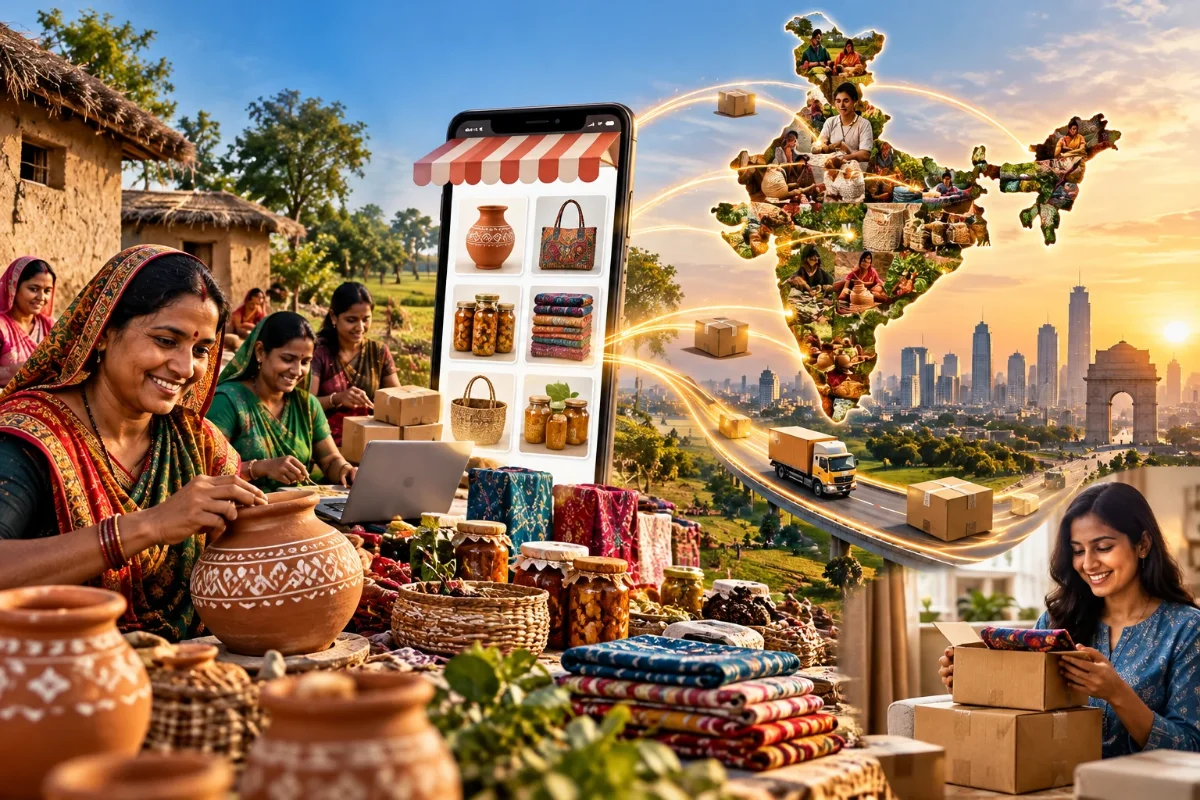
AI Generated Image
Dignity at the Grassroots: How Decentralised Micro-Enterprise Reclaimed the Pride of Rural Bharat
A recent wave of government-backed digital commerce initiatives is bringing rural producers, self-help groups, artisans, small retailers and home-based entrepreneurs closer to national buyers without requiring them to surrender control to a single marketplace. The shift is being driven by open-network infrastructure, eSaras, DAY-NRLM and MSME support programmes, which are turning decentralised micro-enterprise into a practical route to income, visibility and local pride across rural Bharat. The emerging story is not just about selling online; it is about restoring dignity through recognition of the producer’s own name, craft and community.
What Changed for Rural Entrepreneurs?
Rural entrepreneurs are gaining access to a more open, connected and assisted commerce ecosystem instead of relying solely on local fairs, middlemen or closed digital platforms. ONDC, an initiative of the Government of India’s Department for Promotion of Industry and Internal Trade, is designed as population-scale digital infrastructure built on open-network principles. Meanwhile, the government-backed eSaras platform connects women-led self-help group enterprises with customers across India. Together, these initiatives are giving the collaborative economy a more grounded form, in which peer-to-peer commerce, digital catalogues, logistics, payments and local support networks can work for the smallest sellers, not just the biggest brands.
The most visible recent push came through the MSME Ministry’s Trade Enablement and Access to Market initiative, announced in May 2026 to help micro and small enterprises participate in digital commerce ecosystems through ONDC. Implemented by the National Small Industries Corporation, the initiative supports small businesses across various stages of e-commerce participation, including onboarding, cataloguing, packaging, logistics and customer management. This matters because many rural enterprises do not struggle due to a lack of skills or product quality; they face difficulties because the commercial systems around them are fragmented, costly and challenging to navigate.
The New Model Is Decentralised, but Not Unsupported
The rise of decentralised business in rural India is often misunderstood as a simple shift from offline to online selling. In practice, the change is more structural. ONDC is not a conventional e-commerce platform or a single marketplace. Official government communication describes it as an open protocol that enables platforms and marketplaces to operate on a decentralised, interoperable network. This approach can help sellers reduce customer acquisition and transaction processing costs.
That distinction is central to the rural story. A small pickle maker, handloom group, pottery collective, honey producer or village retailer does not necessarily need to become a platform expert. What they need is access to a network in which different participants can manage discovery, cataloguing, payments, buyer access and delivery. In this sense, decentralised micro-enterprise does not mean the absence of systems; it means distributing power across local producers, technology providers, logistics partners, government support channels and buyer applications.
For rural Bharat, this model can help preserve what makes local enterprise valuable. Products remain connected to their place of origin, skills and community identity, while market access expands. The enterprise does not have to disappear into an anonymous supply chain. It can remain visible as a local business while reaching buyers beyond its district, state or region.
Key Developments Shaping Rural Digital Commerce
Several recent measures show how policy, platforms and local enterprise networks are beginning to converge at the grassroots level:
- MSME TEAM support: The Trade Enablement and Access to Market initiative aims to provide end-to-end e-commerce support to micro and small enterprises through ONDC-enabled participation, including assistance with onboarding, cataloguing, packaging, logistics and customer management.
- Focus on women-led enterprises: Government communication on ONDC adoption noted that half of the beneficiary MSMEs under the TEAM scheme are likely to be women-owned enterprises. This places women entrepreneurs at the centre of rural digital market expansion rather than treating them as a secondary beneficiary group.
- eSaras expansion: Implemented under DAY-NRLM, eSaras supports self-help groups, women entrepreneurs, producer collectives and Farmer Producer Organisations in marketing their products through a trusted digital commerce platform.
- ONDC integration for SHG products: Official updates state that eSaras is integrated with ONDC-enabled buyer applications, expanding the visibility of self-help group products beyond traditional fairs and exhibitions.
- Capacity-building for first-time sellers: ONDC has supported training and seller resources, including virtual training sessions, technical workshops and a seller handbook in Indian languages, particularly for first-time sellers.
- Village access points: Common Services Centres have gone live on ONDC to connect villages to the national digital market, strengthening assisted e-commerce for rural sellers and buyers.
This combination matters because rural enterprise development is rarely achieved through technology alone. A seller may need help photographing a product, writing a catalogue description, selecting packaging, understanding returns, managing inventory and building confidence in digital payments. The emerging support ecosystem recognises these practical requirements.
eSaras Puts Women-Led Enterprise in the National Shop Window
eSaras has become one of the clearest examples of how local business networks can move from occasional exposure to a year-round market presence. The Digital India Corporation developed the platform under MeitY in collaboration with the Ministry of Rural Development. The government implements it under DAY-NRLM to connect rural producers with customers across the country through digital commerce.
The platform supports self-help groups, women entrepreneurs, producer collectives and Farmer Producer Organisations by enabling digital catalogues, inventory management, secure payments, integrated logistics, order management and multilingual access through BHASHINI. These are practical capabilities rather than abstract digital promises. For a rural self-help group, the difference between a one-time sale at a mela and a sustainable sales channel often depends on its ability to process orders, collect payments and deliver products reliably after buyers leave the stall.
eSaras also demonstrates how decentralised commerce can preserve the human face of production. Official updates cite the example of Falak SHG from Khurja, Uttar Pradesh, which used eSaras to expand market access for GI-tagged Khurja pottery beyond local markets, exhibitions and regional fairs. The broader lesson is that digital access need not erase regional identity; when designed well, it can carry that identity further.
DAY-NRLM Provides the Social Foundation
The commercial shift rests on a deeper institutional foundation built through women’s self-help groups. The Reserve Bank of India describes DAY-NRLM as the Government of India’s flagship poverty-reduction programme for building strong institutions of the poor, particularly women, and enabling access to financial services and livelihood opportunities. The programme promotes affinity-based women’s self-help groups, typically comprising 10 to 20 members, with special provisions for difficult areas and certain vulnerable groups.
This matters because a decentralised micro-enterprise economy depends on trust before it depends on transactions. Self-help groups establish habits of regular meetings, savings, internal lending, repayment discipline and basic record-keeping. These habits become commercial assets when groups begin to sell products, borrow funds, manage packaging, develop brands and negotiate with buyers.
DAY-NRLM’s financial framework also supports the transition from subsistence to enterprise. The RBI’s master circular notes revolving fund support for eligible self-help groups and community investment support channelled through federations, while also referring to credit-related measures for individual SHG members and producer groups. The aim is not merely to inject funds, but to strengthen institutional and financial capacity so that livelihood activities can develop into well-managed enterprises.
ONDC Changes the Economics of Access
The ONDC story is significant because it challenges the traditional assumption that small sellers must first grow large enough to participate in organised commerce. The network’s official timeline records a rapid expansion from its first order in April 2022 to 500 million transactions by 25 July 2026, alongside growth into retail, logistics, transport, tourism, credit and investments. For small producers, this signals the development of commerce infrastructure that extends beyond a single retail channel.
Government communication presents ONDC’s decentralised structure as a way to encourage competition among platforms and make digital commerce more viable for small and medium-sized businesses. It also notes that different entities can specialise in different parts of the value chain instead of requiring one platform to control the entire process. This architecture can be particularly useful in rural settings, where sellers may have strong production skills but limited expertise in technology, logistics or customer acquisition.
The practical effect is a more modular market. A local entrepreneur can potentially enter through a seller-network participant, receive assistance through a government or ecosystem programme, gain visibility through buyer applications and use integrated logistics for fulfilment. No single feature guarantees success, but the combined structure can reduce the distance between a village enterprise and a national buyer.
Pride Returns When Producers Are Seen, Not Hidden
People often measure rural entrepreneurship through income, business growth and market access. These factors remain essential. However, the current transformation also carries a deeper social significance: it increasingly recognises producers as business owners rather than merely treating them as beneficiaries.
For many rural women and artisan groups, enterprises rely on family knowledge, regional materials, seasonal rhythms and inherited skills. Anonymous supply chains can obscure the producer’s identity as products move through them. However, platforms such as eSaras, ONDC-enabled applications, SARAS Melas and local business networks give makers better opportunities to connect directly with customers and earn from the value they create.
That visibility is a form of dignity. It can change how a family views a woman’s work, how a village perceives a collective and how an entrepreneur imagines her own future. A decentralised business model cannot eliminate social barriers on its own, but it gives local producers more opportunities to gain recognition, earn money, receive reviews, attract repeat customers and build a lasting reputation.
The Collaborative Economy Becomes Local and Practical
In urban technology circles, people often discuss the collaborative economy in terms of platforms, shared assets and digital networks. In rural Bharat, it takes a more practical form: self-help group members pooling trust, producer groups aggregating supply, local entrepreneurs sharing market information, logistics providers extending reach and digital applications connecting buyers with previously overlooked sellers.
This is where peer-to-peer commerce gains developmental significance. A buyer in one city can discover a product made by a women-led self-help group or rural producer collective without the seller having to build a large independent e-commerce operation. Meanwhile, the seller can participate through shared infrastructure, assisted onboarding and community-based support rather than bearing every operational burden alone.
Local business networks also help reduce isolation. Rural enterprises often face common challenges, including inconsistent demand, limited packaging knowledge, inadequate working capital, weak branding and uncertain delivery options. When connected through self-help groups, federations, Farmer Producer Organisations, Common Services Centres, state missions and open networks, these enterprises can learn faster and negotiate from a stronger position.
The Remaining Test Is Execution at the Last Mile
The policy and infrastructure signals are encouraging, but the next phase will depend on the quality of implementation. Rural producers need more than onboarding figures. They need repeat orders, fair payment cycles, straightforward grievance resolution, reliable logistics, product-quality support and digital tools in languages they can use comfortably.
Three challenges will determine whether decentralised micro-enterprise becomes a lasting movement:
- Operational reliability: Sellers must be able to manage inventory, packaging, dispatch and returns without becoming overwhelmed by processes designed for larger businesses.
- Trust and transparency: Rural entrepreneurs need clear information about commissions, payments, buyer expectations, dispute resolution and data usage.
- Demand generation: Being listed online is not the same as being discovered. Local products need better visibility, compelling storytelling, seasonal promotion and greater buyer awareness.
These challenges do not weaken the model; instead, they highlight areas that require further work. The strongest rural commerce systems will combine digital infrastructure with human support, local institutions and sustained capacity-building efforts.
A Wider Market Without Losing the Village
The latest phase of rural enterprise development suggests that scale does not have to mean centralisation. India’s open-network commerce initiatives, eSaras, DAY-NRLM and MSME support programmes are creating pathways through which small producers can access wider markets while remaining rooted in their communities. That balance lies at the heart of the current transformation.
If the model continues to mature, rural Bharat’s entrepreneurs may no longer have to choose between local identity and national opportunity. A self-help group can remain community-led, an artisan can stay connected to a craft cluster, a producer collective can retain local governance, and a small retailer can still participate in a larger digital market. The promise of decentralised micro-enterprise is that growth can extend outward while dignity remains rooted at the grassroots.
Also Read: Gen-Z Patriotism: Bridging Tech, Duty And Innovation
To read more such news, download Bharat Express news apps