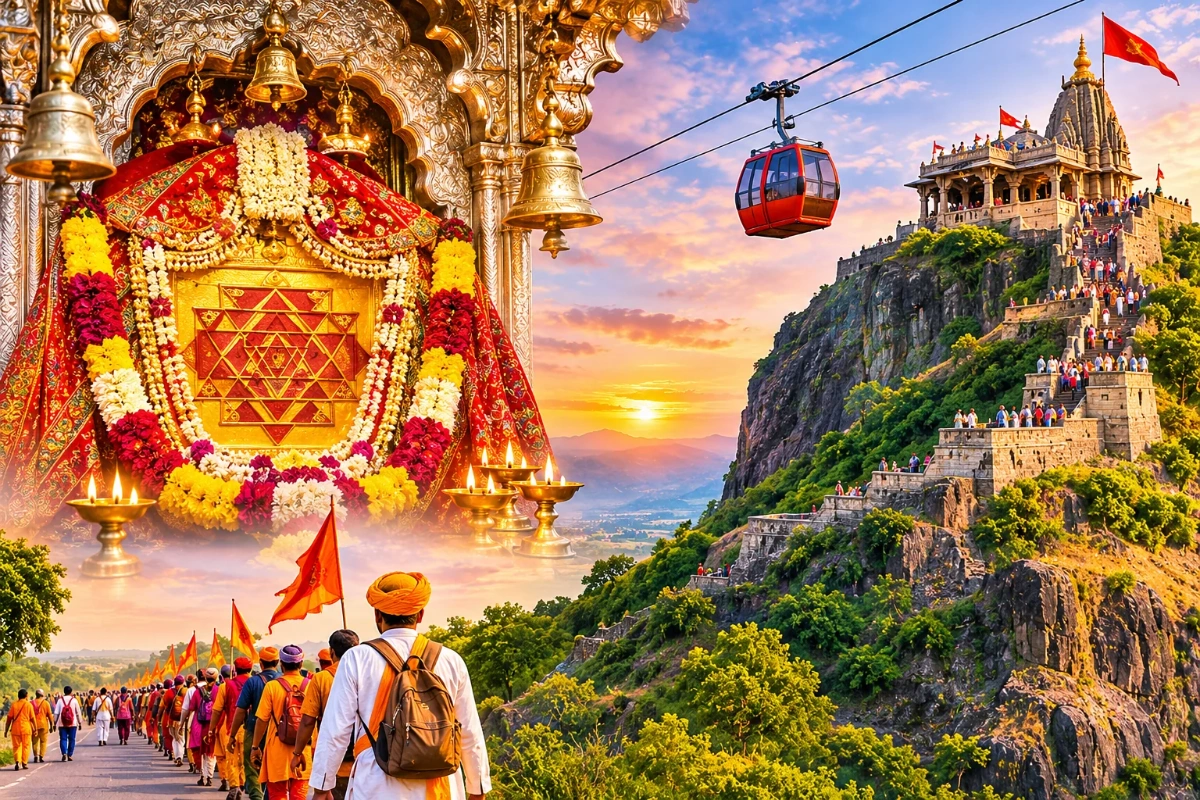
AI Generated Image
The Heart of Shakti and the Ropeway to the Flying Peak
Shree Ambaji and Pavagadh Mahakali are two of Gujarat’s most revered centres of goddess worship, connected through Shakti Peetha traditions and the story of Sati. Ambaji is associated with her heart, while Pavagadh draws pilgrims to a hilltop shrine dedicated to Mahakali. Exploring them together offers an opportunity to understand devotion, sacred landscapes and inner strength without reducing either place to a sightseeing stop.
What Connects Ambaji and Pavagadh Through Shakti?
Ambaji and Pavagadh are connected by their recognition as Shakti Peethas: sacred places associated with the goddess Sati. At Ambaji, tradition holds that Sati’s heart fell. Pavagadh is likewise revered within this sacred geography, with a devotional tradition associating it with her right toe. These are religious beliefs that explain the sites’ significance to worshippers, rather than historical or scientific claims.
Shakti represents divine power understood in feminine form. The phrase divine feminine can help introduce this idea, but it should not reduce a living religious tradition to a general wellness slogan. The British Museum’s exploration of Tantra describes Shakti as power visualised in feminine form, placing the concept within a much richer religious and artistic history.
For a reflective visitor, the two destinations suggest complementary themes. Ambaji invites contemplation of the heart: sincerity, compassion and what deserves your devotion. Pavagadh offers the image of ascent: making an effort, accepting assistance and continuing with care. These are ways to reflect on the journey, not prescribed meanings that every pilgrim must share.
Ambaji and the Heart of Shakti
At Shree Ambaji, there is no idol of the goddess in the main sanctum. Worship instead centres on a sacred yantra, identified by Gujarat Tourism as the Viso Yantra and, in its Ambaji brochure, as the Shakti Visa Shree Yantra. If you have encountered the spelling ‘Visisha Yantra’, these are the names used in the official tourism descriptions.
This distinction matters. Arriving with the expectation of seeing a conventional sculpted image may distract from what makes Ambaji distinctive. The sacred yantra is the focus of reverence at a temple believed to stand where Sati’s heart fell, giving the phrase heart of Shakti a specific devotional connection here.
Gujarat Tourism describes a niche in the sanctum that priests decorate so that its upper portion resembles the goddess when viewed from a distance. This appearance should not be confused with the presence of an idol. Knowing this before entering allows you to approach the shrine with understanding rather than treating its unfamiliar form of worship as something missing.
Consider carrying one quiet intention into your visit. It might be gratitude for someone’s care, a wish to become more patient or a commitment you have postponed. There is no need to manufacture an extraordinary experience; attention itself is a worthwhile beginning.
Padyatra, Devotional Songs and the Approach to Navratri
Ambaji’s great walking pilgrimage is closely connected with the devotion surrounding Navratri, but an important calendar distinction helps explain it accurately. The mass gathering associated with millions of visitors is the Bhadarvi Poonam fair, which takes place before the autumn Navratri festival. India’s Ministry of Tourism describes devotees arriving to invite the goddess to their hometowns for Navratri.
Padyatra means a journey undertaken on foot. Pilgrims approach Ambaji from across Gujarat and beyond, with some routes extending hundreds of kilometres. The fair attracts millions of visitors overall, but that attendance figure should not be interpreted as evidence that every visitor walks the entire distance.
Devotional songs and chants fill the approach roads, turning stretches of highway into shared spaces of worship. Reports describe groups singing and dancing along the route, while the Ministry of Tourism notes that roadside volunteer camps provide meals and basic facilities. The journey is therefore not only about individual endurance; it also depends on collective care.
If you are considering joining a walking group, prepare thoughtfully:
- Understand the route: Ask the organisers about daily distances, rest stops, accommodation and transport alternatives before committing.
- Choose manageable participation: Walking a shorter section respectfully is preferable to treating exhaustion as a spiritual achievement.
- Plan for practical needs: Discuss water, meals, footwear, necessary medication and a way to contact your companions.
- Respect those supporting you: Keep service areas clean, avoid wasting food and follow local crowd-management directions.
Pavagadh’s Volcanic Cliff and the Shrine of Mahakali
Pavagadh rises dramatically from the surrounding landscape, with its upper shrine perched above steep volcanic cliffs. UNESCO identifies the hill as a volcanic formation and describes the surrounding escarpments and plateaus as products of eruptions and lava flows. The shrine of Mahakali, also known as Kalika Mata, crowns this striking setting.
In the devotional tradition associating Pavagadh with Sati’s right toe, the landscape becomes part of a sacred story. Keep the distinction clear as you explore: geology explains the formation of the hill, while religious tradition explains its significance to devotees. Neither needs to be presented as evidence for the other.
The wider setting rewards attention, too. Champaner-Pavagadh Archaeological Park includes fortifications, religious buildings, water systems and the remains of a former capital. UNESCO recognises it as both an archaeological landscape and a place of continuing pilgrimage. Looking beyond the summit helps you encounter the area as layered heritage rather than a single attraction.
Leave room in your plans to notice the relationship between worship and place. You need not rush from the ropeway to the shrine and immediately leave. Where access and local directions permit, allow time to appreciate the surrounding heritage as well.
What Should You Expect from the Pavagadh Ropeway?
The Pavagadh ropeway carries visitors uphill from the Machi area and reduces the walking ascent, but it does not eliminate the final climb to the temple. The temple’s ropeway information describes a further uphill approach after passengers disembark. Think of the ride as assistance along the pilgrimage, not a guaranteed step-free route to the sanctum.
For anyone travelling with an older relative, a young child or someone with limited stamina, this distinction deserves attention before booking. Ask the operator about boarding arrangements and the remaining route rather than assuming a cable car resolves every access need. Plan around your companions’ comfort, not around completing the visit at any cost.
Before departure, use this short checklist:
- Check official operating information: Confirm the selected date, ticket conditions and service notices directly with the operator.
- Allow for disruption: The operator states that weather and other circumstances can delay boarding or affect operations.
- Discuss the remaining ascent: Make sure everyone understands that some climbing is still required after the ride.
- Keep your schedule flexible: Avoid making the return journey dependent on an unrealistically tight connection.
Accepting help need not diminish the meaning of a pilgrimage. The ropeway can become an invitation to let go of the idea that devotion must always be measured by physical hardship.
Inner Strength Without Promises of Instant Awakening
Approach Shakti energy as religious language for divine power, not as a measurable benefit automatically delivered by visiting a temple. Shakti belongs to a substantial devotional and philosophical tradition. Respecting that context leaves more room for genuine learning than promising visitors a predictable transformation.
If you are seeking Shakti awakening or a broader spiritual awakening, try replacing the demand for a dramatic moment with a few practical intentions. Listen before interpreting. Ask respectful questions when an appropriate opportunity arises. Notice whether the journey encourages you to become kinder, more attentive or more willing to help.
The same care applies to energy healing. Do not confuse a meaningful spiritual experience with evidence of medical treatment. For example, the US National Centre for Complementary and Integrative Health states that Reiki has not been clearly shown to be effective for health-related purposes and that its proposed energy field lacks scientific evidence.
Let your own reflection remain modest and honest. You might leave deeply moved, quietly thoughtful or simply interested in learning more. None of these responses needs to be exaggerated to make the visit worthwhile.
Carrying the Journey Home
A useful takeaway does not require a grand declaration. Choose one action that gives your reflections a place in everyday life: keep a promise, thank someone who supported you or offer help without seeking recognition. Let inner strength mean something you practise after the journey, not merely something you hoped to feel during it.
Approach both sacred places with curiosity and humility. Leave space for devotion to belong first to the people who sustain it, and for your own understanding to grow slowly.
Also Read: Exploring Srirangam: World’s Largest Temple Complex
To read more such news, download Bharat Express news apps