AI Generated Image
The Pool of Nectar: Four Doors Open to All Humanity
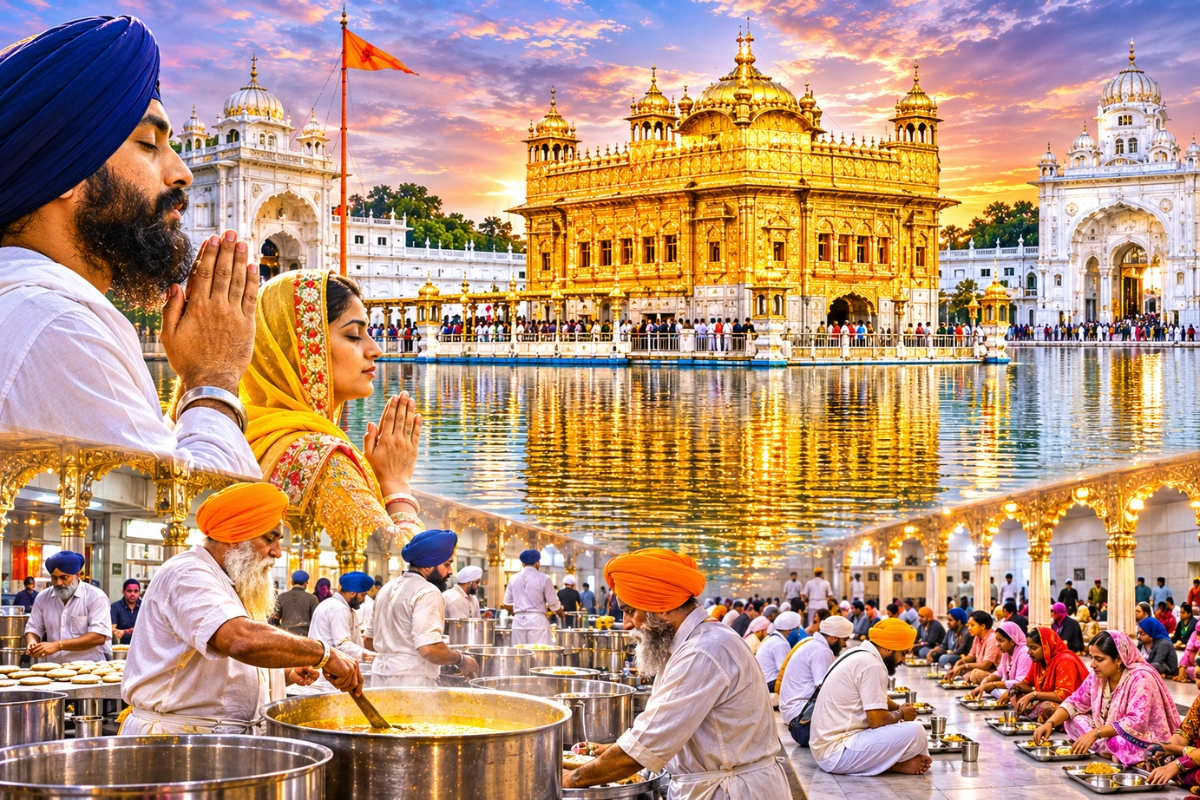
The Golden Temple (Harmandir Sahib) in Amritsar, Punjab, is a Sikh place of worship where the sacred pool, four entrances, and shared community meals express a welcome that transcends religious and social boundaries. Understanding its ‘pool of nectar’ means looking beyond the golden exterior to the ideas of spiritual nourishment, equality, and service that shape the shrine. This article explores these meanings and explains how visitors can engage respectfully.
The Pool of Nectar: Four Doors Open to All Humanity
Read as a thematic motto, these words connect the setting with its purpose: a place where belonging should not depend on wealth, caste, or religious identity.
What Does the Pool of Nectar Mean at the Golden Temple?
The ‘pool of nectar’ refers to the Amrit Sarovar, the sacred water surrounding the Golden Temple. The name conveys a spiritual meaning rather than describing a pool filled with sweet liquid. Amritsar itself takes its name from this pool, linking the city’s identity to the water at its religious heart.
For readers searching for ‘pool of nectar meaning in Hindi’, a simple transliterated rendering is amrit ka sarovar: a pool or lake of amrit. In this setting, ‘nectar’ evokes sacred nourishment and immortality, not a botanical ingredient. The distinction matters because a literal interpretation misses the devotional significance of the name.
The sarovar is part of a living religious landscape, not merely a reflecting pool for photographs. The district’s cultural account describes the importance of visiting Amritsar and bathing at the shrine for Sikh devotees. Visitors need not share that practice to recognise its significance; watching quietly and allowing worshippers space are meaningful ways to show respect.
The Founders and the Foundation Stone
Guru Arjan Dev Ji, the fifth Sikh Guru, founded the Golden Temple and designed its architecture. His work followed the development of the sacred pool under Guru Ram Das Ji, whose role is central to the history of Amritsar. Distinguishing these contributions helps explain how the city, sarovar, and shrine developed through the leadership of successive Gurus.
According to the Shiromani Gurdwara Parbandhak Committee’s official account, the foundation stone was laid by Mian Mir, a Muslim Sufi saint from Lahore, at Guru Arjan Dev Ji’s invitation. This tradition is often understood as an expression of respect across religious boundaries. Historical accounts differ, however: some attribute the laying of the foundation stone to Guru Arjan Dev Ji himself. The Mian Mir account is therefore best presented with attribution rather than as undisputed history.
This distinction need not overshadow the shrine’s message. It allows readers to appreciate a widely shared tradition while recognising that historical interpretation and religious memory do not always produce identical accounts.
Why Does the Golden Temple Have Four Entrances?
The Golden Temple has four entrances facing north, south, east, and west, symbolising a welcome to people of all religions and castes. Guru Arjan Dev Ji’s design made openness part of the building itself. The four directions communicate that no community has an exclusive claim to approach the sacred.
The symbolism becomes more meaningful when translated into everyday conduct. An open door means little if a newcomer is treated as an outsider once inside. Here, the architectural message invites a broader reflection: welcome should be visible in how people share space, offer guidance, and make room for one another.
For visitors, this is a reason to arrive without assuming either special privilege or exclusion. You can enter as a learner rather than an expert. You can also honour the spirit of welcome by remembering that access to a religious place brings responsibilities towards the people worshipping there.
Langar Makes Equality a Shared Experience
The Golden Temple’s Langar is a community kitchen serving free, hot vegetarian meals to visitors regardless of their background. Its importance lies not only in feeding people but also in bringing them together as equals. Sitting alongside strangers turns an abstract principle into the ordinary, necessary act of sharing food.
The scale is enormous, but daily totals should not be treated as fixed. Reporting published on 5 June 2026, citing an SGPC manager, described the kitchen as serving more than 100,000 people daily during that period, with summer numbers reaching approximately 110,000–120,000. Other accounts give lower estimates for ordinary days and higher figures during festivals, so attendance varies according to the occasion and reporting period.
Volunteers called Sevadars sustain the kitchen through acts of selfless service, or seva. However, describing the operation as being run entirely by volunteers would be inaccurate: reporting documents professional cooks and SGPC employees working alongside volunteers. Recognising this collaboration does not diminish the generosity involved; it explains how a demanding daily operation remains organised.
Volunteer duties can include:
- Rolling chapattis: Preparing bread through patient, repetitive work that contributes directly to the shared meal.
- Washing dishes: Helping return plates, bowls, and utensils to use for the next group of diners.
- Cleaning floors: Maintaining the dining space so others can eat in a clean environment.
- Serving food: Attending to people seated in the rows rather than seeking attention for the service itself.
These duties express humility through useful action. The work is not valuable because it is glamorous; it is valuable because someone needs it done.
How Can Visitors Take Part Respectfully?
Visitors can participate by observing the shrine’s customs, sharing Langar, and asking the on-site team about suitable opportunities for seva. No elaborate gesture is necessary. A respectful approach begins with listening, following directions, and treating the community’s religious practices as more important than a personal sightseeing schedule.
Use this practical checklist as a starting point:
- Prepare before entering. Cover your head and remove your shoes as required. Follow the directions provided at the entrance rather than assuming customs are the same everywhere.
- Approach Langar as a shared meal. Follow the serving team’s guidance and take an amount you expect to finish. The experience is about eating together, not comparing the meal with restaurant service.
- Ask before joining a task. Express your willingness to help, then accept an appropriate assignment. Large-scale food preparation depends on coordination, so enthusiasm should support the existing workflow rather than interrupt it.
- Keep attention on people, not content creation. Ask permission before photographing individuals and follow posted restrictions. A moment of service or prayer does not need to become a photograph to be worthwhile.
If you are uncertain, a brief, polite question is better than guessing. You do not need to imitate devotion you do not feel, but you can show consideration for those who do. Curiosity and humility work well together.
Sacred Nectar and Floral Nectar Have Different Meanings
The language of nectar also appears in gardening and beekeeping, but that is a separate subject. Floral nectar is a sugar-rich secretion produced by glands called nectaries in flowers. A flowering plant can therefore serve as a nectar source for visiting animals; the Golden Temple’s sacred pool is not a reservoir of this substance.
Keeping the terms separate makes both subjects clearer:
- Nectar plants provide nectar used by animals such as bees, butterflies, and hummingbirds. Different visitors have different feeding needs and flower preferences.
- Nectar production is a plant process, and the quantity or composition available can change with flower age and environmental conditions. A flower is not necessarily a constant source of nectar.
- Nectar collection describes bees gathering nectar from plants. Bees subsequently process it into honey; honey is not simply nectar taken unchanged from a flower.
The connection is linguistic, not physical. In nature, nectar provides nourishment to flower visitors. In the shrine’s name, the word carries a spiritual association that should not be reduced to a gardening definition.
Carrying the Welcome Beyond the Shrine
The strongest takeaway is not a photograph of gold reflected in water. It is the relationship between welcome and responsibility: opening a door, sharing a meal, and doing the unremarkable work that allows someone else to feel included.
Whether you visit the Golden Temple or encounter its story from afar, that principle is practical. Make space for a newcomer. Share without demanding recognition. Choose a necessary task and complete it with care. The image of four open doors becomes more powerful when it shapes what happens beyond them.
Also Read: Exploring Bharat’s Architecture: Madurai’s Temple Marvel
To read more such news, download Bharat Express news apps