



AI Generated Image
The Agritech Rovers of Assam: Replacing Chemical Sprays With Precision AI on Smallholdings
Assam’s smallholdings need practical technology that accommodates narrow plots, mixed crops, wet conditions, and tight margins. Agritech rovers in Assam are part of a wider shift towards precision agriculture tools that help farmers inspect plants closely, target treatments only where needed, and reduce blanket chemical spraying. Instead of treating every row the same way, these ground-based machines can support more careful, data-led decisions in the field.
How Can Agritech Rovers Help Small Farms in Assam?
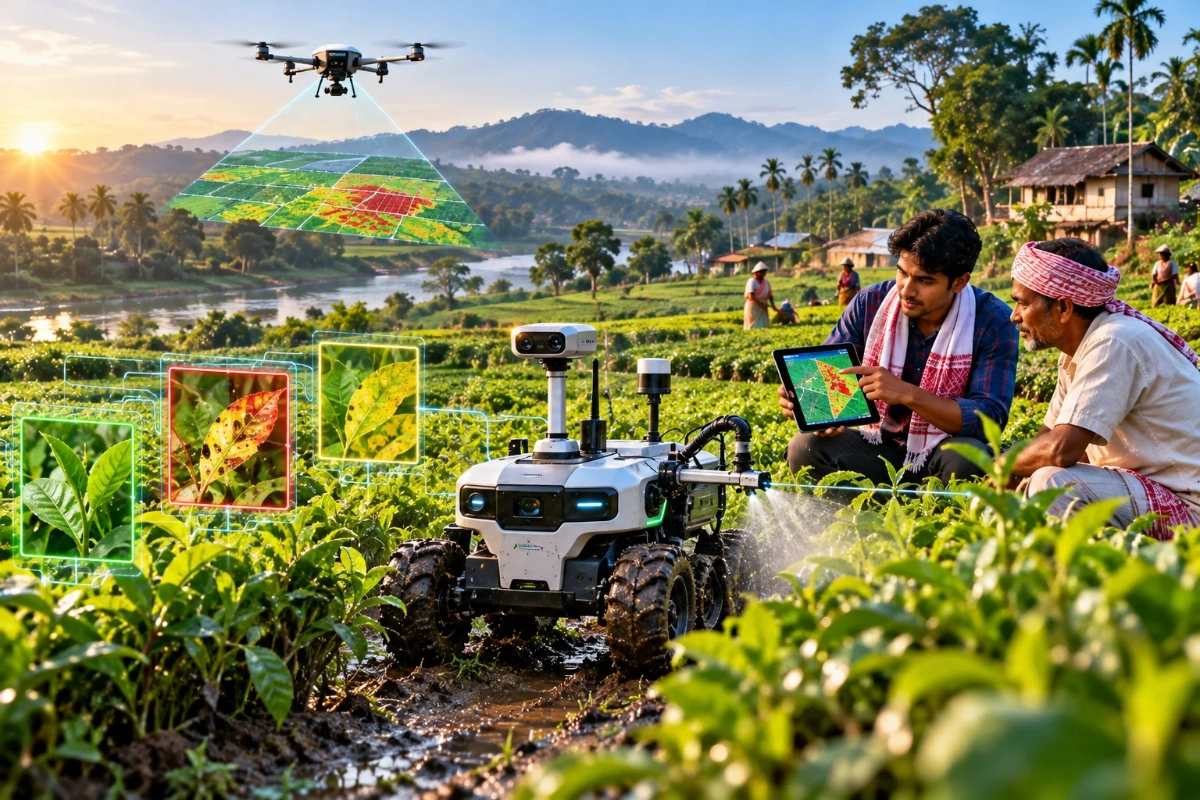
Agritech rovers can help small farms by bringing crop monitoring, spot treatment, and field data collection closer to individual plants. On fragmented land where large machines may be difficult to operate, compact agricultural robots can move through selected sections, capture images, and help identify signs of stress, such as pest activity, leaf damage, uneven growth, or moisture-related problems.
The value lies not simply in automation, but in precision. Farmers and service providers can focus their attention on the areas that need treatment instead of spraying the entire plot. This can support more responsible input use, better timing, and less guesswork during busy growing periods.
Precision Replaces the ‘Spray Everything’ Mindset
Traditional spraying often takes place because farmers need to act quickly, not because every plant is equally affected. Precision agriculture tools change this decision-making process by making crop conditions more visible. A rover equipped with cameras, sensors, or AI-supported analysis can help distinguish healthy areas from those showing signs of problems.
This matters in Assam, where heavy rainfall, high humidity, and diverse cropping patterns can cause field conditions to change quickly. If a pest or disease appears in one section, a targeted response may be more effective than routine, broad-spectrum spraying. Over time, this approach can encourage farmers to observe crops more closely, intervene earlier, and use agricultural inputs more carefully.
Rovers, Drones, and Robots All Play Different Roles
Agricultural drones are often useful for rapid aerial surveys, particularly when farmers or agricultural advisers need a broad overview of crop health. Ground-based rovers, however, can operate at closer range, capturing detailed information from beneath the canopy or near the soil surface. Together, agricultural drones and rover-based robotics can provide a more complete picture of field conditions.
A practical combination of technologies may look like this:
- Drones for an overview: Identifying uneven growth, waterlogging, or large affected areas.
- Rovers for close inspection: Checking leaf-level symptoms, crop rows, and targeted areas.
- AI tools for pattern recognition: Flagging potential areas of crop stress for human review.
- Farmer judgement for final decisions: Combining local experience with digital insights before applying treatments.
What Makes This Agritech Innovation Practical?
Agritech innovation becomes practical when it solves real field problems without adding unnecessary complexity. For smallholders, this means tools should be affordable to access, easy to maintain, and suitable for plots that are not perfectly flat, large, or uniform. The most effective model may not involve every farmer owning a rover; local service providers, cooperatives, or farmer groups could instead share access to the technology.
For adoption to grow, the technology must also accommodate existing farming practices. Clear recommendations, local-language support, straightforward maintenance, and confidence in the results are just as important as sensors or software. A rover that only collects data is interesting; a rover that helps farmers decide where, when, and how much to treat is genuinely valuable.
A More Careful Future for Assam’s Fields
The promise of agritech rovers in Assam is not to replace farmers, but to strengthen their decision-making. By combining AI, robotics, and local knowledge, small farms can move towards more precise crop care and reduced reliance on routine chemical applications.
As precision agriculture tools continue to improve, the most successful solutions will be those designed around Assam’s actual farming conditions. For smallholders, the future of agritech innovation is not necessarily bigger machinery; it is smarter, lighter, and more targeted support in the field.
Also Read: My Bharat Vanguard: Empowering India’s Youth
To read more such news, download Bharat Express news apps