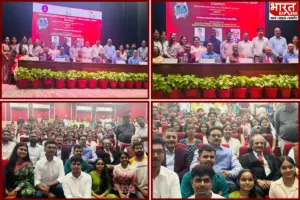


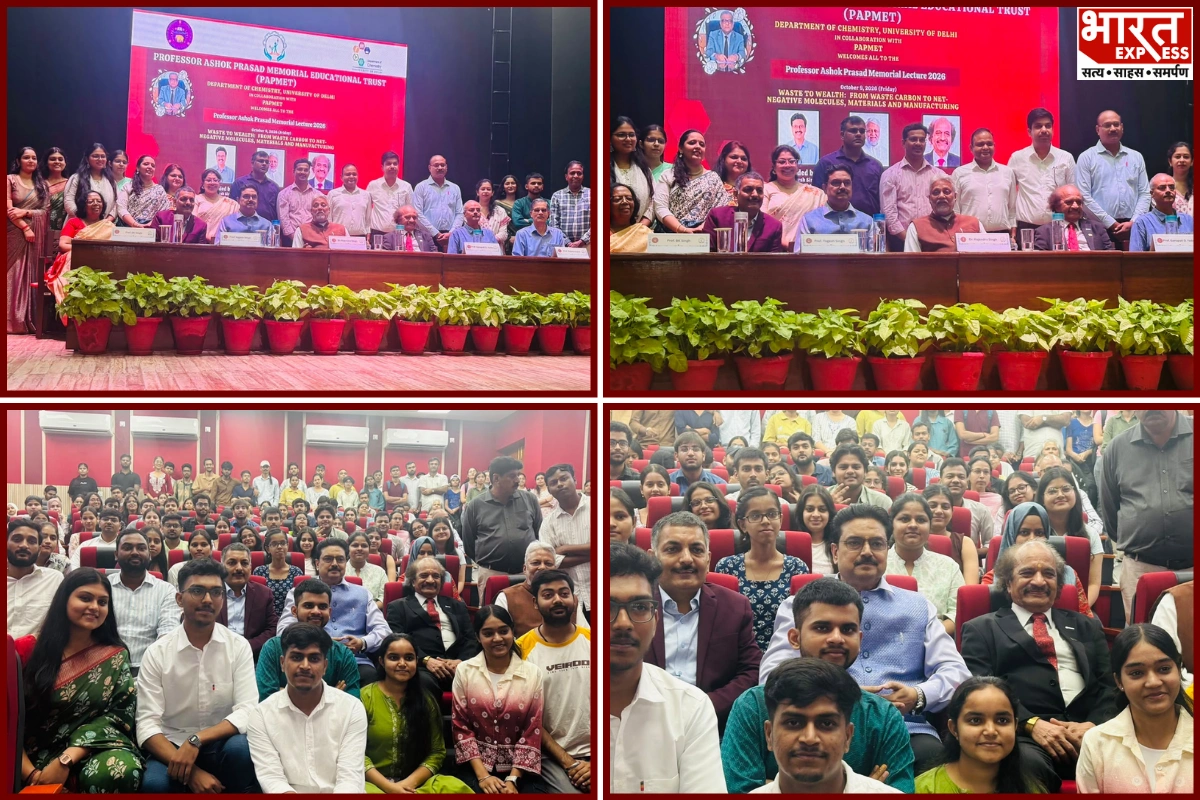
The Professor Ashok Prasad Memorial Educational Trust (PAPMET), in collaboration with the Department of Chemistry, University of Delhi, organised the 3rd Professor Ashok Prasad Memorial Lecture at Sir Shankar Lal Concert Hall.
More than 400 students and over 200 faculty members from universities and colleges attended, alongside research scholars, alumni and invited guests.
The lecture honoured late Prof Ashok K Prasad (1961–2023), a distinguished scholar from the Department of Chemistry whose work in bioorganic chemistry, natural product synthesis and bioactive compounds earned national and international recognition. He authored more than 200 research papers and held 10 patents. The series continues his commitment to scientific excellence, mentorship and the advancement of chemistry.
The theme, ‘Waste to Wealth: From Waste Carbon to Net-Negative Molecules, Materials and Manufacturing’, explored ways to transform waste carbon into valuable chemicals, materials and products, moving beyond waste-to-energy towards waste-to-chemicals, waste-to-materials and net-negative technologies.
Prof Yogesh Singh: Learn from the World, but Design for India
Presiding over the programme, Prof Yogesh Singh, Vice-Chancellor of the University of Delhi, paid tribute to Prof Ashok Prasad and observed that a teacher’s enduring legacy lies in the students they inspire, teach and mentor. He further commended Prof BK Singh for establishing the Trust in his teacher’s honour and welcomed PAPMET’s initiative to support meritorious students from underprivileged backgrounds through scholarships.
Prof Yogesh Singh emphasised that environmental innovation must form an integral part of development and economic growth. He called on universities to embed sustainability in research, teaching and campus practices, and to develop practical solutions for responsible resource use and environmental challenges. He further stressed that the aspiration of a developed India by 2047 must go hand in hand with building a clean and sustainable nation.
Encouraging students to think beyond conventional approaches, Prof Yogesh Singh highlighted the importance of innovation and entrepreneurship in turning research and creative ideas into practical solutions. He reaffirmed the University of Delhi’s commitment to nurturing innovative thinking and supporting start-ups so that young people can translate their ideas into meaningful action.
Summing up his message, Prof Yogesh Singh said: “Learn from the world, but design for India”—urging students to draw on global knowledge while developing solutions suited to India’s needs and aspirations.
Awards were presented to research scholars and postgraduate students of the Department of Chemistry in recognition of their academic achievements.
Dr Rajendra Singh Calls for Community-Led Water Conservation
Dr Rajendra Singh, the ‘Waterman of India’ and recipient of the Ramon Magsaysay Award and the Stockholm Water Prize, attended as the Chief Guest.
Speaking about India’s water systems, Dr Rajendra Singh stressed the urgent need to revive rivers and restore traditional water-management practices.
Drawing on community-led work in Rajasthan, where villages built johads and managed groundwater collectively, Dr Rajendra Singh said scientific knowledge has the greatest impact when communities own it and apply it to local problems. He urged young people to turn awareness into action to promote water security and sustainable development.
Prof GD Yadav Highlights Waste-Carbon Technologies
The memorial lecture was delivered by Padma Shri Prof Ganapati D Yadav, FNA, former Vice-Chancellor of the Institute of Chemical Technology, Mumbai. He further discussed the potential of agricultural residues, municipal solid waste, waste plastics and industrial carbon as sources of valuable carbon and molecular building blocks.
The technologies he discussed included chemical recycling, pyrolysis, gasification, catalysis, carbon capture and utilisation, and the conversion of carbon dioxide into useful products.
Prof Yadav noted that a circular carbon economy would require collaboration across catalysis, biotechnology, materials science, green hydrogen, carbon capture and utilisation, process intensification and artificial intelligence.
Together, the two speakers, however, presented complementary paths to sustainability: community-led environmental action and scientific innovation.
The programme opened with the ceremonial lighting of the lamp and Saraswati Vandana, a tribute to Prof Ashok Prasad, the University of Delhi Kulgeet and a documentary, ‘Journey of Professor Ashok Prasad’.
Prof Rajeev Gupta, Head of the Department of Chemistry, delivered the welcome address. Dr Chandra Has Khanduri, President of PAPMET and former Global Head (API) at Viatris Pharma, introduced the Trust.
The programme, however, concluded with a vote of thanks by Prof BK Singh of the Department of Chemistry and Secretary of PAPMET, followed by the National Anthem.
About PAPMET
The Professor Ashok Prasad Memorial Educational Trust (PAPMET) honours Prof Ashok Prasad through seminars, workshops and learning programmes, with plans to offer scholarships and grants to meritorious and underprivileged students.
Guided by the principles of Knowledge, Growth and Liberation, it supports science education, research training and the dissemination of knowledge.
To read more such news, download Bharat Express news apps