



AI Generated Image
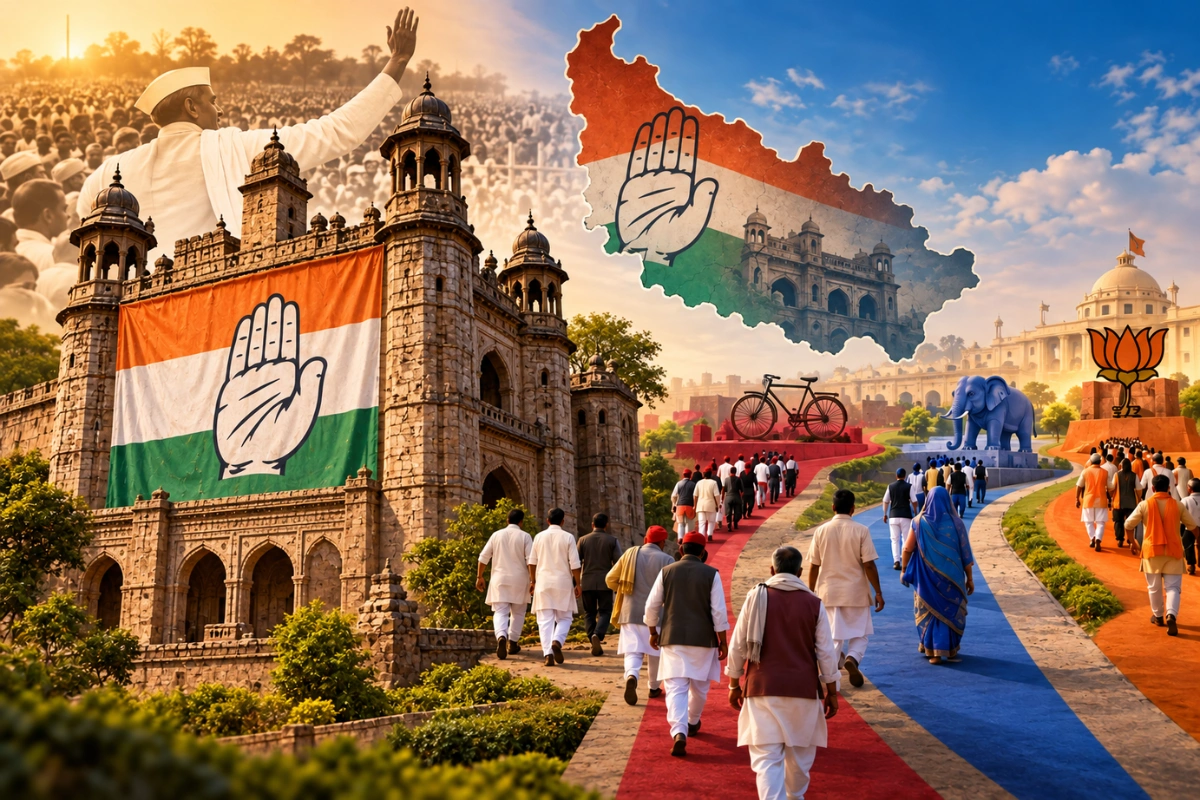
For decades, Uttar Pradesh was not just another electoral state for Congress; it was one of the party’s central pillars. The decline of the Congress party in Uttar Pradesh is a story of social coalitions breaking apart, regional parties rising, organisational machinery weakening, and national messaging failing to translate into local trust. For readers following Congress news or broader Congress party news, Uttar Pradesh remains the clearest test of whether the party can rebuild where it once dominated.
Why Did Congress Lose Uttar Pradesh?
Congress lost Uttar Pradesh because the broad umbrella coalition that once carried it through caste, community, class, and region gradually fragmented. The Mandal era empowered backward-caste politics, the Ram temple movement helped the BJP consolidate Hindu nationalist support, and the Bahujan movement gave Dalit voters a more direct political vehicle. As Carnegie’s analysis puts it, Congress in Uttar Pradesh and Bihar was squeezed between Mandal and Mandir politics, losing upper-caste voters to the BJP and lower-caste voters to the SP and BSP.
That explanation is simple, but the process was not sudden. The Congress party UP story is not one election going wrong; it is a long erosion of trust, cadre, leaders, and social imagination. The party did not merely lose seats. It lost the everyday networks that convert sympathy into votes: district leaders, caste intermediaries, booth workers, local issue ownership, and credible Chief Ministerial faces.
The Old Congress Fortress in Uttar Pradesh
For much of the post-independence period, Uttar Pradesh Congress functioned as a catch-all platform. It could speak the language of national unity while accommodating local elites, caste groups, minorities, farmers, and aspirational urban voters. The party’s strength lay in being broad enough for many groups to see themselves inside it.
That breadth was visible as late as 1985, when Congress won 269 of the 425 seats in undivided Uttar Pradesh, a benchmark that later analysts still used as a reference point for single-party dominance in the state. The same source notes how unusual later mandates looked in comparison, which shows how dramatically Uttar Pradesh politics changed after the Congress high point.
The fortress metaphor works because Congress once had walls in many places at once. It had a national brand, local notables, minority confidence, upper-caste leadership, Dalit support, and a freedom-movement inheritance. But fortresses become vulnerable when their gates are guarded by memory rather than organisation.
The 1989 Rupture Changed the State’s Political Grammar
The 1989 Uttar Pradesh election was a turning point. Janata Dal emerged as the largest party with 208 seats, while Congress fell to 94 seats with a 27.90% vote share, losing 175 seats compared with the previous assembly election. That result did not simply replace one government with another; it signalled that voters were willing to seek representation outside the Congress system.
This was the period when caste-based assertion and religious mobilisation became sharper forces. The old Congress formula depended on balancing social groups without letting any one identity dominate the party’s state image. But as politics became more assertive, voters wanted parties that spoke more directly to their anxieties and ambitions.
The Samajwadi Party eventually became a vehicle for sections of backward-caste and Muslim politics. The BSP gave Dalit assertion a powerful independent platform. The BJP expanded through Hindutva, upper-caste consolidation, and later wider non-Yadav OBC and non-Jatav Dalit outreach. Congress, by contrast, often appeared reactive: too national for state-level caste negotiations, yet too weak locally to shape the national debate from Uttar Pradesh.
The Social Coalition Broke in Different Directions
Congress’s decline in Uttar Pradesh is best understood as a coalition breakup. It was not that every voter left for the same reason. Different groups found different political homes.
- Upper-caste voters: Many shifted towards the BJP as the party expanded its organisational reach and ideological appeal.
- Dalit voters: The BSP offered a more assertive Dalit-led politics than Congress could provide.
- Backward-caste voters: SP, and later BJP in many regions, competed more effectively for OBC representation.
- Muslim voters: Many moved tactically towards parties seen as stronger challengers to the BJP in specific constituencies.
- Local power brokers: As Congress lost office and influence, many leaders migrated to parties with better chances of winning.
The practical effect was devastating. A party can survive losing one vote bank if it gains another. Congress lost multiple social anchors while failing to build a fresh, durable identity for the state.
Organisation Faded as Rivals Built Machines
Political decline becomes permanent when electoral losses weaken organisation, and weak organisation then produces more losses. This cycle hurt the Congress party Uttar Pradesh network badly. Booth committees matter in a state as large as Uttar Pradesh because voters do not experience politics only through speeches; they experience it through who shows up during a dispute, who helps with paperwork, who attends local events, and who can mobilise on polling day.
The BJP invested heavily in cadre systems, welfare communication, ideological networks, and micro-level mobilisation. SP and BSP, at their peaks, had strong caste-community networks and clear social identities. Congress often depended on central campaigns, high-profile visits, and legacy seats, which were not enough in a state where elections are fought lane by lane.
This organisational weakness also affected candidate quality. Strong candidates prefer parties with momentum. When a party looks unlikely to win, it struggles to attract ambitious local leaders; when it cannot attract leaders, it looks even less likely to win. That feedback loop is one of the least glamorous but most important reasons behind the fall of Congress party UP influence.
Did Alliances Help or Hurt Congress in Uttar Pradesh?
Alliances helped Congress remain relevant in some elections, but they also revealed how much bargaining power the party had lost. An alliance can transfer votes, protect a party from complete isolation, and create a larger anti-incumbent front. But if the alliance partner controls the main social base and campaign energy, Congress may win a few seats without rebuilding its independent organisation.
The pattern is visible across recent Uttar Pradesh elections. In 2012, Congress won 28 assembly seats and 11.65% vote share, a modest improvement but not a revival. In 2017, after contesting in alliance with SP, Congress was reduced to seven seats in a BJP-dominated election. Similarly, in 2022, the collapse deepened: Congress won only two of 403 assembly seats and polled 2.3% of the vote.
Yet the 2024 Lok Sabha election showed that alliances can still create openings. In Uttar Pradesh’s 80 parliamentary seats, SP won 37, BJP 33, and Congress six; Congress also polled 9.5% in the state. That performance did not restore Congress to its old position, but it showed that the party could still benefit when anti-BJP votes were coordinated, and candidates were placed carefully.
The 2024 Opening Was Real, but Limited
The 2024 result changed the tone of Uttar Pradesh Congress conversations. After years of grim headlines, Congress had something concrete to point to: wins in seats such as Rae Bareli and Amethi, stronger alliance arithmetic, and renewed visibility within the INDIA bloc. For anyone tracking UP Congress news, that shift matters because morale can influence recruitment, funding, and local activism.
Still, a Lok Sabha opening is not the same as an assembly revival. Parliamentary elections can be shaped by national narratives, alliance arithmetic, and concentrated contests. Assembly elections require a wider bench of candidates, deeper local presence, and a state-level proposition that voters understand.
Congress cannot assume that a few parliamentary wins automatically convert into hundreds of competitive assembly segments. The party needs to answer a tougher question: why should a voter choose Congress as the main vehicle of change when SP already occupies much of the opposition space, and BJP remains organisationally powerful?
What Congress Must Rebuild Before the Next State Test?
Congress has to rebuild in Uttar Pradesh at three levels: message, machinery, and social trust. Without all three, the party risks becoming either a symbolic ally or a spoiler rather than a serious contender.
A practical revival roadmap would include:
- A sharper state-level message: Congress needs an Uttar Pradesh-specific offer, not just national slogans. Jobs, caste census politics, farm distress, law and order, education, and local welfare delivery must be connected to a clear state narrative.
- A booth-first organisation: The party must identify where it is genuinely competitive, then build booth committees, block teams, and district-level accountability. Revival cannot be managed only through press conferences.
- Social coalition clarity: Congress cannot simply ask old voters to return. It must explain which communities it is prioritising, how it will share leadership, and why its platform is more inclusive than its rivals’.
- Candidate credibility: In Uttar Pradesh, local reputation matters. Candidates need community standing, campaign stamina, and the ability to remain active between elections.
- Alliance discipline: If Congress contests with SP or other INDIA partners, seat sharing must be realistic. Too many seats without organisation can damage credibility; too few can restrict growth.
Leadership Changes Show the Urgency
Recent Congress party news from Uttar Pradesh suggests the leadership understands that the state cannot be treated casually. In June 2026, Congress appointed Rajendra Pal Gautam as AICC in-charge for Uttar Pradesh, replacing Avinash Pandey; the move was widely read as part of an outreach effort towards Dalits and socially disadvantaged communities before the 2027 assembly election. In August 2026, the party also appointed six AICC secretaries under Gautam as part of efforts to strengthen its state machinery.
These changes may help, but appointments alone cannot rebuild a party. The test is whether new leaders can create a culture of continuous presence. Uttar Pradesh voters have seen many relaunches, yatras, committees, and campaigns. They will judge Congress by whether it stays visible after the cameras leave.
Lessons From the Lost Fortress
The fall of Congress in Uttar Pradesh offers lessons beyond one party. It shows that historical dominance is not a permanent asset. Social groups keep renegotiating power. Voters reward parties that offer representation, organisation, and emotional clarity.
The Congress party’s decline in Uttar Pradesh also shows the danger of confusing recognition with relevance. Many voters still know the Congress name. Some still associate it with national history. But recognition alone cannot win elections; local leadership, social trust, and a compelling reason to vote now must drive the outcome.
For Congress, Uttar Pradesh remains both a burden and an opportunity. It is a burden because the scale of decline is so visible: from a dominant party in the 1980s to two assembly seats in 2022. It is an opportunity because even a partial recovery in India’s largest political state can reshape national opposition politics.
The Road Back Is Long, but Not Imaginary
Congress lost its hold on Uttar Pradesh because it lost the social grammar of the state before it lost the arithmetic of elections. Mandal, Mandir, Dalit assertion, regional leadership, and organisational decay each took away a piece of the old fortress. By the time the party tried to repair the walls, many voters had already moved into new political homes.
The 2024 Lok Sabha performance showed that Congress is not irrelevant when alliances, candidates, and mood align. But the deeper challenge is to become indispensable again. If rebuilding from the booth upward, speaking clearly to new social coalitions, and negotiating alliances without surrendering identity, Uttar Pradesh Congress can build a new base even if the lost fortress never returns in its old form.
Also Read: Elephant In The Room: Decoding BSP’s Silent Voters And Electoral Magic
To read more such news, download Bharat Express news apps