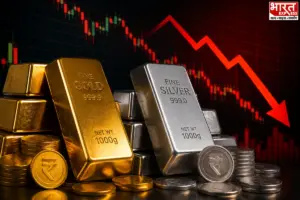




AI Generated Image
India’s gold market is witnessing a clear transition towards investment-led demand as higher prices discourage consumers from purchasing jewellery, a joint study by ICRA and ASSOCHAM revealed. The findings underline a shift in buyer preferences amid persistent price increases.
The study reported that gold jewellery demand in India fell by nearly 26 per cent year-on-year in the first half of FY26.
Increased interest in bars and coins, which rose by 15 per cent, helped offset part of the decline.
Globally, gold jewellery consumption dropped by 15 per cent in FY25 and declined by a further 17 per cent in the first half of FY26, reflecting the impact of elevated prices.
Demand for investment products recorded a significant rise, with purchases of gold bars and coins surging by 74 per cent year-on-year, while exchange-traded funds saw a 60 per cent increase.
“Going ahead, high prices may continue to weigh on jewellery demand in the near term, though rising investment demand, expansion of organised players and increasing financialization are expected to support the sector’s medium-term growth,” the report stated.
India overtook China to become the largest consumer of gold jewellery globally, accounting for around 30 per cent of total demand in FY25.
Cultural factors such as weddings and festivals continued to sustain overall consumption despite higher prices.
Gold prices climbed by about 33 per cent in FY25 and have risen by more than 50 per cent so far in the current fiscal year.
Strong buying by central banks, geopolitical tensions, and the weakening of the rupee against the US dollar supported the upward trend.
Central banks continued to play a major role in the market, purchasing over 1,000 tonnes annually between FY2023 and FY2025, thereby underpinning global prices.
Supply Dynamics and Import Dependence
India remained heavily reliant on imports, which contributed roughly 85–88 per cent of the country’s gold supply due to limited domestic mining capacity.
Global mine output remained stable and accounted for nearly 70 per cent of total supply.
Recycling activity has increased in India, providing some support to the overall supply.
The report also noted that mandatory hallmarking and India Good Delivery Standards have improved purity levels and strengthened refining practices.
The organised segment now represents about 40 per cent of India’s gold jewellery market.
Companies are expanding through franchise-based models and increasing their footprint in tier 2 and tier 3 cities, indicating ongoing structural growth in the sector.
Also Read: Gold Crosses Rs 1.42 Lakh, Silver Near Rs 2.28 Lakh On Safe-Haven Buying
To read more such news, download Bharat Express news apps