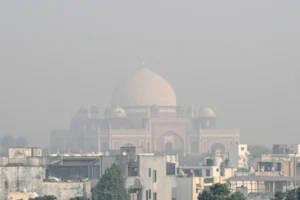




Delhi-NCR residents woke to slightly clearer skies on Tuesday after days of dense smog and hazardous pollution levels.
The India Meteorological Department (IMD) reported that surface winds ranging between 15 and 25 kmph helped disperse stagnant pollutants, offering temporary relief from the region’s toxic air.
According to officials, the improved wind movement allowed fine particulate matter to rise and spread, leading to a modest dip in the Air Quality Index (AQI).
While pollution levels have remained largely within the ‘very poor’ to ‘severe’ categories in recent weeks, several monitoring stations recorded values below the 300 mark on Tuesday.
In Noida, air quality readings showed mild progress.
Data from the Central Pollution Control Board (CPCB) and the Uttar Pradesh Pollution Control Board revealed that Sector 62 registered an AQI of 255, Sector 125 stood at 313, and Sector 116 recorded 307.
Delhi’s monitoring stations also reflected similar patterns. Pusa reported an AQI of 270, Shadipur 239, Vivek Vihar 323, Wazirpur 320, and RK Puram 313.
Despite the slight improvement, most locations remained within ranges known to trigger breathing discomfort.
Foggy Conditions Ahead as Winds Slow Down
The IMD forecast for 9 December indicates light fog, with temperatures expected to range between 9°C and 24°C. Morning wind speeds are likely to remain between 15 and 25 kmph.
Meteorologists anticipate a shift in conditions from 10 December, with shallow fog forming that day and dense fog developing on 11 December.
Temperatures are likely to dip further, with a minimum of 8°C on Tuesday and 7°C by Wednesday.
Officials caution that as wind speeds decrease midweek, pollution levels may rise again, reducing visibility and aggravating health risks.
An AQI reading up to 50 is considered ‘good’, while 51–100 is ‘satisfactory’, posing minimal risk except for sensitive groups.
Levels between 101 and 200 fall into the ‘moderate’ bracket, which may cause discomfort for people with respiratory or cardiac conditions.
Readings between 201 and 300 are categorised as ‘poor’, causing breathing difficulties for prolonged exposure.
The ‘very poor’ range, 301–400, increases the likelihood of respiratory illnesses even among healthy individuals.
Air quality experts classify any reading above 400 as ‘severe’, warning that it endangers all residents.
To read more such news, download Bharat Express news apps