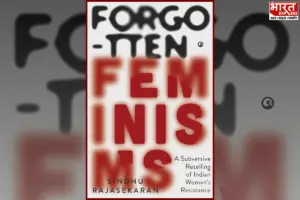




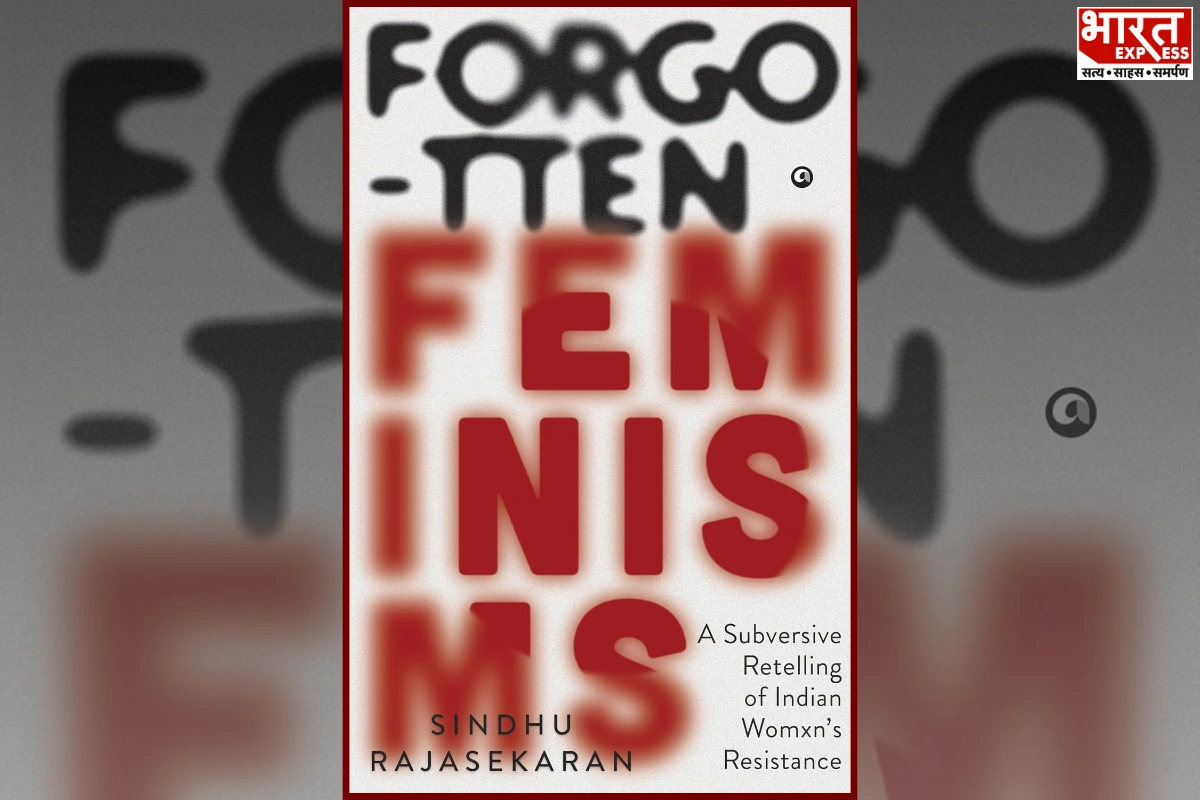
Sindhu Rajasekaran’s Forgotten Feminisms: A Subversive Retelling of Indian Womxn’s Resistance (Aleph Book Company, 2026) is a deliberate intervention in how Indian history is narrated.
Conventional accounts have often reduced Indian women to footnotes in the stories of ‘great men’ or cast them primarily as victims of patriarchy in need of rescue.
Rajasekaran rejects that framing. She argues that across centuries and social locations, Indian womxn (the spelling she deliberately chooses to signal gender fluidity and inclusion) actively resisted Brahmanical patriarchy, caste hierarchies and, later, British colonial rule.
The book is structured in clear historical sweeps. The opening section, ‘In an Antique Land’, moves from prehistory through ancient and medieval periods up to the colonial threshold.
Rajasekaran challenges the idea that ancient Indian society uniformly followed texts like the Manusmriti. Instead, she offers feminist retellings of figures such as the Vedic debater Gargi, Draupadi and Surpanakha from epic lore, the Kakatiya ruler Rudrama Devi, and the Ezhava woman Nangeli, remembered for her dramatic protest against the ‘breast tax’.
Courtesans, saint-poets, dasis, enslaved women and working-class figures appear not as peripheral curiosities but as agents who negotiated, subverted or openly defied the constraints of their time.
The second major section, ‘In Coloniality’, examines how British rule systematically sought to discipline Indian women’s and queer people’s sexuality, mobility and gender expression.
Colonial authorities branded many non-conforming women as ‘prostitutes’ and enacted laws that criminalised diverse practices. Yet resistance continued.
Rajasekaran highlights social reformers such as Savitribai Phule, warriors including Rani Lakshmibai and Jhalkaribai, rebellious sex workers like Piro Preman, and a range of trans women, labourers and tribal women who refused erasure.
Resistance and Recovery
A final ‘Coda’ turns to revolutionary women in the freedom struggle, workers’ and peasants’ movements, and anti-caste struggles, culminating in a call for a renewed ‘tryst with destiny’ grounded in these suppressed histories.
What distinguishes the book is its intersectional and decolonial approach.
Rajasekaran places subaltern, queer, Dalit and marginalised voices at the centre rather than treating them as add-ons to a mainstream narrative. She draws on oral folklore, devotional poetry, colonial archives and popular memory, employing what one review has called a self-described ‘jugaad’ methodology—resourceful, sometimes informal and deliberately resistant to rigid academic conventions.
The result is passionate and accessible rather than purely academic.
Critics have noted that this approach can occasionally blur empirical history and speculative recovery, and that the author’s personal investment sometimes leads to an almost celebratory tone.
Even so, the book succeeds in restoring a sense of continuous female agency that dominant historiography has long obscured.
Rajasekaran brings the right perspective and experience to this project. An engineer by training who later earned advanced degrees in English and creative writing, she is the author of the novel Kaleidoscopic Reflections, the short-story collection So I Let It Be, the widely discussed Smashing the Patriarchy: A Guide for the 21st-Century Indian Woman, and Forbidden Desire, which examines how colonialism disrupted South Asia’s queer pasts. Her work consistently returns to questions of gender, caste, sexuality and decolonial storytelling. Forgotten Feminisms extends that project into a broader historical reclamation.
Revisiting the Past
The book arrives at a moment when conversations about whose stories count in Indian history remain contested.
By insisting that resistance is not a modern import but a long-standing feature of the subcontinent’s social landscape, Rajasekaran invites readers to revise the inherited picture of passive or reformable womanhood.
Even if readers do not accept every interpretive leap, the cumulative effect remains powerful: these stories remind us that Indian womxn have debated, ruled, protested, created and survived for millennia—and deserve to tell those stories without apology or dilution.
In short, Forgotten Feminisms is less a quiet academic monograph than a fiery act of historical recovery. It asks readers to look again at the past and recognise the stubborn, inventive and often radical agency that has always been there.
Also Read: Chandrababu Naidu Meets PM Modi; Seeks Support For Andhra’s Key Development Projects
To read more such news, download Bharat Express news apps