



AI Generated Image
When the Citizen Knocks on the Door of Power: Inside Yogi Adityanath’s Janata Darshan
Yogi Adityanath’s Janata Darshan is a public hearing where citizens bring grievances directly to Uttar Pradesh’s Chief Minister, who issues directions to officials. It operates alongside Jansunwai UP and CM Helpline 1076, connecting face-to-face access with a wider administrative system. Understanding that connection helps distinguish an encouraging hearing from a complaint that produces documented relief.
What Happens at Yogi Adityanath’s Janata Darshan?
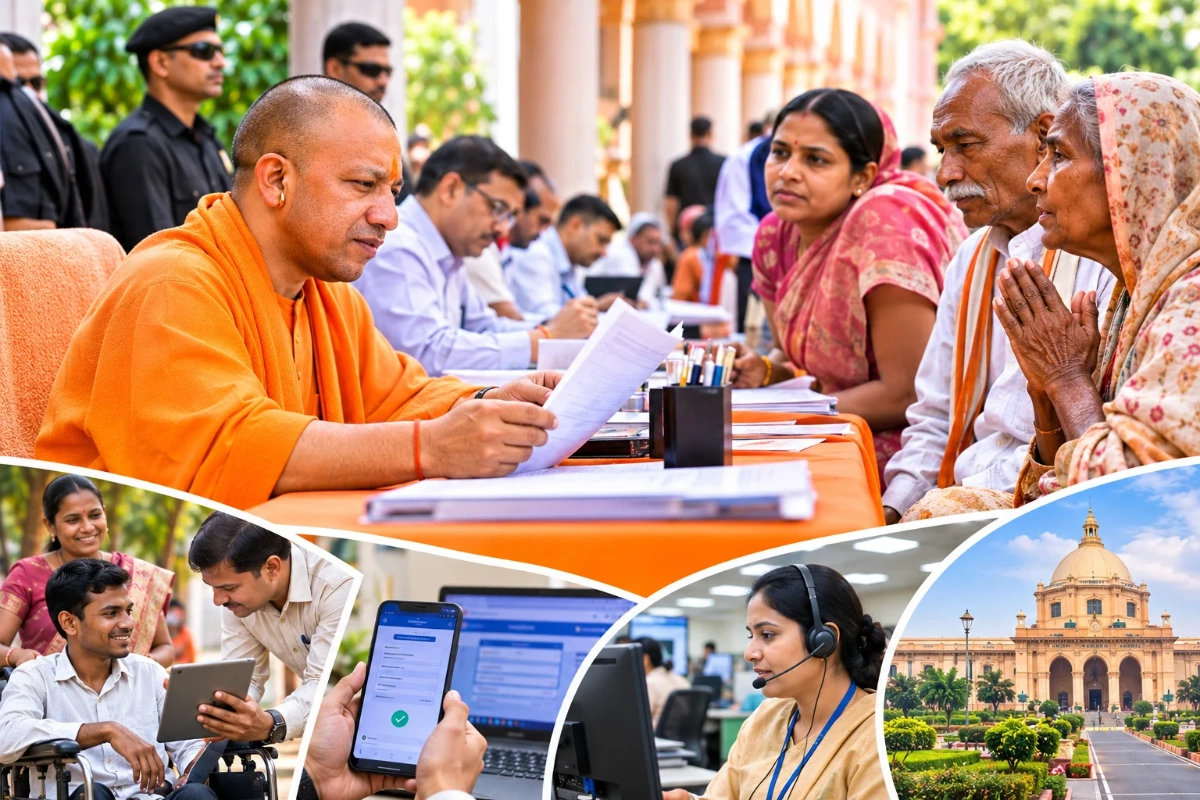
At Janata Darshan, citizens present their problems, the Chief Minister hears their concerns, and officials receive instructions for action. Reported sessions in Lucknow and at Gorakhnath Temple in Gorakhpur have involved land disputes, treatment assistance, pensions and access to welfare benefits. The hearing provides an opportunity to explain a problem directly, but the resulting administrative work still matters.
The administrative bridge is important: Uttar Pradesh’s October 29, 2018, helpline order requires applications received at the Chief Minister’s Janata Darshan to be entered into the grievance portal, scanned and uploaded. A petition should therefore become a traceable reference, rather than remain merely a document handed across a room.
For readers encountering the term UP CM Janta Darbar, the practical distinction is between presenting a grievance and resolving it. An instruction can initiate scrutiny or accelerate attention; it does not, by itself, establish that a pension has arrived or a disputed service has been restored. The meeting should be treated as the beginning of a verifiable administrative response, rather than its conclusion.
A History That Predates the Present Administration
Public hearings in Uttar Pradesh did not begin with the current Chief Minister. In April 2012, The Indian Express reported that Akhilesh Yadav had revived Janata Darshan, holding his first session on April 18. Contemporary reporting also documented Yogi Adityanath’s public hearings in Lucknow in April 2017. His programme belongs within an older practice of direct petitions to political leadership.
The digital system also has a distinct timeline. According to the official Jansunwai FAQ, the platform began at district level on January 25, 2016, and extended to other levels on February 20, 2016. These dates matter because Uttar Pradesh’s grievance redressal system developed across administrations rather than emerging through one initiative alone.
Telephone access expanded that infrastructure. A January 2019 government order records CM Helpline 1076’s trial operation from February 13, 2018; an official planning document identifies July 4, 2019, as its formal inauguration. The evolution is therefore best understood as a set of connected channels: office petitions, public hearings, online registration and telephone assistance.
The Machinery Behind a Grievance
Jansunwai’s Integrated Grievance Redressal System, or IGRS, connects complaints arriving through different routes. Government instructions cover applications submitted at district magistrate and police offices, local resolution days, public service centres, online channels and Janata Darshan. A 2025 parliamentary answer also confirms integration with the Union government’s CPGRAMS platform, allowing relevant complaints to be transferred to the state portal.
For telephone complaints, the published administrative process follows a defined chain:
- Registration: A call-centre operator records the grievance under the appropriate department and category.
- Assignment: The system forwards it to the department’s designated first-level officer, known as L-1.
- Acknowledgement: The complainant receives an SMS containing a reference number and information about the responsible officer’s designation.
- Departmental action: Officers examine the case under departmental procedures; incorrectly assigned references can be returned for rerouting.
- Review: District authorities monitor disposal and satisfaction, while higher administrative levels review quality and can inspect outcomes.
This is the working core of UP digital governance: the same complaint can carry an identifiable record across offices. Jansunwai also allows tracking, reminders when the stipulated period has passed, and feedback that higher officers may use to reopen a disposed complaint. These functions give citizens a way to challenge an inadequate response.
Citizen Experiences Reveal the Difference Between Attention and Relief
A September 8, 2025, Times of India report described Manju Devi Tripathi seeking financial assistance for medical treatment at a Lucknow Janata Darshan. Adityanath asked her to submit a hospital estimate. This documents an administrative next step, but the report does not establish that funding was subsequently released or treatment completed.
The same report described Udham Yadav, a person with a disability from Ghazipur, seeking a higher pension and benefits including housing and an Ayushman card. Officials were directed to address his requests, and the Chief Minister personally handed him an electronic walking stick. The account supports that immediate assistance, not a claim that every requested benefit was delivered.
These reported experiences make the system tangible without turning assurances into invented success stories. When reading Yogi Adityanath news, ask what the evidence establishes: attendance, an instruction, a sanctioned benefit or completed delivery. Each represents a different stage, and responsible assessment should keep them separate.
Does Grievance Disposal Demonstrate Effectiveness?
Disposal figures demonstrate administrative activity, but they do not automatically establish satisfactory resolution. Uttar Pradesh’s published data distinguish satisfactorily closed, specially closed and partially closed complaints. These categories make it important to examine how a case ended, rather than treating every closure as equivalent.
For April 4–August 16, 2022, the CM’s office reported 26,258 resolutions from 28,715 Janata Darshan complaints, according to Hindustan Times.
For the broader system, a government publication states that, by July 29, 2025, IGRS had received 59,198,358 references and disposed of 58,637,247. These are administrative reference totals, not necessarily distinct citizens or independently verified successful outcomes.
A separate 2025 state IT department presentation provides a more differentiated helpline snapshot:
| Reported Category | Count | Share of Complaints |
|---|---|---|
| Total complaints received | 13,693,150 | — |
| Satisfactorily closed | 8,523,846 | 62.25% |
| Specially closed | 4,728,130 | 34.53% |
| Partially closed | 288,133 | 2.10% |
The presentation also lists pending and defaulted cases. Its figures should be treated as a published snapshot, not a live dashboard total.
The category definitions and verification methods are not fully explained on that slide. Consequently, ‘satisfactorily closed’ is a more specific indicator than total disposal, but it still should not be presented as an independent impact evaluation. The figures show substantial processing capacity; they leave open questions about durability, repeat complaints and whether relief reached the person concerned.
Accessible Leadership Must Strengthen Institutional Accountability
Accessible leadership means citizens can make their concerns heard without an impenetrable chain of intermediaries. Institutional accountability goes further: an identifiable office must explain its response, document its action and face review when the response is inadequate. The distinction is between being heard by someone powerful and receiving an answer from the institution responsible.
Janata Darshan’s potential lies in connecting these two principles. The requirement to register petitions, district-level monitoring, departmental review and provision for field verification create an administrative framework beyond the encounter itself. Jansunwai’s feedback mechanism adds another opportunity for higher officers to reconsider a disposed case.
A fair assessment of Yogi Adityanath’s public service should therefore ask whether leadership access improves ordinary departmental performance. Useful measures would include independently checked outcomes, repeat-grievance rates, time to actual relief and whether citizens can secure corrections without travelling to meet the Chief Minister. These are proposed accountability tests, not results established by the cited disposal totals.
Preparing a Complaint That Can Be Followed Through
For citizens navigating public grievances in UP, preparation should focus on making the problem clear and the response traceable:
- Write a concise chronology: Explain what happened, which office you approached and what remains unresolved.
- Specify the requested action: Distinguish a delayed payment, incorrect record or service refusal from a general request for assistance.
- Organise supporting copies: Include relevant applications, acknowledgements, correspondence and earlier reference numbers.
- Keep a follow-up record: Note submission dates and compare the eventual response with the action you requested.
Jansunwai UP offers online registration and tracking, while CM Helpline 1076 provides telephone access. After disposal, read the response rather than relying on the status label. The portal’s feedback page currently permits feedback on cases disposed of within the preceding three months and identifies one- or two-star ratings for higher-level reconsideration.
The Real Test Comes After the Hearing
A meeting between Yogi Adityanath and petitioners can make an overlooked problem visible. Its lasting value, however, should be judged after the citizen returns home: was the problem investigated, was the response reasoned, and did the promised action occur? Accessible leadership is most meaningful when it makes everyday institutions answerable—not when personal access becomes the only apparent route to relief.
Also Read: Right To Live Without Fear In Uttar Pradesh: Safety & Reforms
To read more such news, download Bharat Express news apps