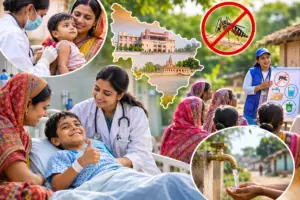




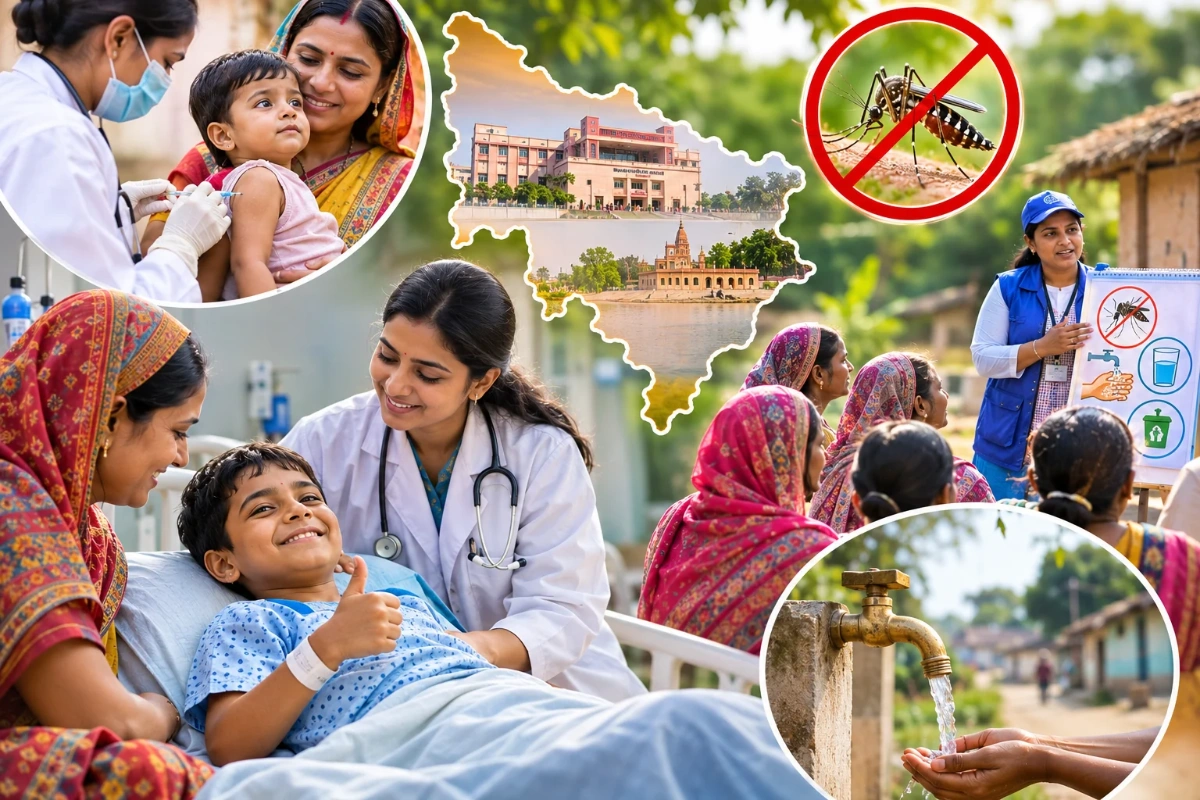
AI Generated Image
The Children Who Deserve a Tomorrow: Uttar Pradesh’s Battle Against Encephalitis
Eastern Uttar Pradesh’s struggle against encephalitis is a story of children lost, families changed and public health learning to respond. Vaccination, community outreach, sanitation initiatives and stronger medical services have helped reduce the burden, although prevention and timely treatment remain essential. Understanding the Uttar Pradesh encephalitis crisis means looking beyond hospital statistics to the journeys families make—and the support survivors need.
Why Has Encephalitis Devastated Eastern Uttar Pradesh?
Eastern Uttar Pradesh has faced recurring encephalitis outbreaks because several risks overlap: environments favourable to disease vectors, multiple infections capable of causing neurological illness, and delays in reaching appropriate care. Gorakhpur and neighbouring districts have recorded seasonal acute encephalitis syndrome outbreaks since 1978, particularly among children. Japanese encephalitis was an important cause, but research subsequently revealed that it could not explain every outbreak.
The human consequences become clearer at a hospital bedside. In an October 2021 report, ThePrint described three-year-old Sooraj from Kaptanganj, whose mother, Savita, recounted seeking help through a local health centre and a private hospital before seizures prompted a journey to BRD Medical College in Gorakhpur. At the time of reporting, he was unconscious and receiving ventilator support. His story illustrates the difficult referral journeys behind the phrase ‘Gorakhpur encephalitis’.
It also changes the question communities must ask. Hospital capacity matters, but so does what happens between the first fever and arrival at an emergency ward.
A History Measured in Monsoons and Hospital Journeys
The geography of Gorakhpur and Basti divisions helped shape the crisis. Rice-growing areas, accumulated water and heavy rainfall created conditions favourable to mosquitoes transmitting Japanese encephalitis virus. During the severe 2005 epidemic, researchers documented thousands of affected people across seven eastern Uttar Pradesh districts.
A parliamentary answer recorded 5,581 encephalitis cases and 1,387 deaths in Uttar Pradesh during 2005. These were statewide reported figures, not a count restricted to Gorakhpur or laboratory-confirmed Japanese encephalitis. Keeping those distinctions visible matters when comparing historical accounts.
BRD Medical College became central both to treating children and investigating outbreaks. Researchers analysed specimens from patients admitted there during the 2005 epidemic, identifying Japanese encephalitis virus. The institution’s contribution therefore extended beyond emergency care: its patients and clinicians helped build the evidence needed for prevention.
The Scientific Breakthrough Beyond a Single Virus
Encephalitis means inflammation of the brain. Acute encephalitis syndrome, or AES, is a clinical surveillance category involving acute fever with altered mental status and/or new seizures; it is not the name of one infection. Japanese encephalitis is one cause, while other viral and non-viral infections can produce similar illness.
This distinction transformed understanding of encephalitis in Uttar Pradesh. Research involving BRD clinicians Mahima Mittal and Mahim Mittal, epidemiologist Manoj Murhekar and colleagues from ICMR institutions identified scrub typhus as an important cause of AES in the region. Scrub typhus is a bacterial infection, not viral encephalitis, making accurate diagnosis crucial to treatment decisions.
A Gorakhpur study of acute febrile illness reported a median seven-day interval between fever onset and visiting a health facility. Its findings supported earlier recognition and clinician-directed treatment of scrub typhus before severe complications developed. The practical lesson was clear: the response had to begin before a child reached a specialist ward.
How Do Vaccination and Community Prevention Work Together?
Vaccination prevents Japanese encephalitis, while broader encephalitis prevention requires early fever recognition, appropriate referral and measures addressing different infection risks. No single vaccine protects against every cause of AES. Families therefore need both reliable immunisation services and clear advice about seeking care when illness develops.
India began JE immunisation campaigns in 2006. Under the national schedule, children in endemic districts receive JE vaccine doses at 9–12 months and 16–24 months. Parents should ask their local vaccination team to review missed doses rather than assume that an earlier campaign completed their child’s protection.
The state government launched Dastak in 2018 with UNICEF support, bringing prevention messages to households. Health, rural development and education departments were assigned shared responsibilities, including vaccination, clean drinking water, sanitation and early treatment. Under Yogi Adityanath, encephalitis prevention became a prominent cross-departmental programme, building on earlier national vaccination and surveillance work.
Useful household actions include:
- Check vaccination records: Confirm JE eligibility and dose completion with the local health team.
- Reduce mosquito exposure: Use suitable repellents, protective clothing and window screens where possible.
- Support sanitation measures: Cooperate with local clean-water and environmental-cleanliness activities.
- Act on fever: Seek assessment promptly rather than waiting for neurological symptoms.
Sanitation and Healthcare Must Reach the Same Villages
Dastak’s significance lies partly in treating prevention as a community responsibility rather than a hospital-only task. Its design connects household awareness with drinking-water provision and sanitation drives. These measures should not be confused with a claim that contaminated water directly causes mosquito-borne JE; different AES causes require different preventive responses.
UP healthcare development has also included encephalitis treatment centres at community-level facilities, district paediatric intensive care capacity, ambulance services and fever tracking. The purpose is practical: stabilise children earlier and reduce dependence on one distant referral hospital.
AIIMS Gorakhpur added another major institution to the regional network. Its outpatient services began in February 2019 and inpatient services in May 2021; the complex was inaugurated in December 2021. The new ICMR–Regional Medical Research Centre building was inaugurated that month, strengthening research infrastructure alongside clinical capacity.
Yet buildings alone cannot complete the task. The medical colleges Uttar Pradesh families depend on need dependable staffing, supplies, referral communication and follow-up. These should remain practical tests of UP health schemes, rather than judging progress through construction announcements alone.
The Decline Is Real, but Statistics Need Careful Reading
Official surveillance shows substantial reductions in reported illness and deaths. The National Centre for Vector Borne Diseases Control records the following statewide figures; they should not be presented as eastern Uttar Pradesh-only totals.
| Reported Measure in Uttar Pradesh | 2017 | 2022 |
|---|---|---|
| AES cases | 4,724 | 1,199 |
| AES deaths | 654 | 32 |
| JE cases | 693 | 124 |
| JE deaths | 93 | 4 |
Source: NCVBDC surveillance table. AES and JE are shown as reported; the categories should not simply be added together.
The Uttar Pradesh Economic Survey 2025–26 reports further progress against the 2017 baseline: an 85% reduction in AES cases and a 91% reduction in JE cases by 2025. It reports AES case fatality falling from 13.87% to 0.86%, and JE case fatality from 13.42% to 3.17%. These are government-reported statewide comparisons, not proof that transmission has ended.
For readers following Uttar Pradesh news about Japanese encephalitis, the distinction matters: reported case counts, population incidence, deaths and case-fatality rates measure different things. Progress deserves recognition without turning reduced numbers into a declaration of eradication.
What Encephalitis Symptoms Require Urgent Medical Attention?
Fever accompanied by confusion, unusual drowsiness, seizures or reduced consciousness requires immediate emergency assessment. Encephalitis symptoms can also include headache, vomiting and weakness. A child with neurological warning signs should not wait for a routine appointment or a home remedy to work.
Encephalitis treatment depends on the cause and severity. Japanese encephalitis has no specific antiviral cure; care focuses on stabilisation, seizure management, breathing and other complications. Bacterial causes such as scrub typhus require different clinician-directed treatment, which is why families should not self-prescribe antibiotics.
Recovery also extends beyond discharge. Survivors may need rehabilitation and help with movement, learning or behaviour. WHO recognises the continuing medical, educational and social consequences for children and their families.
A Tomorrow Worth Protecting
Eastern Uttar Pradesh’s progress reflects work across generations: families seeking care, clinicians treating children, researchers identifying causes, vaccination teams reaching communities, and governments coordinating services. No single institution or political term explains the entire change.
The next measure of success should be equally human: fewer frightening referral journeys, timely treatment close to home, and sustained support for every surviving child. A falling death count is an achievement. A child able to return to school, play and family life is the future that achievement should protect.
Also Read: Empowering Women In Uttar Pradesh: Opportunities & Social Change
To read more such news, download Bharat Express news apps