



There is a particular irony about history. Stone can survive for two thousand years, while a man’s name can disappear in two hundred. At Sarnath, near Varanasi, the stones survived.
The stupas survived. The remains of monasteries survived. Fragments of the Ashokan pillar survived. From this soil emerged the celebrated Lion Capital of Ashoka—the four lions that would eventually become the State Emblem of independent India.
But one Indian name, standing close to the beginning of Sarnath’s modern archaeological story, gradually receded from public memory.
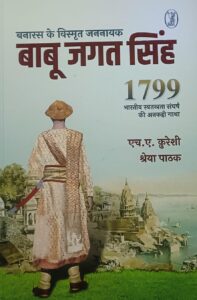
Babu Jagat Singh
For generations, visitors to Sarnath encountered a narrative in which the great archaeological awakening of the site appeared principally through British names: Jonathan Duncan, Colin Mackenzie, Alexander Cunningham and the archaeologists who followed them.
Jagat Singh appeared, when he appeared at all, in a less flattering role—associated with the dismantling of the ancient Dharmarajika Stupa for building material.
That version contained a fact. It did not contain the whole truth.
In March 2026, the Archaeological Survey of India formally acknowledged that the earliest excavation at Sarnath was undertaken by Babu Jagat Singh and that it led to the historical significance of the site coming to light.
ASI Director-General Y S Rawat said the conclusion followed examination of documentary evidence submitted to the institution. The inscription at Sarnath was revised accordingly.
More than two centuries after the digging began, an Indian name had returned to the place where the story started.
And behind that restoration lies another remarkable story: that of Pradeep Narayan Singh, Jagat Singh’s sixth-generation descendant, who chose not merely to inherit a family memory, but to test it against history.
The question is not who ‘discovered’ Sarnath.
The popular question is irresistible: Who discovered Sarnath? It is also slightly misleading. Sarnath was not a lost city suddenly found by one heroic explorer.
The great Dhamekh Stupa remained visible. European travellers had seen ruins in the area before the excavations associated with Jagat Singh. The sacred memory of Sarnath had not vanished completely either.
UNESCO itself describes Sarnath as having declined after the 12th century, fallen into obscurity and been rediscovered in the 18th century.
The more precise—and much more interesting—question therefore is:
Who initiated the excavation that first brought the buried archaeological importance of Sarnath to light in the modern era?
Today, the ASI’s answer begins with Babu Jagat Singh. That distinction matters.
Because history becomes unreliable when a complex process is reduced to a single heroic name. But it becomes equally unreliable when the first link in a chain is forgotten.
Before Cunningham, there was Jagat Singh
Travel back to Banaras in the closing years of the eighteenth century.
India had no Archaeological Survey. Modern archaeology, as an institutional discipline, did not yet exist here.
Ancient structures were often treated as convenient sources of brick and stone. The modern idea of a protected archaeological monument belonged to another age.
It was in this world that Babu Jagat Singh was associated with digging at Sarnath.
Recent documentary research presented to the ASI places the beginning of his excavation activity around 1787-88.
Pradeep Narayan Singh has cited records indicating that Jagat Singh undertook excavation in the area during this period.
Older archaeological literature, meanwhile, records the dramatic opening of the Dharmarajika Stupa and the discovery of a relic deposit in 1794.
These dates have sometimes been presented as contradictory. They need not be.
A more careful reconstruction suggests that the excavation activity began earlier, while the discovery for which a strong contemporary documentary record survives—the opening of the relic chamber—occurred in 1794.
That is not a minor editorial distinction.
It is the difference between repeating history and understanding it.
Eighteen cubits below the surface
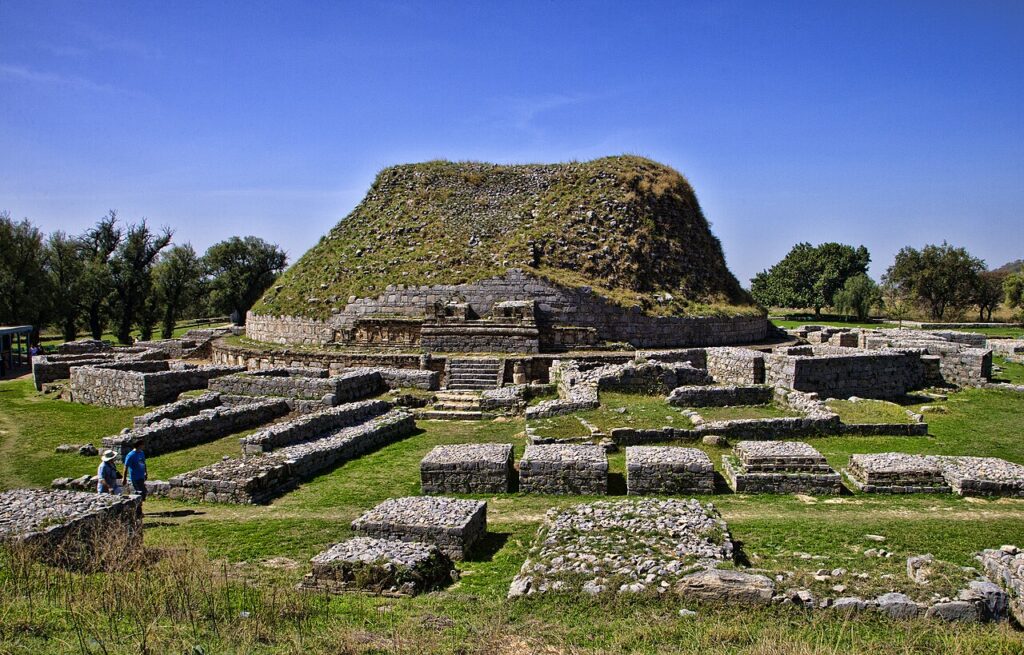
The Dharmarajika Stupa was among Sarnath’s most important ancient monuments.
During the digging associated with Jagat Singh, workers penetrated deep into the structure.
There, according to old archaeological accounts, they encountered a stone container enclosing a smaller green marble reliquary. Human remains and precious objects were reported among the contents.
That discovery attracted the attention of Jonathan Duncan, then the British Resident at Banaras.
Duncan documented the find, and an account appeared in Asiatic Researches.
That act of documentation was historically important. But there is an elementary distinction that later retellings sometimes blurred: the man who records a discovery is not necessarily the man whose action produced it.
Duncan gave the event documentary life. The excavation had already taken place. And the excavation led back to Jagat Singh.
This is one of those deceptively simple observations that can change the architecture of an entire historical narrative.
Was Jagat Singh an archaeologist? No. That makes the story more credible, not less.
There is a temptation, when correcting an injustice of memory, to travel too far in the opposite direction.
We should resist it.
Babu Jagat Singh was not a modern archaeologist conducting a scientific excavation according to twenty-first-century conservation standards.
Nor should the damage suffered by the Dharmarajika Stupa be concealed.
The excavation was connected with the extraction of building material. Ancient masonry was disturbed. By contemporary standards, no serious historian would describe the exercise as archaeological conservation.
That fact has long formed part of the case against Jagat Singh. But history must hold two truths simultaneously. The activity damaged an ancient monument.
And that same activity exposed archaeological evidence that helped bring Sarnath’s buried past back into historical consciousness.
One truth does not abolish the other.
Good history rarely gives us the comfort of perfectly virtuous protagonists.
It gives us human beings, consequences, and evidence.
Then came the British archaeologists—and their contribution was real
Restoring Jagat Singh does not require diminishing those who came later. That would merely replace one distortion with another. Jonathan Duncan documented the early discovery.
Colonel Colin Mackenzie subsequently explored the site. Alexander Cunningham carried out significant investigation at Sarnath in the nineteenth century. Markham Kittoe continued archaeological work.
F O Oertel’s major excavation in 1904–05 produced discoveries of extraordinary consequence, including the remains associated with Ashoka’s pillar and the magnificent Lion Capital.
Later work by John Marshall, H Hargreaves, Daya Ram Sahni and others transformed Sarnath from a landscape of ruins into one of India’s best understood ancient Buddhist sites.
Each belongs in the story.
The correction is not: Cunningham was wrong; Jagat Singh was right. The correction is: Jagat Singh came earlier.
That is an altogether more sophisticated proposition; and the evidence now persuaded the Archaeological Survey of India itself.
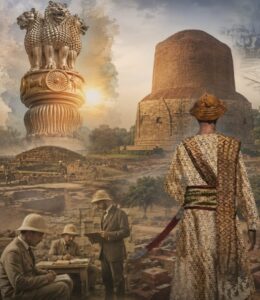
The archives remembered what public memory forgot.
There is another fascinating detail. The historical record did not entirely lose Jagat Singh.
Researchers have pointed to nineteenth- and early twentieth-century references in which the monument was described as ‘Jagat Singh’s Stupa’.
A 2025 academic commentary by former Banaras Hindu University professor Rana P B Singh and Priyanka Jha noted references to this name in archaeological material, including the work associated with Markham Kittoe and Daya Ram Sahni.
The same paper argued that later narratives increasingly cast Jagat Singh primarily as a destroyer rather than as an early explorer of the site.
This produces one of the most intriguing questions in the entire affair:
How does a name remain in the archive yet disappear from popular understanding?
There is rarely one answer. History is shaped not simply by what happened, but by what was documented, translated, classified, taught, repeated, abbreviated and eventually put on plaques.
Repetition gives authority even to incomplete narratives. Once a version appears in a guidebook, another writer cites it. Then another. A generation later, the footnote becomes common knowledge.
That is how institutional memory works. And that is also why institutional correction matters.
Then a descendant decided to ask a dangerous question.
For Pradeep Narayan Singh, the matter was not an academic exercise. Babu Jagat Singh was his ancestor. But family memory alone does not rewrite history. Nor should it.
A descendant saying, ‘My ancestor deserves credit’, is a claim. A descendant arriving with archival records is evidence.
That difference defines what happened next. A five-year research project running from 2019 to 2023 examined colonial correspondence and records in multiple archives.
An academic account of that research says the project was patronised by Pradeep Narayan Singh and ultimately resulted in a substantial research document and published work on Jagat Singh’s life and historical role.
Researchers examined material connected with repositories in India and overseas.
Old accounts were compared. Colonial correspondence was revisited. Archaeological references were re-read.
The family story was subjected to the harder discipline of documentary verification.
That choice deserves attention. Because the most powerful way to challenge history is not indignation. It is evidence.
A plaque may look small. What it teaches is enormous.
Eventually, the evidence reached the Archaeological Survey of India.
The process did not conclude with a commemorative speech.
It resulted in an institutional change.
ASI correspondence instructed that the Cultural Notice Board at Sarnath be revised. A new inscription was installed. Earlier, the Dharmarajika plaque had also been amended. In March 2026, the ASI publicly acknowledged Jagat Singh’s role in the earliest excavation.
To the casual visitor, changing a few lines on a heritage plaque may seem like an administrative fix. It is anything but.
A plaque at a monument is a miniature textbook. A schoolchild reads it. A tourist photographs it. A guide repeats it. A documentary borrows from it. A website paraphrases it. A journalist cites it.
Millions of small acts of repetition turn those few sentences into collective memory.
So when an institution corrects a plaque after reviewing primary evidence, it is doing more than changing words.
It is altering what the next generation will remember.
What Pradeep Narayan Singh actually achieved
It would be easy to tell this as a sentimental tale of a descendant restoring the honour of an ancestor. That would undersell it. The larger achievement is methodological.
Pradeep Narayan Singh’s campaign demonstrates something important about cultural memory: heritage is not preserved merely by protecting stones; it is preserved by continually testing the stories we attach to them. A monument can be perfectly conserved while its history remains incomplete.
Conversely, recovering a forgotten name does not require destroying the reputations of those already present.
The mature approach is additive.
- Keep Duncan.
- Keep Mackenzie.
- Keep Cunningham.
- Keep Oertel.
But put Jagat Singh where the evidence says he belongs. That is not revisionism in the pejorative sense. That is what scholarship is supposed to do. New evidence should improve old understanding.
The deeper story may be larger than Sarnath
Babu Jagat Singh’s life itself opens another historical door.
Research associated with the project has examined his role in the political turmoil of Banaras at the end of the eighteenth century and resistance to expanding East India Company authority.
The 2025 academic commentary describes a body of research concerning civil unrest in 1799, British proceedings against Jagat Singh and his subsequent punishment.
It also makes an important scholarly caution: aspects of the modern rehabilitation of Jagat Singh invite further critical examination rather than unquestioning celebration.
That caution makes the research stronger. History should not exchange colonial hagiography for nationalist hagiography.
It should exchange incomplete evidence for better evidence. There remains much to investigate about Jagat Singh—his political life, his relationship with the Banaras estate, the events of 1799, the circumstances of the excavation and even the subsequent fate of relics associated with the early discovery.
A restored name should be the beginning of research, not its end.
And then, in 2026, history completed an extraordinary circle
Months after Jagat Singh’s contribution received renewed official recognition, Sarnath itself reached another historic milestone.
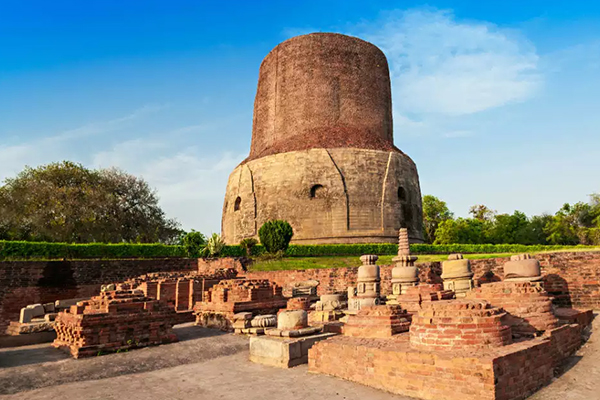
On 25 July 2026, at the 48th session of the UNESCO World Heritage Committee in Busan, South Korea, the Ancient Buddhist Site of Sarnath was inscribed on the UNESCO World Heritage List.
It became India’s 45th World Heritage property.
UNESCO recognises Sarnath for reasons far larger than any modern archaeological dispute.
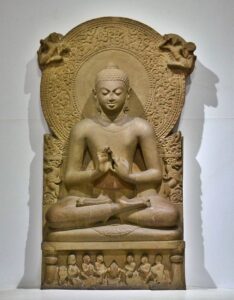
This is the landscape where Buddhist tradition holds that Gautama Buddha delivered his first sermon after enlightenment and gathered his earliest disciples.
It is one of Buddhism’s principal places of pilgrimage.
For centuries, rulers, monks and ordinary devotees built stupas, monasteries and temples here.
Its archaeological remains span an extraordinary civilisational arc.
And among those remains emerged an object that now belongs to every Indian.
From Buddha’s first sermon to the emblem of modern India
The symbolism of Sarnath is almost too perfect.
Here, Buddhist tradition locates the first turning of the Wheel of Dharma.
Centuries later, Emperor Ashoka monumentalised that moral and political imagination in stone.
More than two millennia after Ashoka, independent India chose the Lion Capital of Sarnath as its State Emblem.
Four lions standing back to back.
- The wheel.
- The horse.
- The bull.
The Lion Capital became a visual signature of the Republic after its excavation from the ancient Buddhist site. It now features on government documents, in courtrooms, across state institutions and on Indian passports.
Sarnath, therefore, is not simply somewhere India keeps its past.
It is somewhere India’s past continues to speak through its present.
And that makes the question of how its history is narrated more than an antiquarian argument. It concerns national memory.
There are two kinds of rediscovery in this story
The first happened beneath the earth. An ancient site was excavated. Relics emerged. Scholars arrived. Archaeology followed. The second happened in archives.
Documents were opened. Old assumptions were questioned. A forgotten role was reconstructed. An institution reconsidered its own account.
The first rediscovery brought Sarnath back into history. The second brought Babu Jagat Singh back into the history of Sarnath.
That symmetry gives this story its unusual power. And there is a third figure standing quietly between the two eras:
Pradeep Narayan Singh. He did not excavate a stupa. He excavated the record.
Pradeep Narayan He searched not beneath earth, but beneath layers of repetition. And perhaps that is why his journey matters beyond his family.
Every civilisation inherits two things from the past: its monuments, and its assumptions.
We are usually much better at protecting the first.
The lesson is not to rewrite history. It is to keep history open.
There is a fashionable phrase today: ‘correcting history’. It can become dangerous when it means choosing a preferred conclusion first and searching for evidence afterwards.
The Sarnath episode offers a better model. Start with a question. Search the archives. Invite scholars. Present the records.
Allow the responsible institution to examine them. Correct what the evidence justifies. Leave open what remains uncertain. That process lacks the drama of a slogan.
It is also far more valuable. Peter Drucker famously made institutions think about the difference between doing things efficiently and doing the right things.
In heritage, there is a comparable distinction. We can preserve a monument efficiently.
But preserving truthfully what the monument means is the greater responsibility.
Because heritage without accurate memory eventually becomes decoration.
Babu Jagat Singh does not need mythology
Perhaps the greatest respect Bharat can pay Babu Jagat Singh now is not to transform him into another flawless legend. He does not need one.
His documented place in Sarnath’s story is significant enough. The excavation associated with him damaged an ancient structure.
It also exposed material that helped reveal the site’s archaeological importance. British officials documented what followed.
Later archaeologists investigated it systematically. Modern scholarship reconstructed the sequence. And the Archaeological Survey of India eventually revised the public account. That is history in all its complexity. It is more compelling than mythology because it is human.
One name restored. One question left for India.
Walk through Sarnath today and its history appears monumental.
- Ashoka.
- Buddha.
- Stupas.
- Monasteries.
- The Lion Capital.
- UNESCO.
But history is not made only by emperors, prophets and institutions. Sometimes it survives because somebody refuses to accept that the last version of the story must be the final one.
For years, Pradeep Narayan Singh carried a family question into archives. He could have asked India simply to believe him.
Instead, he went looking for proof. That is why this is not merely a story about ancestral honour.
It is a story about the discipline of memory. About the humility required to admit that an institution’s account can be incomplete.
About the courage to challenge an inherited narrative without erasing those who came later.
And about a country learning that reclaiming its history does not mean rejecting every colonial source.
Sometimes those very records contain the evidence necessary to restore the people colonial narratives left in the margins.
There may be many more Jagat Singhs waiting there.
- In district records.
- In forgotten correspondence.
- In archaeological reports nobody has opened for decades.
- In family trunks.
- In Persian petitions.
- In footnotes.
- In libraries.
Their stories should not be recovered because they are Indian. They should be recovered if the evidence shows that history has not given them their rightful place.
That distinction is everything. More than two centuries ago, the earth at Sarnath surrendered part of its secret.
In our own time, the archives surrendered another. The first gave India an ancient past to rediscover.
The second returned an Indian name to that rediscovery.
Babu Jagat Singh. And perhaps the finest tribute to both him and the descendant who pursued his story is not to say that history has finally been rewritten. It is to say something quieter, and more truthful: History has been read again. This time, more carefully.
To read more such news, download Bharat Express news apps