



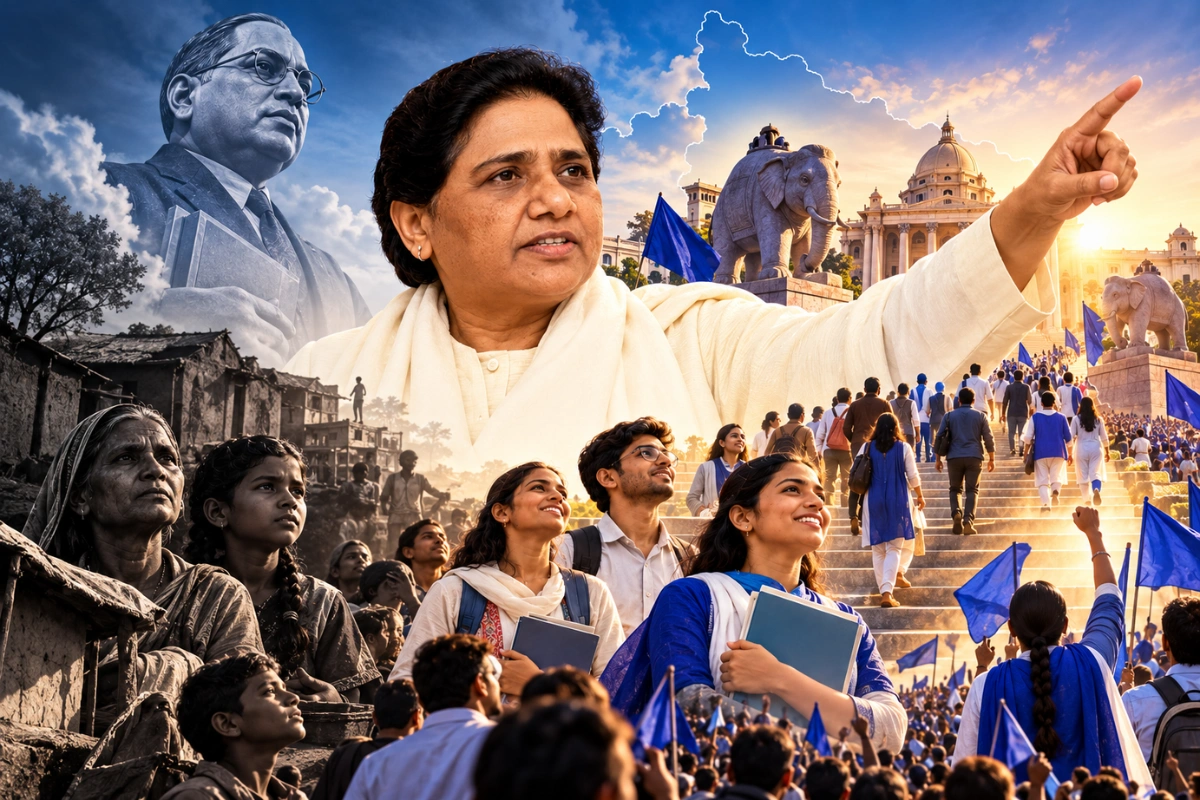
AI Generated Image
Mayawati’s political journey is one of the most striking examples of how representation can alter the imagination of social mobility. Her rise from a Dalit background to multiple terms as Chief Minister of Uttar Pradesh turned electoral politics into a language of dignity, assertion, and access for communities historically kept at the margins. The story of Mayawati’s social mobility is not only about one leader’s ascent; it is about how power, symbolism, policy, and organisation can change what people believe is possible.
Her legacy remains debated, but its central lesson is clear: social change does not happen only through economic growth or moral appeals. It also happens when excluded groups gain political representation, build political influence, and learn to negotiate with institutions that once ignored them.
What Made Mayawati’s Rise More Than an Election Story?
Mayawati’s rise mattered because it challenged the inherited assumption that political authority in North India naturally belonged to upper castes, wealthy families, or male-dominated party networks. When she first became Chief Minister of Uttar Pradesh on June 3, 1995, she became the state’s first Dalit Chief Minister and India’s first woman Dalit Chief Minister, a milestone that carried symbolic weight far beyond one oath-taking ceremony.
That symbolism was not decorative. For many Dalits, especially in Uttar Pradesh, her position in office made visible a possibility that caste society had long tried to suppress: that those treated as subjects of welfare could become makers of policy, controllers of administration, and arbiters of political alliances. In a democracy where numbers matter, Mayawati showed that social exclusion could be converted into organised electoral strength.
The phrase ‘Mayawati social mobility’ therefore points to a larger blueprint. It is the movement from invisibility to visibility, from dependence to bargaining power, and from being represented by others to claiming the right to represent oneself. That shift did not erase caste dynamics, but it changed the terms on which caste had to be discussed.
The Foundation Was Dignity Before Development
Many conversations about economic upliftment begin with income, jobs, or assets. Those matter deeply, but Mayawati’s politics began with a prior question: who is allowed to stand upright in public life? For communities degraded by caste hierarchy, dignity is not abstract. It appears in how officials speak to citizens, whose icons are honoured, whose neighbourhoods receive attention, and whose grievances are treated as legitimate.
This is why her politics placed such emphasis on assertion. The Bahujan Samaj Party, founded by Kanshi Ram in 1984, was built around the idea that the ‘Bahujan’, or majority made up of Scheduled Castes, Scheduled Tribes, Other Backward Classes, and minorities, should become a governing force rather than a permanent vote bank. Mayawati inherited and sharpened that message through a style that was direct, disciplined, and often confrontational towards entrenched elites.
For supporters, this was empowering because it broke the etiquette of deference. In caste society, hierarchy often survives through small daily performances: who waits, who speaks softly, who receives respect, who is made to prove worthiness. Mayawati’s public image reversed that script. She did not present herself as a grateful beneficiary of inclusion; she presented herself as a leader with a mandate.
That matters because social mobility is never purely individual. A person may rise through education or employment, but a community rises when the public meaning attached to that community changes. Mayawati’s politics sought to change that meaning.
Representation Became a Form of Infrastructure
Political representation is sometimes treated as a softer concern than roads, schools, or jobs. Mayawati’s career suggests the opposite. For marginalised communities, representation can function like infrastructure because it creates channels through which claims can travel.
When a community sees people like itself in authority, three practical things change:
- Access Feels Less Forbidden. Citizens who assume the state belongs to others may hesitate to approach it. Representation can make police stations, district offices, and party offices feel less distant.
- Grievances Become Politically Legible. Issues that were dismissed as local irritation can become part of a larger agenda when organised through party structures.
- Ambition Becomes Collective. A leader’s rise can make education, government service, and political participation seem more attainable to younger people watching from below.
- Negotiation Replaces Pleading. Communities with electoral strength can bargain with parties instead of waiting for goodwill.
This is one reason the Mayawati model cannot be measured only by whether every promise translated into material prosperity. Its deeper impact was to normalise the idea that Dalits could be central actors in state power. That is a form of social change that precedes, and sometimes enables, economic change.
At the same time, representation by itself is not enough. It must connect to institutions, budgets, protections, and opportunities. Mayawati’s significance lies in how she joined symbolic presence with electoral organisation, making identity a platform for bargaining rather than a badge of victimhood.
How Did Mayawati Reshape Caste Dynamics?
Mayawati reshaped caste dynamics by refusing to treat caste merely as a social problem to be wished away; she treated it as a political reality that had to be organised, confronted, and strategically negotiated. Her approach recognised that caste already structured access to power, so the answer was not silence about caste but a new distribution of political influence.
In her early political appeal, Dalit assertion was central. This was not simply about winning reserved seats or speaking in the name of the oppressed. It was about building a confident voting bloc that could discipline larger parties, punish neglect, and reward recognition. That altered the relationship between Dalits and mainstream parties, which had often expected loyalty without offering leadership.
Later, especially in the run-up to the 2007 Uttar Pradesh election, Mayawati expanded the BSP’s approach through what was widely described as ‘social engineering’. The party sought to combine its Dalit base with support from Brahmins and other groups, moving from a strictly oppositional Bahujan frame towards a broader ‘sarvjan’ appeal. Reports at the time noted the importance of the Dalit-Brahmin alliance in the BSP’s strategy.
This shift was politically significant because it did not abandon caste; it rearranged caste arithmetic. Instead of accepting the idea that upper castes would always lead and Dalits would always follow, Mayawati tried to build a coalition in which Dalits remained the anchor. The message was subtle but powerful: inclusion did not have to mean dilution if the core group retained organisational control.
For critics, this raised difficult questions. Did broad coalition-building soften the transformative edge of Dalit politics? Did it require compromises with groups historically associated with caste privilege? Those questions are valid. But strategically, the move showed that empowerment could involve both assertion and alliance-making. In a vast and diverse state like Uttar Pradesh, moral clarity alone was not enough to govern; numbers had to be assembled.
The 2007 Majority Showed the Power of Organised Aspiration
The 2007 Uttar Pradesh Assembly election remains a key moment in understanding Mayawati’s social mobility as a political project. The BSP won 206 of 403 seats, securing a clear majority in India’s most populous state at the time and allowing Mayawati to form a government without depending on coalition partners.
That majority mattered because earlier phases of her Chief Ministership had been shaped by unstable alliances. The official Uttar Pradesh Legislative Assembly record lists her earlier tenures in 1995, 1997, and 2002–2003 before her full 2007–2012 term. In 2007, the BSP’s victory suggested that a Dalit-led party could move from protest power to governing power.
The practical lesson was not simply that caste coalitions win elections. It was that communities historically excluded from elite networks could build disciplined political machinery. Booth-level mobilisation, clear messaging, candidate selection, and leadership control all mattered. Mayawati’s politics showed that aspiration becomes powerful when it is organised.
The 2007 victory also changed how rivals understood Dalit voters. They could no longer be treated as passive recipients of welfare or symbolic gestures. They were a decisive political constituency capable of shaping government formation. That recognition itself contributed to political representation across the spectrum, as other parties had to speak more directly to Dalit concerns.
Economic Upliftment Needs Power, Not Pity
Economic upliftment is often discussed as if disadvantaged communities only need schemes designed by benevolent rulers. Mayawati’s politics offered a different premise: communities need power to influence which schemes are created, how they are administered, and whether benefits actually reach them.
This distinction matters. Poverty and caste discrimination overlap, but they are not identical. A Dalit family may face economic hardship, social humiliation, administrative bias, and limited access to networks at the same time. A purely economic programme may address one layer while leaving the others intact. Political empowerment can help communities demand attention to the full structure of exclusion.
In practical terms, the Mayawati model connected economic upliftment to four forms of power:
- Electoral Power: The ability to influence who wins and loses.
- Administrative Power: The ability to shape priorities inside the state.
- Symbolic Power: The ability to define dignity publicly.
- Negotiating Power: The ability to make alliances without disappearing inside them.
This is why her supporters often understood statues, memorials, and public iconography differently from critics. Critics saw excessive symbolism or misplaced spending. Supporters saw public recognition of figures and histories that had been excluded from dominant memory. The debate is real, but it reveals an important point: economic mobility and symbolic dignity are not always separate in societies structured by humiliation.
Still, symbolism cannot substitute for material outcomes. Schools, safety, healthcare, land access, employment, and fair administration remain essential. The strongest version of Dalit empowerment is one in which dignity and development reinforce each other rather than compete.
Social Change Moved Through Language, Memory, and Space
One of Mayawati’s most notable contributions was her use of public language and memory. Her politics drew from the longer anti-caste tradition associated with figures such as BR Ambedkar, Jyotirao Phule, and other reformers whose work challenged Brahminical hierarchy and social exclusion. By placing Dalit icons at the centre of political communication, she helped shift the emotional vocabulary of power.
That shift matters because social hierarchy is sustained not only by laws or income gaps, but also by stories. If public memory honours only kings, saints, reformers, and leaders from dominant groups, then marginalised communities learn that their struggles are peripheral. By foregrounding Dalit icons, Mayawati’s politics insisted that the oppressed were not footnotes in Indian democracy; they were authors of it.
Public space became part of this argument. Parks, memorials, statues, and named institutions were controversial, but they also made a claim about who deserves visibility. In caste society, visibility is not neutral. To be seen with honour is to challenge a long history of enforced invisibility.
For social mobility, this has psychological consequences. A child who grows up seeing her community’s leaders honoured in public may inherit a different sense of possibility. That does not guarantee success, but it changes the horizon of ambition. Social change often begins when the imagination expands before institutions fully catch up.
Political Influence Changed the Behaviour of Other Parties
Mayawati’s influence extended beyond the BSP’s own victories. Once Dalit voters became visibly organised under a strong leader, other parties had to respond. They had to nominate candidates differently, adjust rhetoric, build outreach strategies, and publicly acknowledge caste-based exclusion in ways they might have avoided earlier.
This is a crucial but sometimes overlooked measure of political influence. A leader’s impact is not limited to offices held. It also includes the pressure placed on competitors. When one party proves that a marginalised community can decide outcomes, every serious party begins to calculate that community differently.
Mayawati’s politics therefore altered the incentive structure of Uttar Pradesh politics. Dalit concerns could not be treated as ceremonial. Even opponents who criticised her governance had to recognise the durability of her base and the emotional connection she built with many supporters. That changed the marketplace of democratic promises.
The same dynamic can be seen in the language of respect. Terms like dignity, representation, and social justice became harder to ignore. Parties may use such language sincerely or strategically, but either way, the public agenda shifts when marginalised groups gain organised power.
The Blueprint Was Built on Discipline and Central Control
Mayawati’s leadership style has often been described as highly centralised. Supporters view this as discipline: a way to prevent factionalism, keep the message clear, and protect the party from being captured by local elites. Critics argue that it limited internal democracy and made the BSP too dependent on one personality.
Both readings point to a real feature of her political model. The BSP under Mayawati did not operate like a loose ideological forum. It functioned as a tightly controlled electoral machine with a clear chain of command. In a political environment full of defections, caste competition, and local strongmen, central control helped maintain coherence.
That coherence had advantages. It allowed the party to deliver a consistent message across regions, negotiate alliances from a position of authority, and keep Dalit assertion at the centre of its identity even while courting other communities. But it also created vulnerabilities. A movement that depends heavily on one leader can struggle to renew itself, adapt to new voters, or cultivate second-line leadership.
For anyone studying empowerment movements, this is an important tension. Discipline can build power, but over-centralisation can narrow participation. The challenge is to create an organisation strong enough to win and democratic enough to last.
The Limits of the Model Deserve Honest Attention
A serious assessment of Mayawati’s legacy must include criticism. Her governments and party have faced controversies, including debates over memorial spending, allegations involving corruption cases, and questions about candidate selection. Her style has also drawn criticism for being distant, hierarchical, and heavily leader-centric.
These criticisms matter because empowerment politics cannot be exempt from accountability. A movement born from injustice must still answer questions about governance, transparency, public spending, and internal democracy. Representation is powerful, but it does not automatically guarantee good administration.
There is also the question of how far symbolic empowerment travels without broad economic transformation. Many Dalits continued to face everyday caste discrimination, rural vulnerability, unequal education, and precarious work even during periods of Dalit-led government. No single leader could solve such entrenched problems, but the gap between symbolic victory and lived equality remains important.
Another limit concerns coalition strategy. The move from Bahujan assertion to sarvjan outreach helped produce the 2007 majority, but it also complicated the party’s identity. A party built to challenge caste hierarchy must constantly ask how much compromise is strategic and how much weakens its original purpose.
Yet these limits do not erase the significance of the project. They make it more instructive. Mayawati’s career shows both the power and the difficulty of turning social protest into state power.
What Can Today’s Movements Learn From Mayawati’s Politics?
Today’s movements can learn that empowerment requires more than visibility, more than slogans, and more than moral critique; it requires organisation, leadership, negotiation, and the ability to convert social pain into institutional power. Mayawati’s politics worked at its strongest when dignity, electoral strategy, and coalition-building reinforced one another.
The lessons are practical, not merely historical:
- Build a Base Before Chasing Broad Appeal. Mayawati’s wider alliances mattered because they rested on a core Dalit base with emotional commitment and political discipline.
- Treat Symbolism as Serious, But Not Sufficient. Public dignity can energise communities, but it must connect to education, livelihoods, safety, and fair access to state services.
- Negotiate From Strength. Coalition politics can empower marginalised groups when they enter alliances with clear demands and organised numbers.
- Create Leaders, Not Just Followers. Long-term social change needs many local voices, not only one central figure.
- Make Policy Legible to People. Empowerment deepens when citizens understand how power affects land, jobs, schools, policing, and welfare delivery.
- Defend Accountability. Movements for justice gain durability when they hold their own leaders to high standards.
These lessons apply beyond Uttar Pradesh and beyond caste politics. Any community seeking social mobility must ask how it will move from recognition to leverage, from leverage to policy, and from policy to everyday change.
The Emotional Power of Seeing Oneself in Command
One reason Mayawati’s story continues to resonate is emotional. Politics is not only a contest over resources; it is a contest over self-respect. When a Dalit woman commanded the bureaucracy of Uttar Pradesh, addressed rallies as the undisputed centre of attention, and compelled national parties to calculate around her, it altered the emotional map of democracy.
For supporters, ‘Behenji’ was not just a politician. She represented refusal: refusal to remain deferential, refusal to be spoken for, refusal to accept that caste location should determine ambition. That emotional power helps explain why her influence cannot be understood only through recent election tallies or day-to-day commentary.
Social mobility often begins with a breach in expectation. Someone crosses a line that society had presented as permanent. Others then see the line differently. Mayawati crossed that line in a way that was public, repeated, and institutionally consequential.
This does not make her beyond criticism. It makes her politically important. Democratic societies need to understand figures who transform the imagination of the excluded, even when their records invite debate.
A Legacy Written in Power, Dignity, and Possibility
Mayawati rewrote the rules of social mobility by showing that dignity could be organised, caste dynamics could be confronted electorally, and political representation could become a route to collective confidence. Her career turned Dalit empowerment from a moral demand into a governing claim.
The blueprint she offered was never simple. It combined assertion with alliance, symbolism with administration, and identity with strategic calculation. It produced historic victories and serious controversies. Similarly, it inspired pride while raising hard questions about governance and movement-building.
That complexity is exactly why her story matters. Mayawati’s legacy is not just that she rose; it is that her rise changed what millions could imagine. In the long struggle for social change and economic upliftment, imagination is not a substitute for justice, but it is often where justice begins.
Also Read: Youth In The Saddle: How Akhilesh Yadav Brought Modernity To Regional Politics
To read more such news, download Bharat Express news apps