AI Generated Image
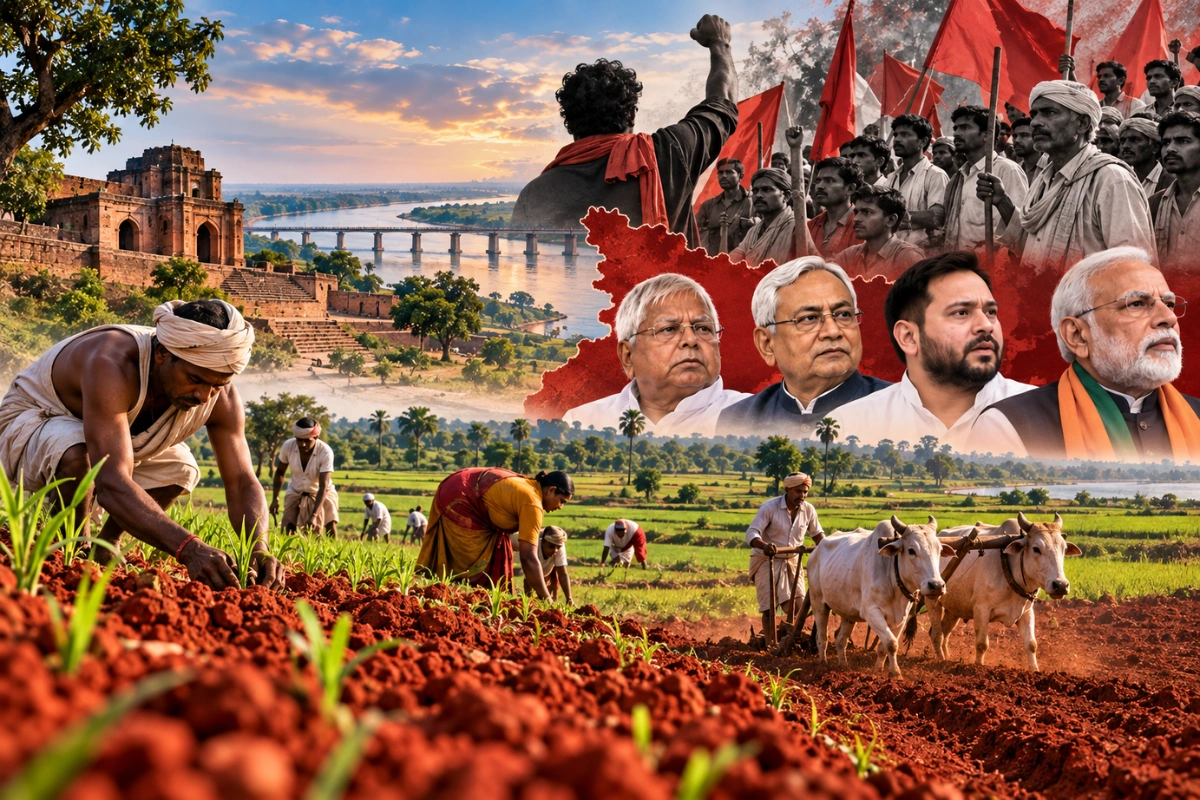
Bhojpur’s ‘red soil’ can be read in two ways: as the physical earth that supports its fields, and as a political metaphor for a region where agrarian conflict, caste assertion, and Left mobilisation shaped public life. The story of the red soil of Bhojpur is not simply about land; it is about how struggles over wages, dignity, and representation moved from underground networks into the open arena of elections.
What Makes the Red Soil of Bhojpur Politically Important?
The red soil of Bhojpur matters because land was the stage on which social power was negotiated. Bhojpur district, with Ara as its headquarters, has long been a cultivated region; the district administration lists rice, wheat, maize, and gram among its main crops, with the Ganga and Sone as major rivers. In that agrarian setting, control over land, labour, wages, and voting rights became deeply political questions.
When people speak of ‘red’ Bhojpur, they often mean more than soil colour. The phrase evokes the Left, especially the Naxalite and CPI(ML) traditions that took root in parts of central Bihar. The seeds of the Naxalite movement in Bihar are often traced to Ekwari village in Bhojpur’s Sahar block, where Jagdish Mahato, a local schoolteacher, became associated with struggles against exploitative landlord power.
The Agricultural Base Beneath the Politics
To understand Bhojpur’s political firepower, start with farming. Agrarian societies create dense relationships between landowners, tenants, labourers, sharecroppers, traders, and local officials. In Bhojpur, these relationships were intensified by caste hierarchy and dependence on agricultural work.
The SEO phrase red soil properties usually refers to soils that are reddish because of iron compounds, often with textures that can range from sandy loam to clay loam depending on location. Red soils can support agriculture when moisture, organic matter, and nutrient management are handled carefully; under good management, they can be used for cereals, pulses, oilseeds, horticulture, and other crops suited to local rainfall and irrigation.
For Bhojpur specifically, the district’s official crop profile points to a mixed farming economy rather than a single-crop landscape: rice in the monsoon season, wheat in the rabi season, and crops such as maize and gram in rotation. That variety matters because agricultural politics is rarely abstract. It is built around harvest seasons, wage bargaining, irrigation access, crop risk, and who gets to decide how village resources are used.
Red Soil Benefits in a Farming Landscape
The practical red soil benefits depend on management, not mythology. Where red soils are well-drained, they can be useful for crops that do not tolerate waterlogging. With irrigation, compost, green manure, and balanced fertiliser use, they can support productive cultivation.
For farmers and planners, the main lesson is straightforward:
- Test Before Deciding: Soil colour alone cannot determine fertility; pH, organic carbon, nitrogen, phosphorus, potassium, and micronutrients need testing.
- Add Organic Matter: Farmyard manure, compost, crop residue, and green manure improve structure and moisture retention.
- Match Crops to Water: Red soil crops should be selected with rainfall, irrigation, and drainage in mind.
- Protect the Surface: Mulching, cover crops, and bunding reduce erosion and conserve moisture.
- Rotate Intelligently: Pulses such as gram can support soil health when used as part of a broader rotation.
From Underground Struggle to Public Mobilisation
Bhojpur’s political transformation began when local grievances found organised expression. Accounts of the movement emphasise conflicts around land, wages, caste humiliation, and the right of poor peasants and agricultural labourers to participate in politics without intimidation. The district later became known as a major arena of Bihar’s Naxalite politics; even mainstream election reporting has described Bhojpur as a cradle of Bihar’s Naxalite movement.
The shift from underground activity to electoral politics did not happen overnight. Movements that begin in confrontation often face a strategic question: remain outside the formal system, or enter it to convert local influence into legislative power. CPI(ML) Liberation and associated mass organisations gradually built a model that combined village-level mobilisation with elections, campaigns, unions, and issue-based politics.
This is where ‘red soil’ becomes a powerful metaphor. Soil stores memory: of tilling, drought, debt, harvest, conflict, and migration. In Bhojpur, the political soil stored networks of cadre, local leaders, grievance committees, cultural activism, and voting blocs. Over time, those networks became capable of influencing constituencies.
How Did the Movement Become Electoral Firepower?
The movement became electoral firepower by turning local credibility into votes. Instead of relying only on ideology, Left organisers in parts of Bihar built around concrete issues: wages, land disputes, social dignity, state violence, education, employment, and representation. These issues made politics legible to people whose lives were tied to farms and daily labour.
A few mechanisms explain the transition:
- Local Leadership: Leaders emerging from villages carried social recognition that outside candidates often lacked.
- Issue Continuity: Electoral campaigns echoed older struggles rather than appearing only during polling season.
- Cadre Networks: Organised workers helped convert meetings, protests, and grievances into booth-level mobilisation.
- Alliance Strategy: In later elections, alliances helped concentrated local support translate into seats.
- Symbolic Memory: Bhojpur’s history gave Left politics a moral vocabulary around injustice, resistance, and dignity.
The 2020 Bihar Assembly election became the clearest example of this transformation: CPI(ML) Liberation won 12 of the 19 seats it contested as part of the Mahagathbandhan, its best performance at that point. The later 2025 Bihar Assembly result was much weaker, with ADR’s party-position report listing CPI(ML)(L) at 2 seats, showing that electoral firepower can be real without being permanent.
Bhojpur’s Constituencies and the Geography of Competition
Bhojpur district has seven Assembly constituencies: Sandesh, Barhara, Ara, Agiaon, Tarari, Jagdishpur, and Shahpur. These constituencies matter because they convert social history into measurable political outcomes. A movement may begin in a village, but elections test whether that influence can cross caste lines, survive alliances, withstand rival mobilisation, and speak to younger voters.
In Bhojpur, Left politics has often been strongest where agrarian labour, caste oppression, and memories of struggle remain politically active. But competition is intense. Parties such as BJP, JD(U), RJD, Congress, and smaller formations all interpret local caste equations, candidate reputations, development promises, and alliance arithmetic differently.
Lessons From the Red Soil of Bhojpur
The Bhojpur story offers a guide to how rural movements become electoral forces.
Key takeaways:
- Land Is Political Infrastructure: In agrarian regions, soil, crops, irrigation, and labour relations shape voting behaviour.
- Memory Matters: Movements gain depth when people connect present campaigns to older struggles.
- Organisation Beats Symbolism: Slogans matter, but booth work, local leaders, and issue follow-up turn sentiment into votes.
- Electoral Gains Are Reversible: A strong result in one election does not guarantee lasting dominance.
- Agriculture and Dignity Are Linked: For many rural voters, crop security, wages, caste respect, and political voice are part of the same demand.
The red soil of Bhojpur is therefore both material and historical. Its fields support rice, wheat, maize, and gram; its political memory supports a long argument about justice, power, and representation. To understand Bhojpur, one must see both layers together: the soil that feeds people, and the struggles that taught them to vote with organised purpose.
Also Read: The Vanishing Varna: How The Grand Old Party Lost Its Grip On Bihar’s Power Corridors
To read more such news, download Bharat Express news apps