



AI Generated Image
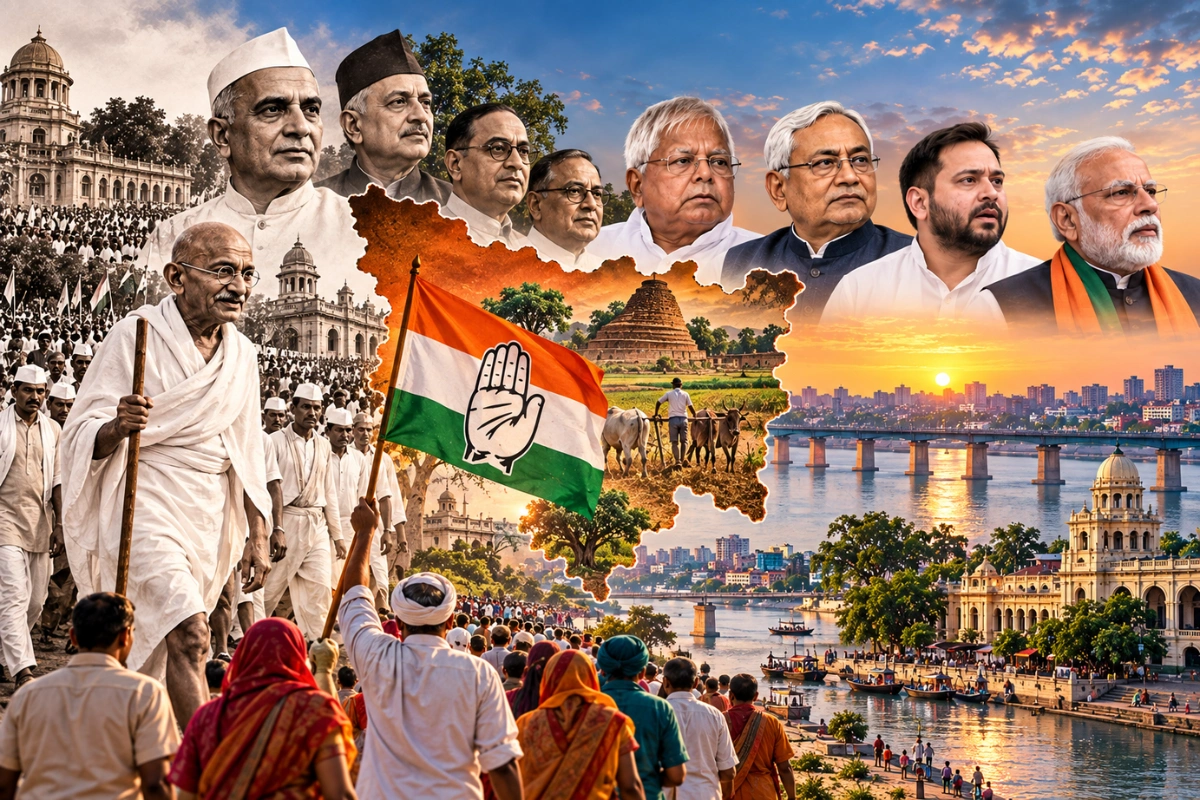
Bihar’s political story is not simply about one party declining and another rising. It is about the collapse of an old social compact, the growth of caste-based assertion, and a new grammar of alliances, welfare, and governance. To understand modern Bihar politics, we have to read the Congress decline alongside the rise of regional forces and new claims to power.
How Did Congress Lose Bihar’s Power Corridors?
Congress lost its grip because the old coalition that sustained it after Independence gradually fractured. In the early decades, the party dominated Bihar governance, with leaders such as Shri Krishna Sinha shaping the state’s first postcolonial political order; official Chief Minister records show his long tenure before later Congress and non-Congress leaders entered the frame. But by the late 1960s, socialist mobilisation, anti-Congress sentiment, and backward-caste politics had begun challenging the authority of the ‘grand old party’.
This shift was not sudden. The political history of Bihar shows a slow weakening of Congress’s upper-caste-heavy base, followed by the rise of leaders who spoke the language of social justice, dignity, and representation. Reports on Bihar political history point to 1967 as a key rupture, when non-Congress forces made serious gains, and the party’s aura of inevitability began to fade.
The Old Order Met the Politics of Representation
The ‘vanishing varna’ in Bihar politics can be read as the decline of a power structure where social hierarchy often overlapped with party control. Congress once carried a wide umbrella, but that umbrella became thinner as backward classes, Dalits, minorities, and agrarian groups demanded direct political voice.
A few turning points stand out:
- The Socialist Challenge: Leaders inspired by Ram Manohar Lohia and later Jayaprakash Narayan questioned Congress dominance and gave opposition politics moral force.
- Karpoori Thakur’s Legacy: His politics helped normalise backward-caste representation as a governing principle, not just an election slogan.
- The Mandal Moment: The 1990s pushed caste representation to the centre of Bihar political parties and electoral strategy.
- Regional Consolidation: RJD, JD(U), BJP, and smaller allies began occupying spaces Congress once controlled.
By 1990, Lalu Prasad’s ascent marked a decisive turn in the political history of Bihar, while Rabri Devi’s later tenure continued the RJD era before Nitish Kumar’s JD(U)-BJP alliance changed the governing narrative after 2005.
Why Did Regional Parties Become Stronger?
Regional parties became stronger because they spoke to specific social blocs while also negotiating broader alliances. RJD built its appeal around social justice and minority-Yadav consolidation; JD(U) under Nitish Kumar emphasised governance, roads, law and order, and welfare; BJP expanded through alliance politics and a growing organisational base. Analyses of Bihar elections note that RJD, JD(U), and BJP became the main poles of competition, while Congress increasingly depended on allies.
This is where Bihar governance became inseparable from identity. Voters did not abandon caste, but they increasingly judged parties on delivery, leadership credibility, and coalition arithmetic. The result is a layered field where no party can rely only on nostalgia.
Congress’s Challenge Today Is Organisational, Not Just Emotional
The Congress problem in Bihar is often described as a loss of voters, but it is also a loss of booth-level machinery, local leadership, and narrative ownership. In a state crowded with powerful Bihar political leaders, a party cannot survive only as a junior ally or a memory of its freedom-era past.
For readers searching for ‘political history of Bihar in hindi’, the core lesson is simple: Bihar’s politics moved from elite-led consensus to competitive social representation. Any party hoping to return must rebuild trust locally, identify credible leaders, and speak to both dignity and development.
The Takeaway
The story of Congress in Bihar is the story of a party that once defined power but failed to renew its social base. Bihar politics did not stand still; it moved through socialism, Mandal, regional assertion, alliance-era governance, and development promises. The grand old party’s lost corridors can reopen only if it stops treating Bihar political history as nostalgia and starts treating it as a warning.
Also Read: When Patna Was The Capital Of Freedom: The Glorious Rise And Fall Of Bihar Congress
To read more such news, download Bharat Express news apps