




AI Generated Image
The Ice Lingam of the Anantnag Heights: Where Shiva Revealed the Secret of Immortality
Amarnath Cave, in the Himalayan heights of Anantnag district in Jammu and Kashmir, is a Hindu pilgrimage site revered for its naturally forming ice Shiva lingam. According to Hindu tradition, this secluded cave is where Shiva revealed the secret of immortality to Parvati. Understanding its sacred stories, mountain setting and pilgrimage routes helps visitors approach the shrine with both reverence and realistic expectations.
What Is the Ice Lingam in Anantnag?
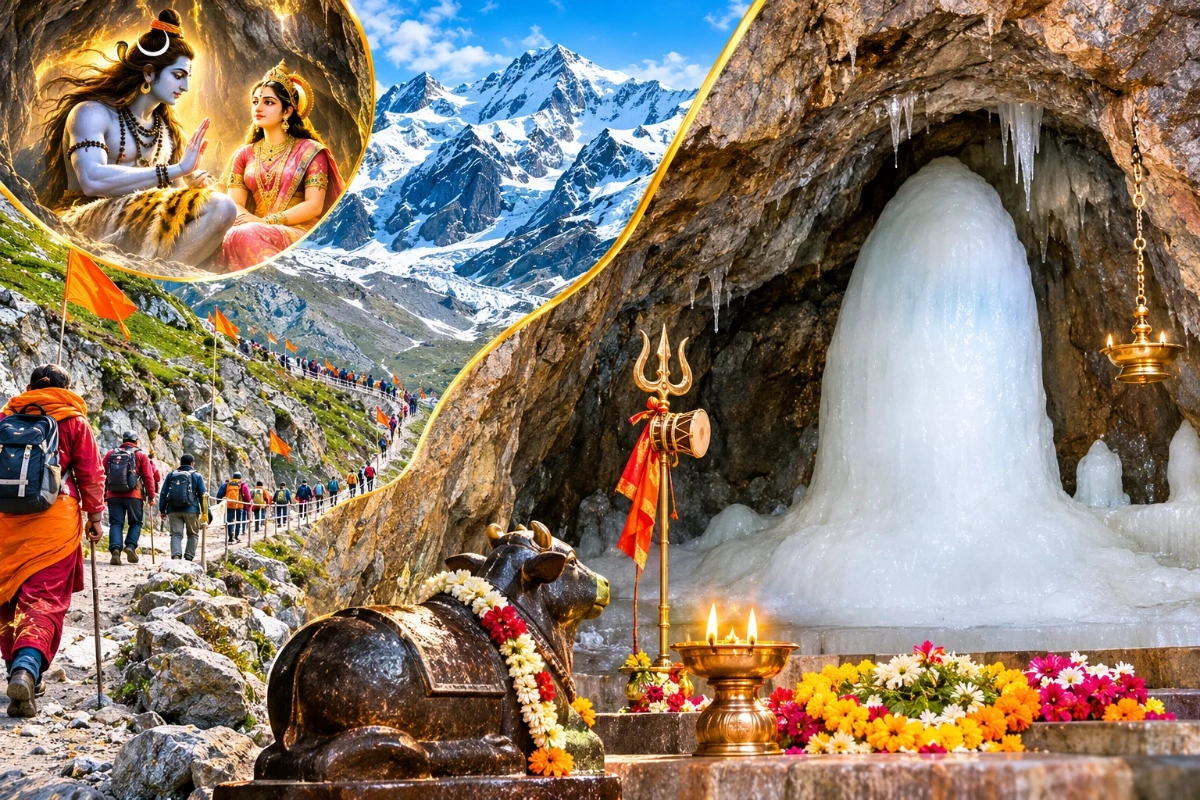
The ice lingam in Anantnag is a naturally occurring ice formation inside Amarnath Cave that devotees worship as a manifestation of Shiva. It is an ice stalagmite: a formation that rises from the cave floor as dripping water freezes. Unlike a carved temple image, its form emerges through natural freezing rather than human craftsmanship.
That distinction is central to the shrine’s appeal. Here, the object of worship is inseparable from its mountain environment. Smaller ice formations within the cave are also traditionally associated with Parvati and Ganesha, placing Shiva within a sacred family setting.
For visitors, the useful distinction is between physical formation and religious meaning. Describing how water becomes an ice pillar explains the natural process; recognising it as Shiva expresses its devotional significance. Neither description requires presenting a sacred belief as a scientifically established claim.
The Legend of Shiva’s Secret of Immortality
According to the tradition presented by Incredible India, Parvati asked Shiva about the mystery of immortality. Shiva chose Amarnath Cave as a secluded place to recount the Amar Katha, the story of immortality. The remoteness of the setting becomes part of the narrative: this was knowledge to be shared away from ordinary life.
The journey towards the cave also carries symbolic meaning. In the legend, Shiva leaves Nandi at Pahalgam, the moon from his hair at Chandanwari and his serpents at Sheshnag. Further along, he parts with Ganesha at Mahagunas and releases the five elements at Panjtarni before entering the cave.
One way to read these episodes is as a gradual letting go of worldly attachments. The route becomes more than a passage through mountains; each place invites reflection on what a person carries, values and might learn to release.
A related local legend tells of two pigeons that overheard the sacred conversation and became enduring inhabitants of the cave. These accounts belong to the shrine’s living religious tradition. They are best understood as sacred storytelling rather than independently verified historical events.
How Does the Ice Shiva Lingam Form?
The ice Shiva lingam forms when water dripping inside the cave freezes and accumulates upwards from the floor. The physical process is that of an ice stalagmite, not a permanent stone column. Its appearance therefore depends on conditions that allow ice to accumulate or melt.
Devotional accounts also associate the lingam’s growth and decline with the phases of the moon. The Anantnag district administration describes this association as a belief held by pilgrims. It should not be confused with a guaranteed forecast of the formation’s size on a particular date.
Plan around authorised access, not promises of a particular ice formation. Photographs from another season cannot establish what you will see during your visit. Let the cave’s religious significance guide your expectations rather than treating the journey as a search for an exact visual match.
The Mountain Setting Shapes the Experience
Amarnath is a high-mountain shrine, not a roadside temple. Incredible India places the cave at approximately 3,888 metres above sea level, while the Shrine Board’s health advisory notes that the pilgrimage involves trekking at elevations reaching about 14,000 feet. Altitude is therefore a practical consideration, not merely part of the scenery.
This setting calls for a different mindset from ordinary sightseeing. Leave room for rest, accept a slower pace and resist measuring the day only by how quickly you progress. A spiritual journey need not become a test of endurance or a competition with other pilgrims.
Build flexibility into the wider trip as well. Avoid arranging your return around the assumption that every stage will proceed without interruption. Check official access instructions and forecasts before setting out, rather than relying on an old itinerary or someone else’s experience. The India Meteorological Department provides a dedicated Amarnath Yatra forecast service.
Two Routes, Different Demands
The principal approaches to Amarnath Cave are through Pahalgam and Baltal. The Government of India identifies the Pahalgam axis with Anantnag district and the Baltal axis with Ganderbal district. This helps explain why the pilgrimage is closely associated with Anantnag while also drawing visitors through another part of Kashmir.
Consider the routes by their demands, not distance alone:
- Pahalgam approach: The traditional route passes through Chandanwari, Sheshnag and Panjtarni. These places are important both to the route itself and to the sacred narrative associated with Shiva’s journey.
- Baltal approach: The Shrine Board describes a shorter trek of roughly 14 kilometres one way, with steep rises and falls. Shorter does not mean easier, particularly when the terrain is demanding.
- Your decision: Compare the authorised itinerary with your health, walking experience and available time. Do not choose a route solely because it appears to fit a tighter holiday schedule.
Confirm the permitted route and entry date during registration. The Shrine Board’s registration guidance ties the pilgrimage permit to a specified route and date of access.
What Should You Prepare Before the Pilgrimage?
Prepare by checking official registration requirements, completing the required health assessment and planning for high-altitude walking rather than ordinary tourism. The Shrine Board requires a Compulsory Health Certificate through its registration process and advises pilgrims to develop their fitness before undertaking the journey.
Use this checklist before committing to travel arrangements:
- Verify official requirements. Check the Shrine Board’s instructions for the intended season, including registration, medical certification and permitted entry arrangements. Do not assume an earlier year’s permit rules apply unchanged.
- Discuss your health honestly. Consult your clinician about existing conditions and the demands of higher elevations. If your health changes after certification, seek medical advice again before departing.
- Prepare for sustained walking. Build up your activity beforehand, then walk slowly during the pilgrimage. Allow time to acclimatise and rest rather than pushing beyond your normal capacity.
- Take altitude symptoms seriously. Nausea, dizziness, unusual weakness, confusion or breathing difficulty require attention. Do not continue ascending if you suspect altitude illness; seek medical help promptly and follow advice about descent.
Keep permits, identification, prescriptions and essential contact details organised and accessible. Make sure your companions know where these are stored. Preparation should reduce avoidable decisions on the trail, leaving more attention for your surroundings and wellbeing.
Respect at the Shrine and Along the Trail
Let consideration for others guide your conduct. Give people space to pray, avoid blocking movement for photographs and follow staff instructions about queues, belongings and permitted behaviour. If you are unsure whether something is appropriate, ask rather than assume.
The same care belongs outside the cave. Keep wrappers and other waste contained until you reach an appropriate disposal point. Avoid leaving offerings in streams or scattering materials along the route; reverence should not create extra work or damage for others.
Treat support workers and fellow pilgrims with patience. Agree clearly on services before accepting them, ask permission before photographing individuals and avoid pressuring a slower companion to keep your pace. These choices make respect something you practise throughout the journey, not only at its destination.
Anantnag Tourism Beyond the Pilgrimage
Amarnath is one part of Anantnag’s broader cultural landscape. Official district information also identifies the Martand Sun Temple, the Mughal gardens of Achabal and Verinag, and several Muslim shrines among its important places. Anantnag tourism can therefore offer context beyond a single pilgrimage destination.
If you have time, consider a separate, unhurried day for a heritage site or garden rather than adding several stops immediately after the trek. Verinag, for example, combines a spring with an octagonal enclosure and a Mughal garden associated with Emperor Jahangir. Confirm local access before arranging any extension.
Carry the Meaning Beyond the Cave
Approach Amarnath with curiosity, respect and practical preparation. Learn the tradition without confusing legend with documented history, and make room for the mountain’s demands without treating hardship as the purpose of the visit. The most meaningful takeaway may be less about reaching a remarkable formation than about the patience and attention you bring to the journey.
Also Read: Black Stone Ramayana: Unveiling Kalaram’s Sacred Legacy
To read more such news, download Bharat Express news apps