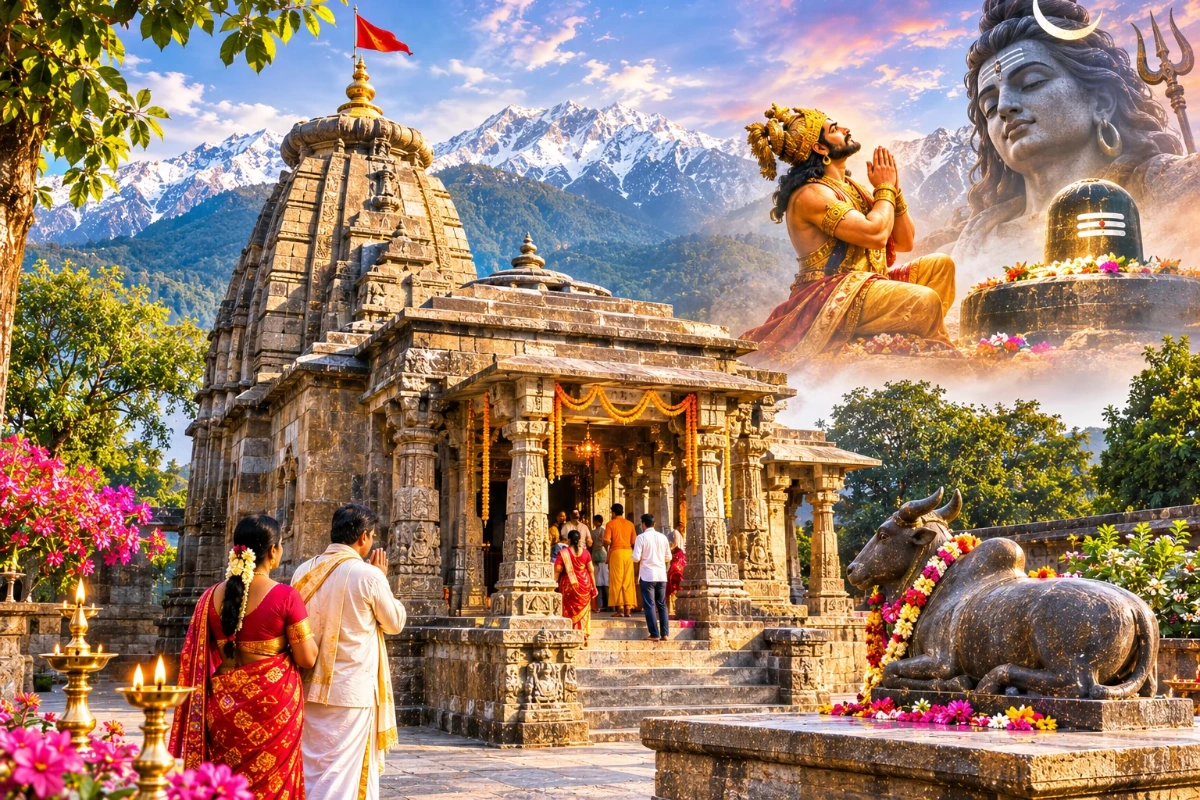
AI Generated Image
The Vaidyanath of the Kangra Valley: Where Ravana Meditated in the Shadow of the Dhauladhars
Baijnath Temple, also known as the Vaidyanath Temple, is a Shiva shrine in Himachal Pradesh’s Kangra district, set against the Dhauladhar mountain range. Built in 1204 CE by local merchants Ahuka and Manyuka, it honours Shiva as Vaidyanath, the Lord of Physicians. Its appeal lies in the meeting of documented medieval history, distinctive stone architecture and living traditions surrounding Ravana’s devotion to Shiva.
For travellers, the most rewarding approach is to look beyond the mountain backdrop. Read the temple as both a historic building and a place of worship: notice its inscriptions, follow the approach to the sanctum and make room for the stories that give Baijnath its particular character.
What Makes the Vaidyanath of the Kangra Valley Significant?
The Vaidyanath of the Kangra Valley is significant because its surviving medieval structure stands on an older sacred site, while inscriptions identify the patrons behind its construction. Two long inscriptions record the temple’s history, anchoring its foundation in historical evidence rather than legend alone. The Kangra district heritage account also describes worship here as having continued since the present temple was built.
The names Ahuka and Manyuka deserve attention. They remind visitors that temple patronage was not exclusively a royal undertaking: local merchants also helped shape the sacred landscape. The National Culture Fund’s account records that the founders supported the shrine with donations that included land, a shop and an oil-extracting machine. These details reveal the practical resources needed to sustain worship beyond the act of construction.
This distinction changes how you experience the building. Instead of treating it as an isolated relic, consider the people who financed it, maintained it and continued to worship there. Stone preserves the foundation story; religious practice gives the site another kind of continuity.
The Vaidyanath of the Kangra Valley: Where Ravana Meditated in the Shadow of the Dhauladhars
Local tradition associates Baijnath with Ravana’s intense meditation and penance to Shiva. In one account, Ravana offered his heads to the deity, who restored them in recognition of his devotion. This healing episode connects the story with Shiva’s identity as Vaidyanath. These are religious narratives, not events established by the temple’s medieval inscriptions.
Another familiar account concerns Ravana’s attempt to carry a sacred Shiva linga to Lanka. Shiva granted his request on the condition that the linga must not touch the ground during the journey. Near Baijnath, Ravana entrusted it to a shepherd, who eventually placed it on the ground. The linga then became established at that spot.
The useful distinction is between the age of the surviving temple and the sacred past described in tradition. The construction date belongs to recorded history, while Ravana’s association belongs to the shrine’s religious storytelling. Appreciating both does not require confusing one with the other.
If you speak with a priest or local guide, ask how the story is told here. Listen without insisting that every retelling match a version encountered elsewhere. The value of the conversation lies partly in understanding what the place means to those who worship at it.
Why Are Ravana Effigies Not Burned at Baijnath During Dussehra?
At Baijnath, Ravana effigies are traditionally not burned during Dussehra out of respect for his devotion to Shiva at this site. While effigy burning elsewhere marks Ravana’s defeat, the local tradition foregrounds his identity as a devoted worshipper. Reports from Baijnath, including statements attributed to the temple’s head priest, document this distinctive practice.
This is more than an unusual festival detail. It offers a way to understand how a community’s relationship with a sacred place can emphasise one aspect of a familiar religious figure. Here, the focus is on devotion to Shiva rather than a simple reversal of the wider Ramayana narrative.
For visitors, the practical implication is straightforward: do not arrive expecting a Ravana-burning spectacle. Nor should the absence of that event be treated as something missing from the experience. Learning why a community refrains from a familiar celebration can be as revealing as witnessing a celebration itself.
Reading the Temple’s Stone Architecture
Baijnath is an example of North Indian Nagara temple architecture. Its principal elements include a sanctum beneath a tall, curving shikhara, an entrance vestibule and a mandapa, or pillared hall. A small pillared shrine containing Nandi, Shiva’s bull, stands before the entrance porch.
Rather than trying to identify every carving immediately, follow the building’s main features:
- Begin with the shikhara. Step back to see the tower’s curved outline and how it rises above the lower entrance spaces.
- Look towards Nandi and the porch. Use their position to understand the approach to the shrine, while leaving the route clear for worshippers.
- Examine the mandapa. Notice the transition from the exterior tower to the more sheltered hall and its supporting pillars.
- Seek out the inscriptions. Ask where they can be viewed without interrupting worship; they connect the building with its named patrons.
The sculptural decoration also rewards closer attention. An archaeological inventory identifies figures including Shiva-Gangadhara, Ganesha, Karttikeya and Bhairava. You do not need specialist knowledge to appreciate the work, but identifying even one figure can turn a general impression of carved stone into a more attentive encounter.
Where access permits, try two passes around the exterior: first to take in the overall form, then to examine the details. This keeps photography from becoming the only way you look at the temple. A wide view explains the structure; a slower second look reveals the individual choices made by its craftspeople.
Planning a Respectful, Unhurried Visit
Build your visit around attention rather than a rigid checklist. Give yourself enough flexibility to pause when worship is taking place, ask a question when someone is available or return to a carving that initially escaped notice. Avoid treating the temple as a hurried photography stop between longer drives.
Before setting out, use this practical checklist:
- Confirm current access arrangements. Check opening hours, ritual schedules and any restrictions locally rather than relying on an old itinerary.
- Ask about photography. Seek permission before photographing interiors, ceremonies, priests or other visitors.
- Follow footwear and clothing guidance. Observe posted instructions and ask an attendant if anything is unclear.
- Keep worship routes open. Choose places to stop that do not obstruct the entrance or people approaching the sanctum.
- Check the day’s weather and road conditions. Leave enough flexibility to adjust your wider travel plans if necessary.
Treat the dedication to the Lord of Physicians as a religious belief, not a promise of medical treatment. You can appreciate its spiritual meaning without assuming that a visit, offering or ritual guarantees a physical cure.
If you want to witness a festival, Maha Shivaratri is an important occasion at Baijnath. Himachal Pradesh Tourism describes a fair that draws pilgrims to the town. Confirm the arrangements for the relevant year before planning around it, and allow for an atmosphere different from that of an ordinary sightseeing visit.
Giving Baijnath Space in a Kangra Valley Journey
Baijnath fits naturally into a Himachal Pradesh itinerary centred on Palampur. The state tourism department lists the temple at approximately 16 kilometres from Palampur, making the town a practical starting point. Palampur’s tea gardens offer a contrasting landscape, while Andretta provides another possible stop for travellers interested in art and pottery.
Choose a combination that matches your interests instead of simply collecting destinations. Pair the temple with tea country if you want to experience landscape and heritage, or consider Andretta if you prefer a more craft-focused day. The point is to leave enough time for each experience to register.
A flexible sequence works better than an ambitious timetable:
- Make Baijnath the main cultural stop. Arrive ready to explore the architecture and understand the shrine’s traditions.
- Leave space for a meal or rest. Avoid attaching every spare moment to another attraction.
- Add one contrasting experience. Choose a tea landscape or an art-related visit rather than attempting every nearby option.
Before booking transport, confirm that your destination is Baijnath in Kangra district, Himachal Pradesh. Include the district and state alongside the temple name, especially when sharing plans with someone unfamiliar with the region.
A Place to Understand, Not Just Photograph
The strongest reason to visit Baijnath is the relationship between its different stories: merchant patronage, carved architecture, Shiva worship and Ravana’s remembered devotion. None needs to displace the others. Arrive with curiosity, distinguish historical evidence from sacred tradition, and allow the temple to become more than a mountain-backed image on your itinerary.
Also Read: Discover The Sacred Matabari Sati Temple In Tripura
To read more such news, download Bharat Express news apps