



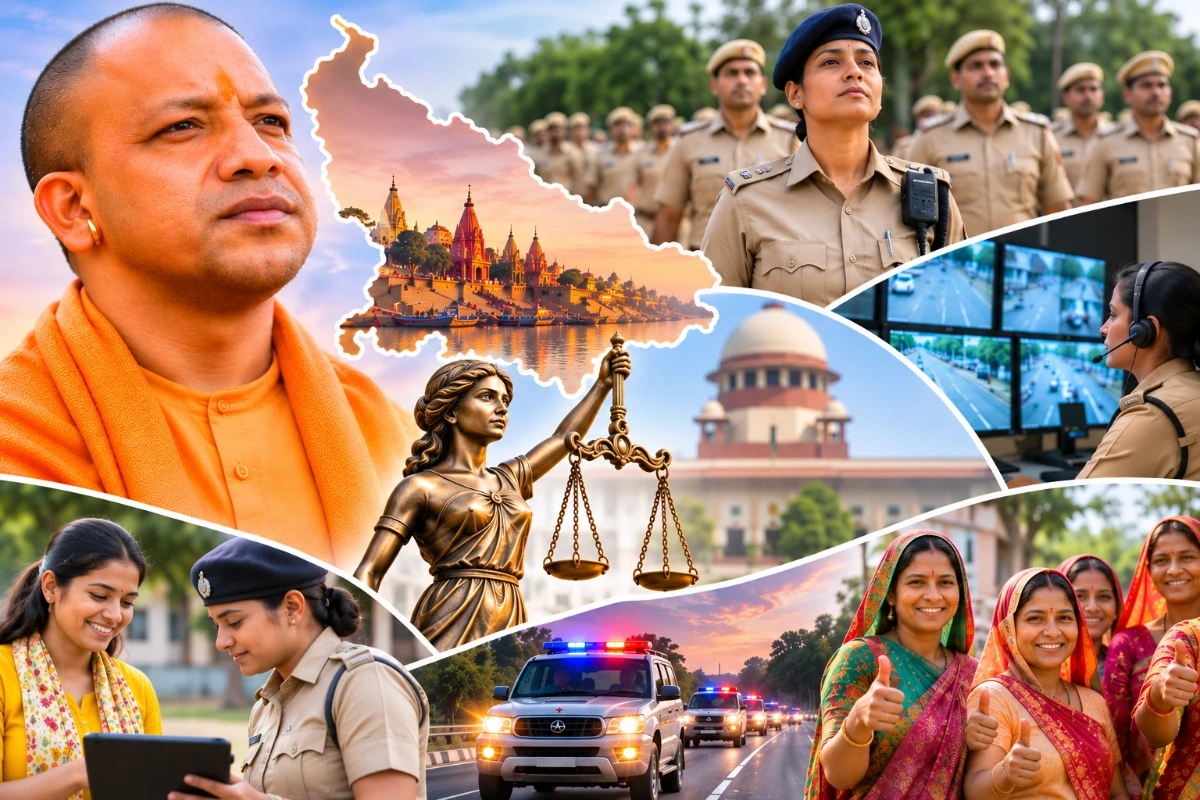
AI Generated Image
The Right to Live Without Fear: Law and Order and Justice in Yogi Adityanath’s Uttar Pradesh
The right to live without fear in Uttar Pradesh requires protection from criminals and arbitrary state action. Since Yogi Adityanath took office in March 2017, recorded murders have declined and police capacity has expanded, but crime indicators and judicial findings present a mixed picture. Assessing that record means examining safety, access to justice and constitutional safeguards together—not treating forceful enforcement as proof of all three.
Has Uttar Pradesh Become Safer Since 2017?
Uttar Pradesh has recorded improvements in some serious-crime indicators since 2017, particularly murder, but the evidence does not establish an across-the-board reduction in crime. NCRB statistics show fewer registered murders over the period, while registered crimes against women increased. These contrasting trends make category-by-category analysis more useful than a single verdict on Uttar Pradesh’s law and order.
| Indicator | Earlier Figure | Later Figure | What It Establishes |
|---|---|---|---|
| Registered murders | 4,324 in 2017 | 3,218 in 2024 | A substantial decline between these endpoints |
| Registered crimes against women | 56,011 in 2017 | 66,398 in 2024 | No equivalent decline in this broader category |
| Crimes against women, recent comparison | 66,381 in 2023 | 66,398 in 2024 | The registered total was virtually unchanged |
Sources: NCRB’s Crime in India 2017; reporting on NCRB’s 2024 murder figures; and NCRB Table 3A.1 for crimes against women. These figures represent registered cases, not estimates of every offence committed.
Population-adjusted comparisons add context. In 2024, UP’s recorded murder rate was 1.3 per 100,000 people, against 1.9 nationally. Its recorded crimes-against-women rate was 58.0 per 100,000 women, compared with 64.6 nationally. A below-average rate and a large absolute caseload can therefore coexist; neither figure should erase the other.
Reading the UP Crime Rate Without Losing Context
Uttar Pradesh crime statistics require careful interpretation. NCRB explicitly warns against comparing states purely through crime figures. Registration practices, access to reporting and the population denominator matter, so a low recorded rate should not automatically be equated with low victimisation.
The transition from the Indian Penal Code to the Bharatiya Nyaya Sanhita during 2024 adds another complication. Independent reporting on NCRB’s 2024 release noted that the bureau linked part of the national decline to changes in legal classification. Long-term comparisons should therefore check offence definitions rather than assume every category remained identical.
A practical assessment should distinguish:
- Counts from rates: Counts indicate workload and the number of registered incidents; rates adjust for population.
- Registration from prevalence: Police records cannot capture offences that are never reported or registered.
- Chargesheets from convictions: Filing a case for trial does not establish guilt.
- Association from causation: A decline during an administration does not, by itself, prove which policy produced it.
These distinctions prevent both exaggerated success claims and misleading conclusions drawn from raw totals. NCRB’s warning about comparisons makes this caution particularly important.
UP Police Reforms: Capacity Beyond Visible Enforcement
UP police reforms since 2017 include substantial recruitment and a stronger emphasis on technology-supported investigation. On June 15, 2025, appointment letters were distributed to 60,244 civil police constables, according to the Union government’s Press Information Bureau. This represents additional staffing capacity, not proof that vacancies, training requirements or deployment pressures have disappeared.
A review on January 7, 2025, also focused on forensic services, digital systems and the implementation of the new criminal laws. The Union Home Minister called for more than one forensic mobile van per district and regular monitoring of Zero FIR transfers. These were directions and implementation priorities; they should not be presented as independently verified completion across every district.
The practical test is whether capacity produces better investigations. Useful measures would include forensic turnaround times, evidence quality, response-time distributions and complainant feedback. For readers assessing Yogi Adityanath’s law and order claims, recruitment announcements are a starting point; consistent service at police-station level should be the outcome being tested.
Organised Crime Enforcement and the Limits of Asset Action
Action against organised crime in UP has prominently targeted alleged criminal assets. NDTV reported that the state’s cumulative property-action figure rose from Rs 1,800 crore by August 2021 to Rs 15,233 crore by October 2026. Importantly, that headline combined attachment, demolition and final confiscation—legally different actions, not a single measure of assets permanently recovered after trial.
Following the money can be a useful enforcement objective, but the evidentiary connection matters. An Allahabad High Court judgment published in its March 2024 law reports overturned a vehicle attachment under the Gangsters Act. The court found that the vehicle came from lawful resources and that the attachment process had been arbitrary and mechanical.
The lesson is not to abandon financial investigation. It is to demand a demonstrable link between the property and criminal proceeds, reasoned decisions and meaningful judicial scrutiny. Enforcement totals should be accompanied by information on attachments upheld, properties released and completed prosecutions; otherwise, activity can be mistaken for durable success.
Women’s Safety Requires Access, Not Just Visibility
Women’s safety in Uttar Pradesh cannot be judged solely through street patrols or a single offence category. NCRB recorded 66,398 crimes against women in 2024, compared with 65,743 in 2022. Although UP’s population-adjusted rate was below the national average, those totals do not support a claim that registered crimes against women fell overall during those years.
Institutional developments include the Women and Child Security Organisation, established on August 18, 2020. UP Police describes its work alongside the 1090 Women Power Line, which addresses complaints involving harassment, stalking and domestic violence. The helpline itself predates 2017, so its continued operation should not be confused with a new initiative introduced by this administration.
A stronger evaluation would follow the survivor’s experience: Was the complaint registered? Was immediate protection available? Could she obtain medical assistance, counselling and legal support without repeated obstacles? These questions turn an abstract safety claim into a service standard worth measuring.
Can Tough Policing Uphold Constitutional Protections?
Yes. Firm policing and constitutional protections are compatible when investigation, arrest and punishment follow lawful procedures. Articles 14, 21 and 22 establish equality before the law, protection of life and personal liberty, and safeguards concerning arrest and detention. These protections apply to accused people as well as everyone seeking protection from crime.
Judicial records show why this distinction matters. On November 13, 2024, the Supreme Court issued nationwide demolition safeguards, rejecting executive punishment through the destruction of property merely because someone was accused or convicted. Its directions included notice, a hearing and opportunities for judicial scrutiny, subject to specified exceptions.
In the separate Manoj Tibrewal Akash case, concerning an unlawful demolition in Uttar Pradesh, the Supreme Court ordered Rs 25 lakh in interim compensation and official accountability measures. That decision documents a concrete failure of lawful procedure, rather than merely a political disagreement about enforcement.
Police shootings require scrutiny too. An Associated Press investigation in October 2026 examined repeated leg shootings and allegations of religious bias; police maintained that officers acted in self-defence. Such allegations require independent examination, not automatic acceptance or dismissal. The Supreme Court’s 2014 encounter-death guidelines require safeguards, including FIR registration and an independent investigation of fatal encounters.
Citizen Perceptions and the Next Accountability Test
Public perceptions have included substantial approval. A LocalCircles survey published around the 2022 election reported that 78% of respondents believed law and order had improved over five years. This is evidence about participating respondents, not proof that every district or community experienced the same change.
Confidence deserves attention alongside recorded crime. A more useful public dashboard would combine:
- District-level offence rates and registration trends.
- Complaint handling, emergency response and forensic delays.
- Case outcomes, witness protection and compensation delivery.
- Independent safety surveys broken down by gender, caste, religion and location.
- Findings and action taken after custodial-abuse or unlawful-force complaints.
The takeaway is straightforward: recognise measurable improvements without overlooking unresolved harms. The ambition to live without fear should mean freedom from criminal intimidation and confidence that the state itself will obey the law. That is a more demanding—and more useful—standard than enforcement publicity alone.
Also Read: Uttar Pradesh Development: From Agriculture To Industry
To read more such news, download Bharat Express news apps