



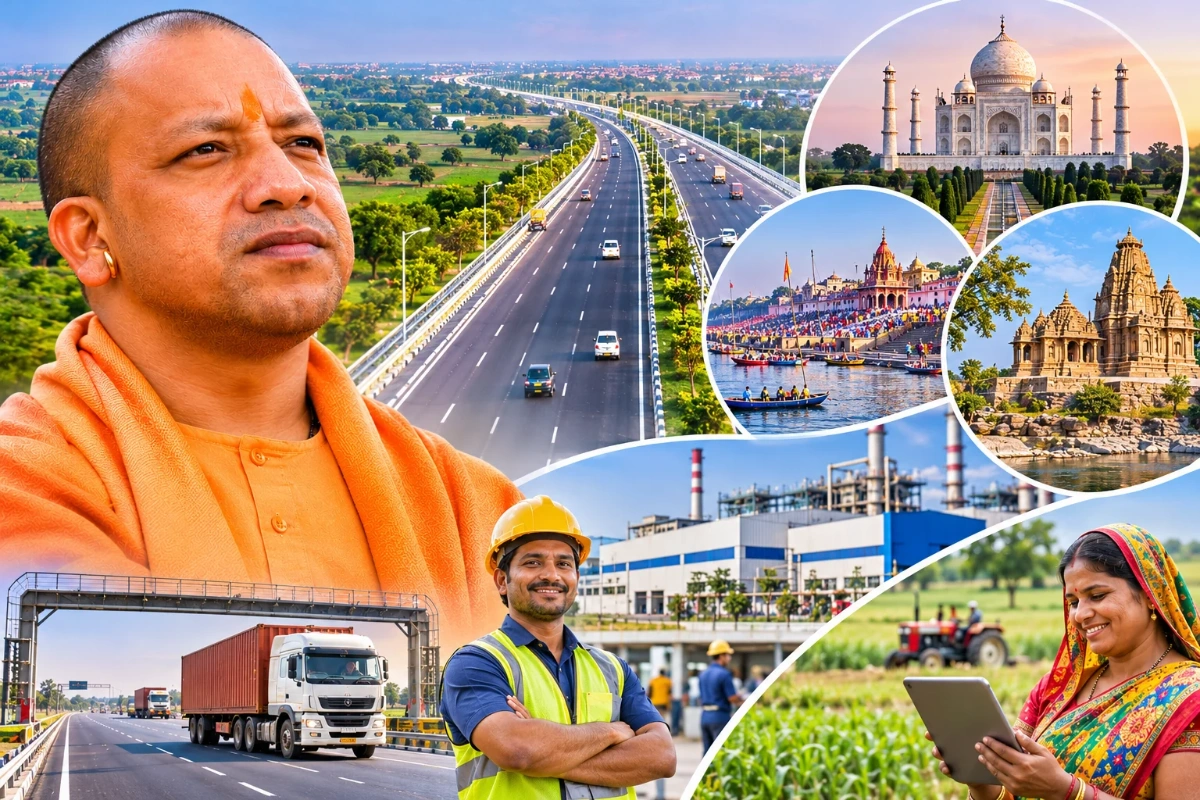
AI Generated Image
The Roads That Rewrite Destiny: Uttar Pradesh’s Expressways and the Geography of Opportunity
Uttar Pradesh’s expressways are changing how the state’s regions connect with markets, workplaces and visitor destinations. From the western corridor towards Agra to newer routes across Purvanchal and Bundelkhand, the network creates opportunities for more dependable movement—but roads alone cannot guarantee prosperity. This article traces the major projects, their costs and status, and what their development could mean for businesses, travellers and local workers.
How Has Uttar Pradesh’s Expressway Network Developed?
The network developed in successive phases: a western gateway through the Yamuna Expressway, an extension to Lucknow, and then corridors reaching eastern Uttar Pradesh and Bundelkhand. More recently, the Gorakhpur Link Expressway and Ganga Expressway have broadened that geography. The next phase focuses on linking existing corridors rather than simply building longer, standalone routes.
The Western Foundation
The Yamuna Expressway opened between Greater Noida and Agra in August 2012. The Comptroller and Auditor General records construction between November 2006 and July 2012, at a construction cost of Rs 9,962 crore. Its development crossed administrations: Mayawati’s government advanced the project, while Akhilesh Yadav inaugurated it on August 9, 2012.
The approximately 302-kilometre Agra–Lucknow Expressway followed, inaugurated on November 21, 2016, under the Akhilesh Yadav government. Delivered through the Uttar Pradesh Expressways Industrial Development Authority, it extended the western expressway connection towards the state capital. Together, these corridors established the foundation for subsequent eastward expansion.
Expansion Towards Underserved Regions
Under Yogi Adityanath’s government, the programme expanded through the Purvanchal, Bundelkhand, Gorakhpur Link and Ganga projects. These corridors brought high-capacity road infrastructure towards regions beyond the established western growth belt. Their strategic importance lies in widening access to the capital, national markets and existing transport networks—not merely increasing road length.
The phrase ‘Yogi Adityanath expressway projects’ therefore describes an important expansion phase, not the entire history. State governments, central institutions, development authorities and private contractors have contributed at different stages. Crediting those roles separately gives a more accurate account than assigning the whole network to one administration.
Major Projects: Timelines, Costs and Operational Status
The following snapshot reflects verified announcements available by November 27, 2026. Costs are not directly comparable: some include land acquisition, while others describe construction or an earlier project estimate. An inauguration date also does not establish when every ancillary facility became available.
| Expressway | Route and Scale | Timeline and Status | Published Cost Basis |
|---|---|---|---|
| Purvanchal Expressway | Lucknow–Ghazipur; approximately 341 km | Contracts effective October 2018; inaugurated November 16, 2021; operational | Rs 22,494.66 crore, including land |
| Bundelkhand Expressway | Chitrakoot district–Etawah district; approximately 296 km | Foundation stone laid February 29, 2020; inaugurated July 16, 2022; operational | Around Rs 14,850 crore, as reported at inauguration |
| Gorakhpur Link Expressway | Jaitpur–Salarpur, joining Purvanchal; approximately 91 km | Work began February 2020; inaugurated June 20, 2025; operational | Approved Rs 7,283.28 crore, including land |
| Ganga Expressway | Meerut–Prayagraj; approximately 594 km | Foundation stone laid December 18, 2021; inaugurated April 29, 2026 | Approximately Rs 36,230 crore in the project’s pre-feasibility estimate |
Sources: UPEIDA project records, inauguration announcements and the Ganga project’s environmental-clearance documentation.
The Ganga Expressway should no longer be described simply as awaiting completion: its inauguration is officially recorded. IRB’s project company also announced trial traffic operations on the Meerut–Budaun section from April 30, 2026. Travellers should nevertheless verify current access, tolling and restrictions before departure.
For the next wave, a November 5, 2026, report republished by Invest UP recorded contractor selection for five links: Agra–Lucknow to Purvanchal, Ganga to Bundelkhand via Farrukhabad, Bundelkhand to Jhansi, Bundelkhand to Chitrakoot Dham, and Ganga to Yamuna via Jewar. Their combined estimated cost was Rs 17,104 crore, with civil works expected to begin soon. These are contracted or pre-construction projects in that update—not operational roads or proof that construction has begun everywhere.
Reading the UP Expressway Map as an Opportunity Map
A useful UP expressway map shows junctions and connecting roads, not just coloured lines. Purvanchal links the Lucknow region with Ghazipur; Gorakhpur Link joins that corridor from the northeast. Bundelkhand connects with Agra–Lucknow, while Ganga provides a separate Meerut–Prayagraj axis. Together, these relationships explain the changing geography of Uttar Pradesh transport.
For a business, the relevant question is whether goods can reach an interchange efficiently. A site beside an access-controlled road may still require a substantial detour to enter it. Feeder-road access should therefore be tested alongside the main corridor when assessing a location. The state’s industrial-policy planning recognises the importance of connecting economic centres with expressways and freight corridors.
Use the map to test three practical connections:
- Origin to Interchange: Can delivery vehicles reach the entrance without difficult village-road sections?
- Interchange to Customer: Does the exit serve the actual market, factory or distribution centre?
- Road to Other Transport: Is rail freight or another logistics facility relevant to the shipment?
This network perspective matters because expressways in UP complement, rather than replace, Uttar Pradesh highways, district roads and rail corridors. Multimodal planning around Dadri and Greater Noida illustrates why the wider transport chain deserves attention.
What Do Expressways Change for Logistics, Industry and Employment?
Expressways create the conditions for more predictable distribution and a wider choice of industrial locations, but lasting employment depends on functioning businesses alongside them. Uttar Pradesh is pursuing that connection through expressway-linked industrial and logistics clusters. The appropriate distinction is between infrastructure delivered, investment committed and jobs actually sustained.
Logistics Gains Need an End-to-End Calculation
For a hypothetical food processor, a less interrupted trunk journey could make dispatch schedules easier to organise. For a manufacturer, dependable arrivals could matter more than a faster single trip. These are business mechanisms to test, not measured savings established for every expressway user.
Operators should compare tolls, fuel, driver hours, loading delays and the complete door-to-door route. Cold storage, warehousing and efficient local access remain important even beside a high-speed corridor. Uttar Pradesh’s corridor strategy explicitly targets logistics, warehousing and food processing, reflecting that broader requirement.
Industrial Land Is Progress, Not a Completed Economic Outcome
In May 2025, UPEIDA reported acquiring 3,827 hectares for industrial corridors along five expressways, with more than Rs 5,500 crore invested in acquisition-related costs. That is a tangible development milestone. It does not, by itself, establish factory output, export growth or permanent employment.
The Union government’s defence-industrial initiative adds another institutional layer, with UPEIDA implementing the Uttar Pradesh Defence Industrial Corridor. Its six identified nodes include Jhansi and Chitrakoot, making regional transport access relevant to supplier development. However, a defence corridor and an expressway are distinct programmes; their benefits should not be counted as interchangeable achievements.
For regional employment, evaluate opportunities in stages rather than relying on a single headline projection:
- Construction: Distinguish temporary contracting work from continuing employment.
- Operations: Check recruitment for maintenance, tolling, patrol and roadside services.
- Industry: Track occupied factories, operating warehouses, apprenticeships and local supplier contracts.
UPEIDA’s toll-operation and safety-vehicle tenders demonstrate continuing service requirements. Wider employment expectations still need to be tested against actual business operations.
Tourism Needs Good Journeys Beyond the Exit
For Uttar Pradesh travel, the network creates opportunities to combine destinations more conveniently. Yamuna serves the Agra corridor, Bundelkhand improves regional access towards Chitrakoot, and Ganga reaches Prayagraj. Yet these route connections should not be confused with direct expressway access to every attraction—or evidence that visitor spending has already increased.
Tour operators should build itineraries around realistic last-mile journeys, rest stops and destination access. Local businesses can assess whether clearer directions, reliable opening hours or bookable experiences would help convert passing traffic into visits. Tourism growth is most valuable locally when visitors stop and spend, rather than simply travel through.
The Real Destination Is Broader Opportunity
The strongest test of UP infrastructure development is what follows the opening ceremony. Judge expressways in Uttar Pradesh by dependable journeys, occupied industrial sites, sustainable local employment and accessible destinations—not announced investment alone. The roads create connections; the next task is making those connections useful to the communities along them.
Also Read: Uttar Pradesh Transformation: Measuring Human Development
To read more such news, download Bharat Express news apps