



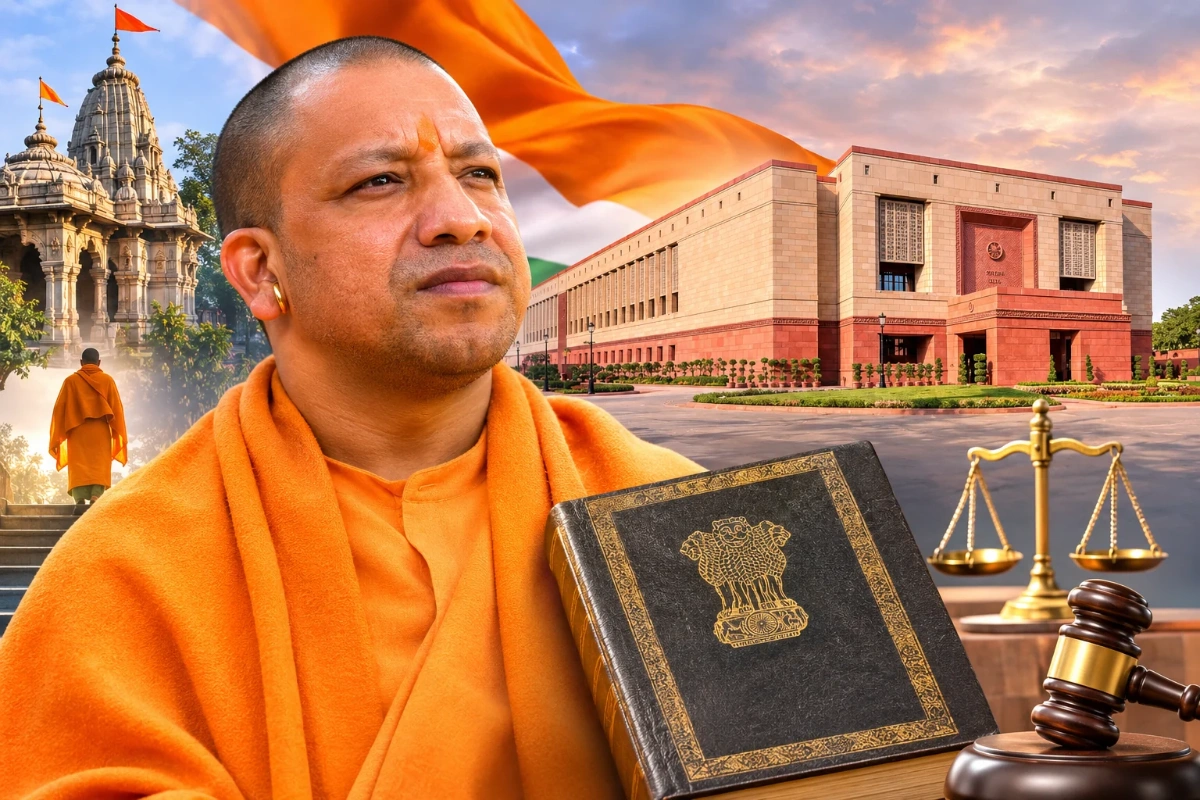
AI Generated Image
The Saffron and the Constitution: A Monk’s Journey Through the Responsibilities of Democratic Leadership
Yogi Adityanath’s journey from monastic life to elected leadership brings spiritual identity into direct conversation with constitutional responsibility. His association with the Gorakhnath Temple and the Nath tradition helps explain his public image, while India’s Constitution establishes the obligations against which public authority must be judged. Understanding that relationship requires distinguishing religious inspiration, political claims and demonstrable standards of governance.
How Can Spiritual Leadership Coexist With Constitutional Responsibility?
Spiritual leadership can coexist with democratic office when personal belief inspires service without determining who receives equal protection, public resources or access to justice. India’s Ministerial oath requires allegiance to the Constitution and service to all people according to law. Faith may inform a leader’s motivation; it cannot replace the legal responsibilities attached to office.
This distinction offers a useful way to approach Yogi Adityanath’s governance. Rather than assuming that religious commitment either guarantees ethical administration or automatically prevents it, readers can examine decisions, procedures and outcomes. The relevant question is whether the exercise of power meets the standards promised to every citizen.
Adityanath himself has articulated a connection between spirituality and public service. In an interview with Governance Now, he distinguished dharma, understood as duty and ethical conduct, from a particular form of worship. He also said the government should not be partisan towards any community and described his work through seva, or service. These are documented statements of his philosophy, not independent proof of administrative performance.
Saffron History and the Ethics of Public Service
The meaning of saffron becomes especially relevant where religious symbolism meets national identity. During the Constituent Assembly’s flag debate on July 22, 1947, S. Radhakrishnan associated saffron with renunciation and argued that leaders should be detached from personal advantage. His explanation connected a spiritual ideal with the practical ethics of public responsibility.
That moment in saffron history matters because it offers something more demanding than symbolic identification. Renunciation, interpreted politically, should invite scrutiny of self-interest, favouritism and the accumulation of unchecked authority. It suggests that the strongest expression of moral conviction may be restraint rather than the unrestricted assertion of power. This is an interpretation of Radhakrishnan’s argument, not a constitutional qualification for holding office.
India’s heritage colours also belong to a shared national symbol. The Home Ministry’s account of the flag reproduces the explanation linking saffron with disinterestedness and dedication. Reading the colour in that civic context encourages a distinction between honouring cultural heritage and treating citizenship as the possession of one religious community.
The Nath Tradition Behind a Public Identity
The Nath Sampradaya provides essential context for Yogi Adityanath’s spirituality. Associated with Gorakhnath, the tradition places importance on yogic practice, the teacher-disciple relationship and spiritual discipline. Sahapedia’s account also describes strands of Nath devotion directed towards a formless divine, including challenges to caste-based and sectarian distinctions. Its history should not be reduced to a single contemporary political interpretation.
Adityanath’s own biographical account records his initiation by Mahant Avaidyanath on February 15, 1994. It also records his first election to the Lok Sabha in 1998 and his becoming Chief Minister of Uttar Pradesh on March 19, 2017. These milestones show that his religious and parliamentary identities developed through overlapping institutional paths.
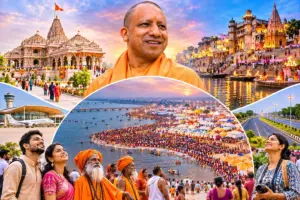
The Gorakhnath Temple is therefore more than a visual backdrop to his political identity. His legislative profile lists associations with educational institutions, health-related services and spiritual organisations. Those documented institutional connections help explain why service features prominently in his public presentation, although they do not establish the effectiveness or fairness of state policy.
A useful distinction follows: a spiritual lineage can explain a leader’s vocabulary and formation without explaining every administrative choice. Nath philosophy, temple administration, party politics and constitutional government are connected here, but they are not interchangeable categories. Keeping them separate makes the intersection easier to assess rather than merely celebrate or condemn.
How Does Religious Background Influence His Approach to Governance?
Adityanath’s religious background influences his public identity through his monastic role, spiritual vocabulary and stated understanding of government as service. His official legislative profile identifies yoga and spirituality among his interests and describes activities involving education and rural health. These connections help explain the emphasis on duty and social service in his presentation of leadership.
His statements also connect cultural heritage with political purpose. In a 2023 The Indian Express interview, he described Indian heritage in spiritual and religious terms while saying that dialogue with people of every caste, faith and religion was his responsibility. Read together, these remarks reveal a central feature of Yogi Adityanath’s philosophy: an attempt to present cultural rootedness and universal public service as compatible.
That attempted reconciliation deserves examination rather than automatic acceptance. A leader’s declaration of inclusion should be tested through the experience of citizens who do not share his beliefs. Equally, an assessment should distinguish disagreement with religious symbolism from evidence that a particular decision violates a right.
Three distinctions help keep that assessment grounded:
- Identity is not evidence of performance. Monastic status explains public symbolism but cannot establish the quality of schools, hospitals or policing.
- Declared intentions are not verified outcomes. Statements about universal service require examination alongside implementation and accessible public records.
- Cultural advocacy is not unlimited authority. A commitment to heritage must still be assessed against the legal responsibilities of office.
These distinctions allow readers to take religious influence seriously without treating it as either an endorsement or a verdict.
Constitutional Values Turn Ideals Into Obligations
Constitutional values supply a public standard that does not depend on sharing a leader’s faith. Article 14 guarantees equality before the law; Article 15 prohibits specified forms of state discrimination; and Article 25 protects freedom of conscience and religion, subject to constitutional limitations. Article 164 also makes a state’s council of Ministers collectively responsible to its legislative assembly.
Together, these provisions distinguish democratic leadership from spiritual authority. Citizens are entitled to protection and accountability, not merely invited to trust a leader’s character. The practical implication is that public decisions need defensible legal grounds, including when they enjoy strong political support.
A concrete illustration comes from the Supreme Court’s November 13, 2024, judgment on the demolition of structures. The Court held that the executive cannot punish an accused person by demolishing property without following the prescribed legal process. Its reasoning emphasised the rule of law, separation of powers and accountability for arbitrary action. This nationwide ruling supplies a relevant standard for evaluating forceful administration, rather than a finding about every individual demolition.
What Should Citizens Examine Beyond Symbolism?
Citizens should examine whether service is accessible, enforcement is lawful and officials can be held accountable. Spiritual language becomes politically meaningful when it corresponds to fair procedures and decisions that can withstand scrutiny. The most useful approach is to evaluate specific actions rather than infer administrative virtue or failure from religious appearance.
A practical checklist can guide that work:
- Check eligibility and access. Compare published service rules with the experiences documented in complaints, audits and official responses.
- Separate allegations from findings. Identify whether a claim comes from a political speech, an investigation or a court judgment.
- Examine procedural safeguards. Look for notice, reasons, opportunities to respond and avenues of appeal when state action affects rights.
- Ask who can question a decision. Consider whether affected residents have a realistic route to review, not simply a theoretical one.
- Distinguish preservation from preference. Assess a heritage initiative’s public purpose, selection criteria and treatment of different communities.
These are suggested reading habits, not a substitute for examining individual cases. Their value lies in making praise and criticism more precise. They also help prevent symbolic debates from crowding out questions about how government actually treats people.
Service Is the Bridge, Accountability Is the Test
The intersection of spiritual philosophy, the Nath tradition and democratic leadership is best understood as a relationship between motivation and obligation. Adityanath’s documented language of duty and seva explains how he presents that bridge; constitutional government supplies the independent test. Neither heritage nor electoral popularity removes the need for lawful, impartial administration.
The strongest takeaway is therefore neither that saffron guarantees good governance nor that spiritual identity excludes democratic service. It is that cultural conviction should be assessed alongside restraint, equal treatment and accountability. A monk’s journey into public office becomes a democratic story through the responsibilities accepted—and through citizens’ ability to examine how they are fulfilled.
Also Read: The Monk Who Entered Power: Yogi Adityanath’s Journey
To read more such news, download Bharat Express news apps