



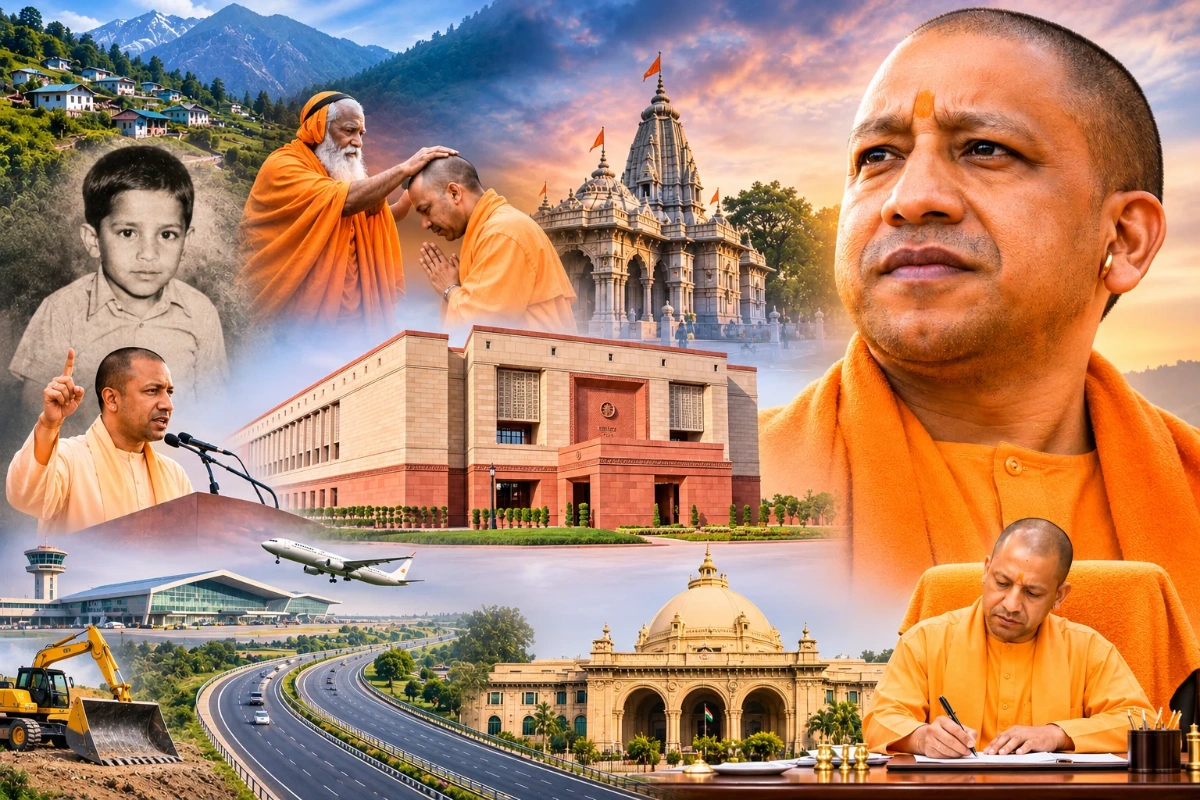
AI Generated Image
The Monk Who Entered the Corridors of Power: The Extraordinary Journey of Yogi Adityanath
Yogi Adityanath’s journey connects a Himalayan village, a powerful monastic institution, five terms in Parliament and the leadership of Uttar Pradesh. Born Ajay Singh Bisht, he became a disciple of Mahant Avaidyanath before building a political career rooted in Gorakhpur. This biography follows that transformation through documented milestones, reported family recollections, and the achievements and controversies surrounding his public life. As of November 27, 2026, he remains the Chief Minister of Uttar Pradesh.
Who Is Yogi Adityanath, and What Is His Real Name?
Yogi Adityanath is a Hindu monk, Bharatiya Janata Party politician, head of Gorakshpeeth in Gorakhpur and Chief Minister of Uttar Pradesh. His birth name is widely recorded as Ajay Singh Bisht, although some published accounts use Ajay Mohan Bisht. He was born on June 5, 1972, and official legislative records identify Panchur in present-day Uttarakhand as his birthplace.
Readers searching for ‘Yogi Adityanath real name’ are looking at the starting point of a larger transformation. His adopted name belongs to his monastic identity, acquired through his association with the Gorakhnath religious establishment. The distinction matters because the young science graduate and the saffron-clad political leader belong to one continuous life, not two unrelated biographies.
Three strands make that life intelligible: religious succession, constituency politics and executive power. His appointment as Chief Minister did not follow immediately after he entered religious life; nearly two decades of parliamentary representation separated his first election from his move to Lucknow. Understanding those intervening years prevents the familiar description of a ‘monk becoming Chief Minister’ from obscuring the political work behind his rise.
Panchur: The Himalayan Setting of His Early Life
Panchur, in Uttarakhand’s Pauri Garhwal district, occupies a central place in the Yogi Adityanath life story. When he was born, the region belonged to Uttar Pradesh; Uttarakhand became a separate state later. His father, Anand Singh Bisht, worked in the forest department and retired as a range officer, while his mother, Savitri Devi, remained closely associated with the family’s village home.
A useful childhood anecdote comes from The Week’s 2017 reporting in Pauri Garhwal. His sister Shashi recalled accompanying the younger Ajay to the government school through the surrounding forest and checking on him in class. Such recollections offer something more concrete than retrospective claims that a future leader was destined for greatness: they show an ordinary child within a household and a landscape.
The same report described electricity reaching the village during his childhood and neighbours gathering at the family home to watch Ramayan on television. These details place his upbringing within a period of changing communications and shared village life. They do not establish precisely why he later chose monasticism, but they help recover the world that preceded his public identity.
His father later told The Indian Express that Ajay had shown an inclination towards serving others from childhood. That is a family recollection, not independent proof of a lifelong political mission. Keeping the distinction visible makes the biography more credible: relatives can illuminate temperament, while dates, qualifications and election records establish the verifiable framework.
Education Before the Monastery
Yogi Adityanath’s education is an important corrective to accounts that begin and end with religious training. Official parliamentary and legislative profiles record him as a science graduate educated at Hemvati Nandan Bahuguna Garhwal University in Srinagar, Uttarakhand. Reporting on his student years identifies mathematics as his undergraduate subject and connects his studies with Kotdwar.
NDTV’s account also places him in Rishikesh for postgraduate study and reports his association with the Akhil Bharatiya Vidyarthi Parishad during his undergraduate years. However, pursuing further study should not be confused with completing another qualification. The securely documented description in official profiles is that he is a science graduate; there is no need to inflate that record into an unsupported postgraduate credential.
His education and student associations provide context rather than a complete explanation of his later politics. A mathematics degree does not, by itself, establish a particular governing ability, just as involvement in a student organisation does not make every subsequent decision inevitable. These details demonstrate that his formative years extended beyond a narrowly religious environment.
The transition towards Gorakhpur therefore involved a change in direction, not simply the continuation of childhood temple duties. He moved from the educational world of Garhwal into a monastery with its own hierarchy, institutions, public responsibilities and political history. That institutional encounter would prove more consequential than the degree title alone.
Why Did Ajay Singh Bisht Become a Monk?
The documented turning point was Ajay Singh Bisht’s decision to become a disciple of Mahant Avaidyanath at Gorakhnath Math. Institutional records date his designation as successor to Gorakshpeeth to February 15, 1994, while contemporary profiles connect this period with his initiation into the Nath tradition. The public record establishes the commitment and the mentor; it cannot fully reconstruct the private spiritual motivations behind the decision.
That distinction is especially important in a biographical narrative. A spiritual calling is personal, and later admirers or critics may interpret the same choice very differently. A responsible account can explain what renunciation required without inventing an inner monologue or presenting a dramatic conversion scene unsupported by evidence.
Avaidyanath’s Influence
Avaidyanath became both his religious teacher and his political mentor. He had represented Gorakhpur in Parliament and was associated with the Ram temple movement, placing the younger disciple inside an institution where religious leadership and electoral activity already overlapped. Adityanath therefore entered an established public tradition rather than creating the monastery’s political role from nothing.
The relationship also explains a detail that can confuse readers researching the Yogi Adityanath family. Some official profiles list Avaidyanath under ‘Father/Guru’, and Adityanath’s election affidavit identified his mentor in the father’s-name field. These references reflect his monastic lineage; his biological father was Anand Singh Bisht.
Renunciation and Succession Were Different Stages
Being named a successor in 1994 did not mean immediately becoming the institution’s full head. Adityanath assumed leadership of Gorakshpeeth in September 2014, following Avaidyanath’s death. The intervening years allowed him to develop responsibilities within the institution while establishing his own electoral position.
This distinction keeps the chronology clear. Initiation concerned entry into religious life; designation established an anticipated line of succession; installation as head brought the senior institutional role. Compressing all three into one moment makes the story sound simpler, but hides the apprenticeship that connected them.
Gorakshpeeth as a School of Public Responsibility
Gorakshpeeth was not merely a backdrop for prayer. Adityanath’s institutional profile lists responsibilities connected with educational establishments, charitable hospitals, nursing education and other service organisations. These included institutions bearing the names of Gorakhnath, Digvijaynath and Maharana Pratap, demonstrating the breadth of the network around the monastery.
For a young religious leader, such a setting offered exposure to practical questions: how institutions are managed, how requests reach a senior figure and how religious authority interacts with education and healthcare. It is reasonable to see this as part of his preparation for public administration, although running a religious institution and governing a state remain fundamentally different responsibilities.
His official legislative biography describes activities involving hostels for disadvantaged children, educational institutions and the extension of healthcare to rural areas. Those descriptions establish the institution’s stated areas of work, not an independent assessment of every service delivered. Reading them alongside outside reporting helps keep organisational claims identifiable as such.
The monastery’s significance also survives in his public grievance meetings. Reports of Janata Darshan gatherings at Gorakhnath temple describe citizens presenting requests concerning medical treatment, housing, land disputes and administrative delays. This continued association helps explain why Gorakhpur remains central to his identity, even after his move into statewide government.
Personal Discipline Without the Mythology
Accounts of Adityanath’s routine repeatedly describe early rising, prayer, yoga and attention to the monastery’s cows. In reporting published around his appointment as Chief Minister in 2017, temple associates described morning yoga and regular visits to the cowshed. These are attributed descriptions of his habits, not proof that an identical timetable has continued unchanged throughout his premiership.
The practices matter because they connect his public appearance with an ongoing religious discipline. His official profile also lists yoga, spirituality, gardening, religious discourse and cow protection among his interests. The saffron clothing is therefore only the most visible part of a broader monastic identity.
A report on his first day in office described a lengthy working schedule that included meetings with officials and political colleagues. That provides a dated example of his administrative approach, but it should not be expanded into an unverifiable claim that every working day follows the same pattern. Political profiles become less useful when isolated observations turn into permanent superlatives.
The practical distinction is between personal discipline and institutional performance. A leader may maintain demanding habits while the government still requires independent scrutiny. Prayer, austerity and long hours can help explain a public persona; they cannot substitute for evidence about hospitals, policing, employment or the handling of complaints.
Building a Political Base in Gorakhpur
The Yogi Adityanath political journey entered its electoral phase in 1998, when he won the Gorakhpur Lok Sabha seat. He subsequently won again in 1999, 2004, 2009 and 2014, giving him five consecutive parliamentary victories. His first success followed Avaidyanath’s withdrawal from active electoral politics and support for his younger disciple.
Repeated victories changed his position. He was no longer only a designated religious successor benefiting from his mentor’s standing; he had become an established representative with his own political following. His constituency remained Gorakhpur, but his visibility increasingly extended beyond it. Reporting in 2014 already described him as a sought-after BJP campaigner across Uttar Pradesh.
A major development was his establishment of the Hindu Yuva Vahini in 2002. The organisation described itself in cultural and nationalist terms, while reporting documented its aggressive Hindutva mobilisation and controversies involving communal tensions. Its history is essential to understanding his growth, but its own description should not be mistaken for an independent evaluation.
The organisation gave his politics an additional vehicle outside ordinary constituency representation. At the same time, its confrontational reputation deepened concerns about minority rights and communal polarisation. Coverage of his 2007 arrest during unrest in Gorakhpur illustrates how public mobilisation and controversy developed together; an arrest or allegation must still be distinguished from a conviction.
His relationship with the BJP was not always frictionless. Contemporary reporting described occasions when he backed candidates against official party nominees and maintained a distinct regional power base. His later elevation to Chief Minister is more understandable when viewed against that record of political independence, rather than as the promotion of an obscure party functionary.
Parliament: The Less Visible Part of His Biography
A Yogi Adityanath biography focused entirely on speeches and religious symbolism misses his long parliamentary apprenticeship. Official records list committee assignments involving food and public distribution, external affairs, public undertakings, transport, tourism and culture. These responsibilities placed him within the routine machinery of national legislative work, beyond the rallies that attracted wider attention.
Committee membership alone does not establish legislative effectiveness. It does, however, identify the subjects and institutions with which a member formally engaged. To understand an MP’s work, readers should examine questions, debates, committee responsibilities and constituency issues together rather than treating media visibility as the sole measure.
Encephalitis and the Concerns of Eastern Uttar Pradesh
One of the clearest documented threads in his parliamentary work was encephalitis. The Indian Express, reviewing parliamentary records in 2017, found repeated questions and interventions about the disease over preceding years. Its reporting identified an April 2003 intervention and subsequent efforts to draw national attention to deaths in eastern Uttar Pradesh.
The parliamentary record of August 11, 2016, provides a direct example. Adityanath called attention to the spread of encephalitis, particularly in eastern Uttar Pradesh, bringing a regional health emergency into a national forum. This is stronger evidence of sustained engagement than a later general claim that healthcare had always been a priority.
The issue also reveals how his responsibilities changed after 2017. As an MP, he could question Ministers and demand action; as Chief Minister, he became responsible for the state administration’s response. The deaths at Gorakhpur’s BRD Medical College later that year consequently carried particular political weight, because the crisis involved a subject he had repeatedly raised.
That movement—from raising a problem to being accountable for addressing it—is one of the most important transitions in his life story. It marks the difference between representation and executive authority. The same concern can run through both phases, while the standard of judgment changes substantially.
Entering the Chief Minister’s Office in 2017
Adityanath first took office as Chief Minister of Uttar Pradesh on March 19, 2017, following the BJP’s decisive Assembly election victory. His selection brought a five-term parliamentarian and serving religious leader to the head of the state government. International coverage immediately highlighted the significance of choosing a politician known for hardline Hindu nationalist positions.
The appointment did not itself make him an elected member of the Uttar Pradesh Legislative Assembly. Official records show that he entered the state Legislative Council in September 2017; his first Assembly election victory came in March 2022. Distinguishing the two houses helps avoid a common error in simplified accounts of his career.
The move to Lucknow also broadened the constituency he had to serve. A Gorakhpur MP represented one parliamentary seat, while a Chief Minister directs a government responsible for citizens across the state. Religious supporters, party workers, political opponents and people with no interest in his personal beliefs all became part of that administrative responsibility.
His appointment sharpened a central question about his public evolution: how would a leader shaped by a monastery and regional mobilisation exercise the powers of a statewide government? Supporters saw decisiveness and ideological clarity; critics feared exclusionary politics and pressure on minorities. Both expectations became part of the scrutiny surrounding his administration.
What Defines Yogi Adityanath’s Leadership of Uttar Pradesh?
Adityanath’s leadership combines an emphasis on law and order, infrastructure, welfare delivery and Hindu religious identity. His administration’s supporters present these priorities as mutually reinforcing; critics question the methods used in policing and demolitions and whether all communities receive equal protection. A balanced assessment must examine concrete outcomes alongside constitutional safeguards, rather than treating popularity or controversy as a complete verdict.
Infrastructure and the Promise of Investment
Expressways, airports and medical infrastructure became prominent parts of the administration’s development narrative. Reporting before the 2022 election described the inauguration of the Purvanchal Expressway and Kushinagar airport, alongside other projects at different stages of implementation. Those distinctions matter: a foundation stone, a construction site and an operational facility are not interchangeable achievements.
For residents and businesses, the useful questions are practical. Does a road improve access to markets or hospitals? Does an airport attract sustainable demand? Similarly, does a medical institution have the staff and services patients need? These questions provide a better basis for assessment than the size of an announcement alone.
Development is also cumulative. Projects can involve central funding, state execution, earlier planning and work spanning more than one administration. Giving credit responsibly means identifying those contributions where records allow, rather than assuming that every facility belongs exclusively to the government that inaugurates it.
Welfare and Everyday Political Trust
Food support and other household benefits formed another important part of the government’s electoral appeal. Reporting on the 2022 contest identified free rations as a significant element of the BJP’s campaign and its connection with poorer voters. This complicates an explanation of Adityanath’s popularity based only on religious identity or forceful rhetoric.
For a household facing insecure income, reliable assistance can matter more immediately than a distant investment pledge. Evaluating welfare should therefore include eligibility, access, continuity and the handling of exclusion errors. Electoral success may indicate that beneficiaries valued assistance, but it does not prove that delivery was universal or free of problems.
Public Health as a Continuing Test
Later reporting from Gorakhpur described substantial improvements in the encephalitis situation, linking progress with public-health campaigns and changes in treatment arrangements. Doctors interviewed by ThePrint nevertheless urged caution about declaring the problem eliminated. Progress and continued vulnerability can coexist, particularly when disease surveillance and timely treatment remain essential.
The strongest assessment therefore avoids both extremes: ignoring improvements because of political opposition, or describing a difficult health problem as permanently solved. The earlier parliamentary record, the 2017 hospital crisis and later field reporting belong in the same account. Together, they show why health is an unusually revealing measure of his transition into executive office.
The Controversies That Cannot Be Separated From the Record
Adityanath’s public life has generated sustained debate about the relationship between majoritarian politics and equal citizenship. His Hindu nationalist positioning is not incidental to his biography; it helped shape his political appeal and the objections raised against him. Presenting only the monk’s discipline or the government’s development announcements would leave out a substantial part of the historical record.
One recurring issue concerns police encounters. Supporters of forceful policing argue that action against organised crime restores confidence and deters intimidation. Critics warn that public approval cannot replace lawful investigation, fair trials and accountability for the use of lethal force. Recent Associated Press reporting on Uttar Pradesh recorded allegations of bias and impunity, alongside police officials’ position that officers act in self-defence.
Demolitions have produced a related argument. The ‘Bulldozer Baba’ image associated with Adityanath turned demolition machinery into a political symbol of toughness, while critics described punitive destruction as a threat to due process. The essential distinction is between enforcing building law through lawful procedures and using property destruction as punishment for alleged wrongdoing.
On November 13, 2024, India’s Supreme Court ruled that the executive cannot punish a person by demolishing property merely because that person is accused of a crime. It issued nationwide procedural directions governing demolitions, subject to specified exceptions. The judgment was not a ruling that every demolition in Uttar Pradesh was unlawful, but it established a clear constitutional limit relevant to the wider debate.
The state’s approach to religious conversion and interfaith relationships has also drawn criticism. Reporting on the 2020 anti-conversion measure connected it with the politically charged ‘love jihad’ narrative and concerns about Muslim men and interfaith couples. A biography should identify those concerns without assuming that a government’s stated justification resolves every question about implementation or discrimination.
These controversies should neither erase documented administrative work nor be treated as an inconvenient footnote. They concern the exercise of state power over people’s liberty, security, property and relationships. Those are central questions for any Chief Minister’s record.
A Second Mandate, Followed by Further Tests
Adityanath took the oath for a second term on March 25, 2022. The BJP won 255 of Uttar Pradesh’s 403 Assembly seats, and he won his own first Assembly election from Gorakhpur Urban. The result strengthened his position as an electoral leader, not merely a Chief Minister initially selected after a party victory.
However, a political biography should not turn that result into a story of uninterrupted ascent. In the 2024 Lok Sabha election, the opposition made major gains in Uttar Pradesh, including the constituency containing Ayodhya. A national election does not directly remove a state government, but it can challenge assumptions about the durability of a governing party’s support.
The administration also faced the demands of organising the 2025 Maha Kumbh in Prayagraj. The festival combined religious significance, large-scale logistics and political visibility. A deadly crowd crush on January 29, 2025, in which police initially reported at least 30 deaths, underscored the human consequences when crowd safety becomes a critical administrative test.
These developments broaden the record beyond election victories. Leadership includes responding to setbacks, publishing reliable information and accepting scrutiny when public systems fail. As of November 27, 2026, official Uttar Pradesh government sources continue to identify Adityanath as Chief Minister; predictions about higher national office remain predictions, not biographical milestones.
Family Ties After Renunciation
Renunciation did not make every family connection disappear. In October 2017, reporting described Adityanath meeting his father and former teacher during an official visit to Najibabad and honouring them with shawls. The episode offers a documented glimpse of personal continuity beneath the formal separation associated with monastic life.
A more difficult moment came when Anand Singh Bisht died on April 20, 2020. Adityanath did not attend the funeral, explaining that his responsibilities during the coronavirus emergency prevented him from leaving. His statement also asked relatives to observe lockdown restrictions and keep attendance limited. That explanation should be reported as his stated reason, rather than turned into an unverifiable judgment about private grief.
In May 2022, he visited Panchur and met his mother, with photographs showing him seeking her blessings. Savitri Devi subsequently died on November 20, 2026, and reporting documented his participation in her last rites in Haridwar the following day. Older profiles describing both parents as living are therefore no longer current.
Together, these episodes resist a simplistic choice between complete detachment and an ordinary household life. The public record shows a monk whose institutional identity changed, while certain family relationships remained visible at significant moments.
Key Milestones in the Journey
The chronology helps separate religious advancement, parliamentary service and state leadership. These were overlapping developments, not a single leap from village life into executive office. The central milestones are recorded in official profiles and contemporary reporting.
| Year or Date | Milestone |
|---|---|
| June 5, 1972 | Born; official profiles identify Panchur, Garhwal, as his birthplace. |
| Early 1990s | Science education and the transition towards religious life. |
| February 15, 1994 | Designated successor to Gorakshpeeth. |
| 1998 | First elected to the Lok Sabha from Gorakhpur. |
| 1999–2014 | Re-elected in four further parliamentary elections. |
| 2002 | Founded the Hindu Yuva Vahini. |
| September 2014 | Became head of Gorakshpeeth. |
| March 19, 2017 | Began his first term as Chief Minister. |
| September 2017 | Entered the Uttar Pradesh Legislative Council. |
| March 2022 | Elected to the Assembly from Gorakhpur Urban. |
| March 25, 2022 | Began his second term as Chief Minister. |
The youth organisation’s founding and his current constituency are independently documented in election reporting and legislative tracking. Keeping the timeline anchored to such records avoids attaching unsupported turning points to an otherwise well-established career.
Contacting the Chief Minister Through Official Channels
Some readers arrive at a biography looking for a Yogi Adityanath contact number rather than historical background. The Uttar Pradesh Chief Minister’s Office publishes office telephone numbers, including 0522-2289017 and 0522-2289010. These are institutional contact details, not a personal mobile number or a promise of direct access; check the official directory before calling because listings can change.
For an administrative complaint, the state’s Jansunwai–Samadhan system provides registration, tracking, reminders and feedback. Government information also identifies 1076 as the Chief Minister Helpline. These routes are generally more suitable for a service-delivery grievance than attempting to reach a political leader through an unverified social-media account.
If writing a letter to Yogi Adityanath, prepare it so an official can understand and route the request:
- Use a specific subject: Identify the district, department and issue.
- Summarise the facts: Include relevant dates and earlier complaint references.
- State the requested action: Ask for an identifiable administrative response.
- Attach copies: Retain original documents and a copy of the submission.
- Provide contact details: Include a usable postal address or telephone number without adding unnecessary sensitive information.
The CMO identifies its location as Lok Bhawan, Lucknow, Uttar Pradesh. Confirm the appropriate postal recipient and current address before sending documents, particularly if a department or district office is better placed to act. Official grievance registration offers a tracking reference; a letter by itself should not be assumed to guarantee a response or outcome.
Reading Online Claims With Care
A useful biography should also help readers distinguish public-interest information from search-engine clutter. Queries about Yogi Adityanath’s height add little to an understanding of his career; this article does not assign a measurement without an authoritative record. The same standard should apply to claims about qualifications, family members, personal wealth or private behaviour.
Sensational search strings, including ‘Yogi Adityanath porn’, are not evidence of an event or allegation. A phrase appearing in a keyword list does not make its implied association factual. Do not infer a scandal from autocomplete, an anonymous upload or an edited image.
For readers following Yogi Adityanath news, a simple verification routine is more useful than collecting dramatic headlines:
- Check the event date: An old speech can be recirculated as a new development.
- Identify the source: Distinguish a government announcement from independent reporting.
- Read legal language carefully: An allegation, arrest, charge and conviction are different stages.
- Separate promises from delivery: Announced investment is not the same as an operating enterprise.
- Look for the full record: Include the government’s response and credible criticism where both are relevant.
These habits do not require admiration or opposition. They require only that conclusions remain proportionate to the evidence. That is particularly important when a public figure’s religious identity and political reputation invite strongly contrasting interpretations.
The Enduring Significance of an Unusual Career
Yogi Adityanath’s story is distinctive because religious succession, constituency-building and executive leadership developed within the same career. Panchur explains his origins; Gorakshpeeth explains his institutional formation; Parliament documents his long preparation in representative politics; and Uttar Pradesh provides the continuing test of his governing record.
The most useful takeaway is neither a tribute nor a dismissal. His journey deserves attention precisely because personal austerity, political organisation, public service, ideological conflict and constitutional accountability intersect within it. Understanding that complexity offers a more durable portrait than either heroic mythology or a catalogue of controversies alone.
Also Read: Former CJI BR Gavai Flags Judicial Diversity Concerns In Letter To President Murmu
To read more such news, download Bharat Express news apps