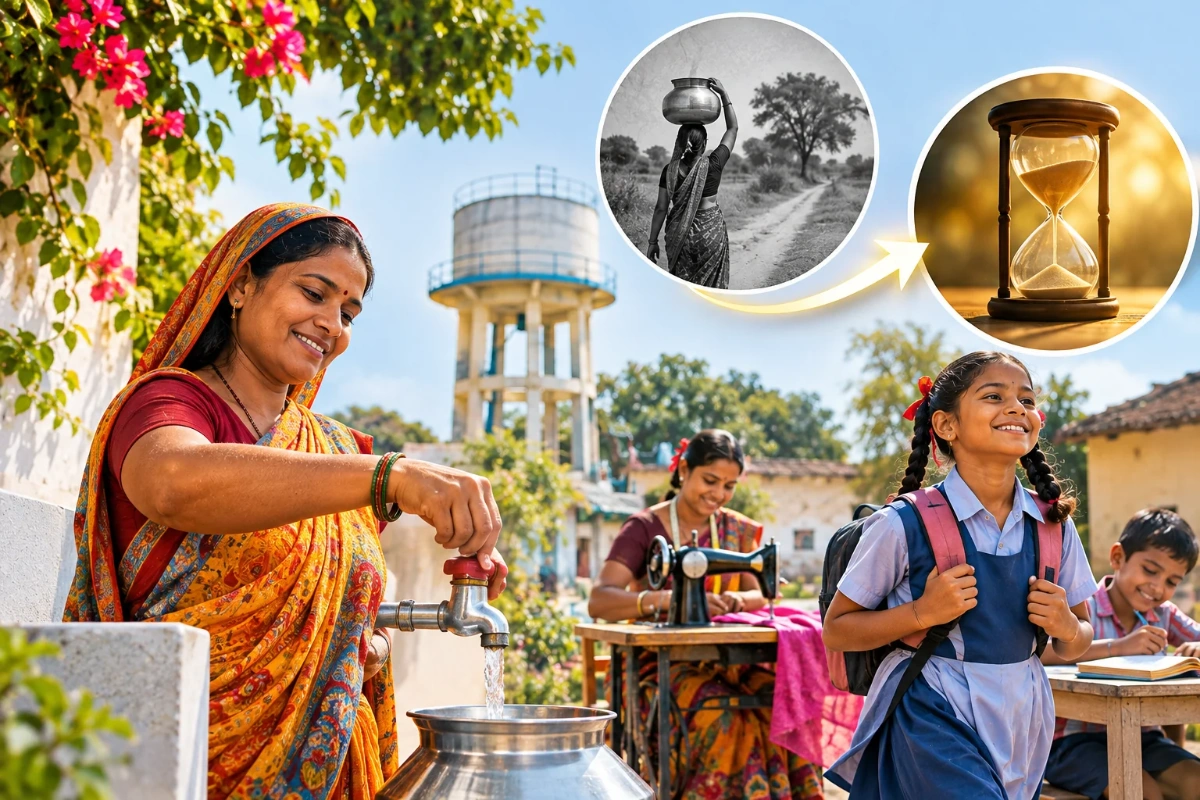
AI Generated Image
When Tap Water Reaches a Village, Who Gets Their Time Back?
Tap water access can return time to people who previously walked, queued and carried water home—often women and girls. However, a household connection alone does not guarantee that benefit. Water must arrive reliably, in sufficient quantities and meet prescribed quality standards. Evidence from the Jal Jeevan Mission and UNICEF India, alongside village planning records, shows why the real measure of progress is a change in daily routines, not simply the number of installed taps.
Who Gets Their Time Back When Water Reaches the Home?
The first beneficiaries are usually household members responsible for collecting water. UNICEF India identifies women and children as frequent water collectors in families without a safe, reliable source at home. Bringing water closer can therefore reduce a burden that competes with schooling, paid work, caregiving and rest. However, who actually benefits should be established by asking each household rather than assuming everyone shares the work equally.
UNICEF India’s reporting from Chhattisgarh describes women who previously spent two to three hours each morning fetching water. With doorstep connections, collection reportedly takes only minutes. This represents a concrete change in household routines, although the account does not provide matched household diaries from which to calculate an exact average time saving.
The benefits are not limited to earning more. A less rushed breakfast, an uninterrupted school morning or time with a young child can matter just as much. UNICEF’s Chhattisgarh account includes a mother describing how she gained more time with her child. Its reporting from Kotri, Rajasthan, describes Alka Tailor using time previously spent fetching water to expand her stitching livelihood. These are documented examples, not outcomes guaranteed for every household.
The Difference Between a Tap and a Dependable Service
Drinking water access needs to be assessed as a service, not simply an installed facility. The Jal Jeevan Mission’s framework considers quantity, quality and regularity together. Its operational guidelines define functionality in terms of adequate water supply—55 litres per person per day—of prescribed quality, delivered regularly, with attention to long-term sustainability.
The government’s summary of the Jal Jeevan Mission Functionality Assessment 2024 makes this distinction clear. The assessment covered 237,608 households in 19,812 Har Ghar Jal villages. It reported working tap connections in 86.5% of households with connections, adequate quantities in 80.2%, supply according to schedule in 83.6% and prescribed water quality in 76%. These are findings from the surveyed villages, not a safety certificate for any particular household.
For a village review, translate these categories into practical questions:
- Did water arrive when promised?
- Could households collect enough during the supply window?
- Did testing establish acceptable quality at the relevant sampling points?
Keep the answers separate. A strong result on one measure should not conceal a failure on another.
How Can a Village Measure Changes in Household Routines?
A useful assessment compares the same households before and after the service begins, recording both water-related work and water availability. Measure the time spent walking, waiting, filling, storing and obtaining backup supplies, alongside the quantities collected and the person performing each task. Treat this as a proposed local monitoring method, not as a claim that a particular village has already achieved a measured time saving.
Use a simple diary for a full week at each assessment point. Repeat the exercise during a different season and include households at the network’s edges, people with limited mobility and families using shared taps. Record missed supply days rather than excluding them from the calculation.
| Measure | What Households Should Record | What the Comparison Reveals |
|---|---|---|
| Collection time | Minutes per trip, including walking and queues | Whether the collection burden actually falls |
| Household handling | Time spent filling, transferring and managing stored water | Whether work disappears or moves indoors |
| Water quantity | Containers filled and their measured capacity | Whether reduced collection time accompanies sufficient water |
| Backup arrangements | Trips, purchases and time spent when supply fails | Whether apparent savings continue during interruptions |
| Distribution of work | Each person’s tasks and the time spent on them | Who gains time and who retains responsibility |
| Use of recovered time | The collector’s own account of work, study, care or rest | Whether the change reflects that person’s priorities |
Calculate net daily time recovered by subtracting the total time spent on water-related tasks after the connection from the comparable total before it. Report the median household result as well as the range, and show results separately for women, men and children. A village-wide average alone is not enough for this purpose.
Also record whether tasks overlap. Someone supervising a child while waiting for water should not automatically have those minutes counted twice. Ask whether the new supply schedule is convenient, too. The aim is to understand the entire routine, not merely measure how much shorter the walk has become.
Village Records Separate Promises From Verified Outcomes
Village records provide a local reference point, but their purpose and date matter. Chandauli’s Village Action Plan in Raebareli district, Uttar Pradesh, was prepared on September 16, 2021, and approved by the Gram Sabha on September 18, 2021. It recorded an aspiration to achieve household coverage by 2024, with 55 litres per person per day and 12 hours of daily supply. These entries describe intended service, not proof that it was subsequently delivered.
The same plan identifies dates for community water-quality surveillance and sanitary inspections, but its displayed water-quality results table is blank. The document therefore does not verify current tap water safety or actual supply reliability. This limitation matters: citing a village plan should not turn an intended activity into a completed test.
For a follow-up review, request dated supply logs, interruption and repair records, household diaries and completed laboratory reports. Compare actual delivery against the village’s promised schedule. Publish unresolved gaps alongside achievements so residents can distinguish documented results from work that remains outstanding.
How Should Reliability and Tap Water Safety Be Verified?
Reliability should be checked against dated delivery records and household experience. Safety requires appropriate water testing, not an assumption based on the existence of a connection. Jal Jeevan Mission guidance calls for village water-quality registers identifying sampling points, test dates, results and testers. Its monitoring handbook also supports displaying results publicly so residents can scrutinise the evidence.
A practical verification checklist should cover four areas:
- Actual delivery: Compare the announced schedule with recorded supply days and hours. Ask households in different parts of the village to confirm whether their experience matches the records.
- Adequate quantity: Record delivered or collected volumes and household size. Do not treat a brief flow from a tap as evidence that daily water needs have been met.
- Dated quality evidence: Check the sample location, collection date, parameters tested, laboratory findings and applicable limits. Distinguish source-water results from household delivery-point results.
- Corrective action: Where a result indicates a problem, request the action record and follow-up testing. Keep the issue open until the responsible water authority documents its resolution.
The distinction between source and delivery point is built into the Jal Jeevan Mission’s village guidance, which calls for testing at both. The guidance specifies bacteriological testing twice a year and chemical testing annually, with results recorded and displayed. These records support scrutiny of tap water safety; they do not provide a permanent guarantee that every future supply will meet the prescribed standards.
Protecting the Time Dividend
Dependable public water systems need people, maintenance and accountable financing. UNICEF India’s account of Kotri describes household water fees deposited into a dedicated village account to pay the pump operator and cover minor repairs. It also describes trained women testing water and uploading results, with problems referred to the public health engineering department.
When reviewing such arrangements, count governance work as well. Ask who collects fees, attends meetings, conducts tests and follows up on repairs. Record those hours separately from household water collection time. Recommend clear responsibilities, training and transparent payment arrangements rather than treating women’s participation as an unlimited source of unpaid labour.
Make inclusion part of the review. Ask residents who use shared collection points or live farthest from the storage tank whether they receive the same dependable service. Give them a practical way to report problems and check what happens afterwards.
The Real Outcome Is Greater Control Over the Day
Clean water access should be judged through three connected measures: service records, quality evidence and people’s daily lives. Count connections, but also measure the work that remains and identify who continues to perform it.
The strongest local assessment can show when water arrived, what testing found, how household routines changed and whose choices expanded. That is a more meaningful account of progress than a tap count alone.
Also Read: Parama Ekadashi: Inspiring Generosity Story
To read more such news, download Bharat Express news apps