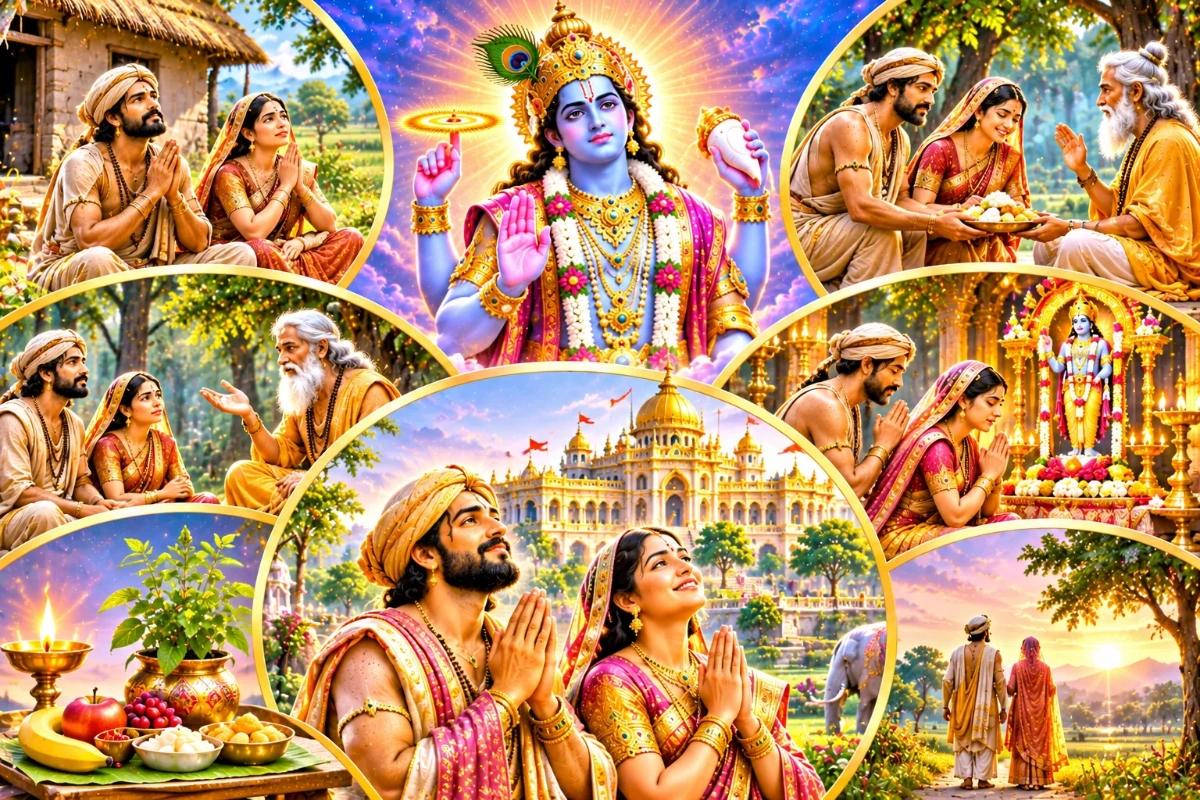
AI Generated Image
They Had Almost Nothing, Yet They Never Stopped Giving: The Powerful Story of Parama Ekadashi
Parama Ekadashi is a Hindu observance dedicated to Lord Vishnu, remembered through the story of Sumedha and Pavitra, a couple whose poverty did not extinguish their generosity. Their sacred story connects hospitality, devotion and hope with a special Ekadashi fast during the additional lunar month. Read as a devotional narrative, it offers a lesson in giving without reducing faith to a promise of material reward.
What Is Parama Ekadashi, and Why Is It Special?
Parama Ekadashi falls on the eleventh lunar day of Krishna Paksha, the waning fortnight, during Adhika Maas, the additional month in the Hindu lunisolar calendar. Because it belongs to this extra month, it does not occur every year. Its observance centres on the worship of Vishnu, fasting, prayer and the sacred narrative associated with the day.
Among Hindu festivals and sacred observances, its story invites a particularly personal reflection: what remains possible when resources seem exhausted? Sumedha and Pavitra do not begin with security or influence. What makes their story compelling is the contrast between their difficult circumstances and their willingness to welcome another person.
That contrast is worth keeping in view. Before the account reaches its miraculous resolution, it asks readers to notice a much quieter act: someone with very little still makes room for a guest.
Parama Ekadashi 2023 and Parama Ekadashi 2026 Dates
For readers looking back at these observances, the dates below provide an India-based reference rather than a universal calendar instruction:
| Observance | Date Reference | Location Context |
|---|---|---|
| Parama Ekadashi 2023 | Saturday, August 12, 2023 | ISKCON Delhi’s published observance |
| Parama Ekadashi 2026 | Thursday, June 11, 2026 | New Delhi calendar listing |
Both dates are now in the past. The 2023 date is documented by ISKCON Delhi, while the 2026 listing identifies June 11 for New Delhi.
Location matters, especially for readers outside India. For example, Drik Panchang lists the 2023 observance for Ojus, Florida, on August 11 rather than August 12. Consult a location-specific panchang or your temple for the appropriate observance date and parana, the time for breaking the fast. Do not simply reuse another city’s schedule.
The Parama Ekadashi Katha: Generosity Before Relief
The traditional account takes place in Kampilya, where a Brahmin named Sumedha lived with his wife, Pavitra. Though portrayed as virtuous, they struggled with severe poverty. Sumedha’s efforts to obtain alms brought little relief, and Pavitra sometimes went hungry while providing food for guests.
This is the emotional centre of the story. Their hospitality does not emerge after prosperity arrives. It exists while they are still uncertain about their own needs. A reader need not romanticise hunger to recognise the depth of that gesture.
Sumedha Considers Leaving Home
Distressed by their circumstances and his wife’s weakness, Sumedha considers travelling elsewhere to earn money. Pavitra urges him to stay, speaking within the story’s traditional understanding of destiny and the fruits of earlier actions. He accepts her request, and they remain together.
Their exchange can be read as a moment of vulnerability rather than a simple instruction about earning a living. Sumedha wants to change their situation; Pavitra fears separation. Neither concern needs to be dismissed for the scene to retain its emotional force.
For a contemporary reader, the useful question is not whether seeking work elsewhere is wrong. It is how people can discuss hardship without allowing fear or frustration to erase their care for one another.
A Guest Becomes a Guide
When the sage Kaundinya arrives, the couple welcomes him respectfully and offers him food. Pavitra then asks for guidance about their poverty. The sage recommends Parama Ekadashi and describes a five-day discipline known as Pancharatri, combining the observance with devotion and charitable acts.
Notice the order: the welcome comes before the request for help. Their guest is not first treated as a solution to their difficulties. That sequence gives their hospitality its moral weight.
Pavitra also speaks openly about their need. Her generosity does not mean pretending that everything is well. One valuable reading of this scene is that giving and asking for assistance are not opposites; both can belong to a life lived with dignity.
The Story Turns Towards Abundance
Following Kaundinya’s guidance, the couple undertakes the observance. In the traditional conclusion, a prince subsequently provides them with a furnished home and land to support their livelihood. Their hardship gives way to comfort, and the narrative ends with spiritual fulfilment.
The ending invites gratitude, but it should not become a financial formula. A sacred account of divine grace is different from evidence that performing a ritual guarantees wealth. Its more enduring invitation is to consider how faith and generosity might survive uncertainty.
What Does the Story Teach About Giving When You Have Little?
One meaningful reading of the Parama Ekadashi vrat katha is that generosity begins with how we regard others, not with the size of our possessions. Sumedha and Pavitra’s example invites compassion without requiring readers to neglect food, health, dependants or essential expenses. The lesson can be practised through modest, sustainable acts rather than dramatic self-denial.
Consider these ways to bring that reflection into everyday life:
- Give something specific and affordable. Offer a meal, a useful item or a manageable donation instead of making a promise that threatens your household’s stability.
- Offer attention without taking control. Listen to someone’s difficulties before deciding what kind of help they need. Respect can matter as much as the object given.
- Make room to receive. Ask for support when necessary. Accepting assistance does not cancel your own capacity to contribute.
- Keep another person’s dignity intact. Help privately when possible, and avoid turning someone’s hardship into a public demonstration of your goodness.
These are suggested applications, not additional ritual rules. They offer a way to engage with the story even when a reader cannot undertake a fast or make a financial gift.
There is also a useful challenge here for those with greater resources. Rather than identifying only with the struggling couple, consider the prince’s role: what would it mean to offer help that provides lasting security rather than a momentary display of generosity?
Approaching Ekadashi Fasting With Devotion and Care
Traditional observance includes worship of Vishnu, offerings such as flowers and a lamp, and remembrance through prayer or devotional singing. ISKCON Delhi’s guidance also emphasises avoiding grains and increasing chanting. These practices give the day a devotional focus beyond simply going without a meal.
A practical preparation checklist can help keep that focus clear:
- Confirm the local calendar. Ask your temple or consult a location-specific panchang for the observance date and fast-breaking time.
- Clarify your tradition’s practice. Seek guidance about food restrictions, worship and any questions concerning the form of the vrat before beginning.
- Set aside time for the narrative. Read the katha slowly, leaving space to reflect on the couple’s hospitality rather than rushing towards the reward.
- Choose a realistic act of service. Decide what you can offer responsibly, whether that is food, practical assistance or time.
The extended austerity described in the story should not be treated as a do-it-yourself health recommendation. Seek qualified medical advice before attempting restrictive or prolonged fasting, especially if you have diabetes or take medication. Religious fasting can increase risks, including dehydration and abnormal blood glucose levels in people with diabetes.
Do not change prescribed treatment on your own to accommodate an observance. Discuss any necessary adjustments with your healthcare professional well beforehand.
Carrying the Story Beyond the Observance
The most useful takeaway need not be a dramatic vow. It might be a manageable meal shared, an honest request for help or a decision to treat someone with greater patience. Choose an action you can sustain without harming yourself or those who depend on you.
Read this way, the story leaves a question worth carrying into ordinary life: not how much must I give to receive a reward, but what care can I offer responsibly today? That shift keeps generosity from becoming a bargain and allows it to remain an expression of regard for another person.
Also Read: Faith & Devotion: The Power Of Padmini Ekadashi
To read more such news, download Bharat Express news apps